The discovery, explained · Chemist no. 230 of 350
MOF-5 and Reticular Chemistry: How Omar Yaghi Turned Metal-Organic Frameworks Into Stable, Designable Materials
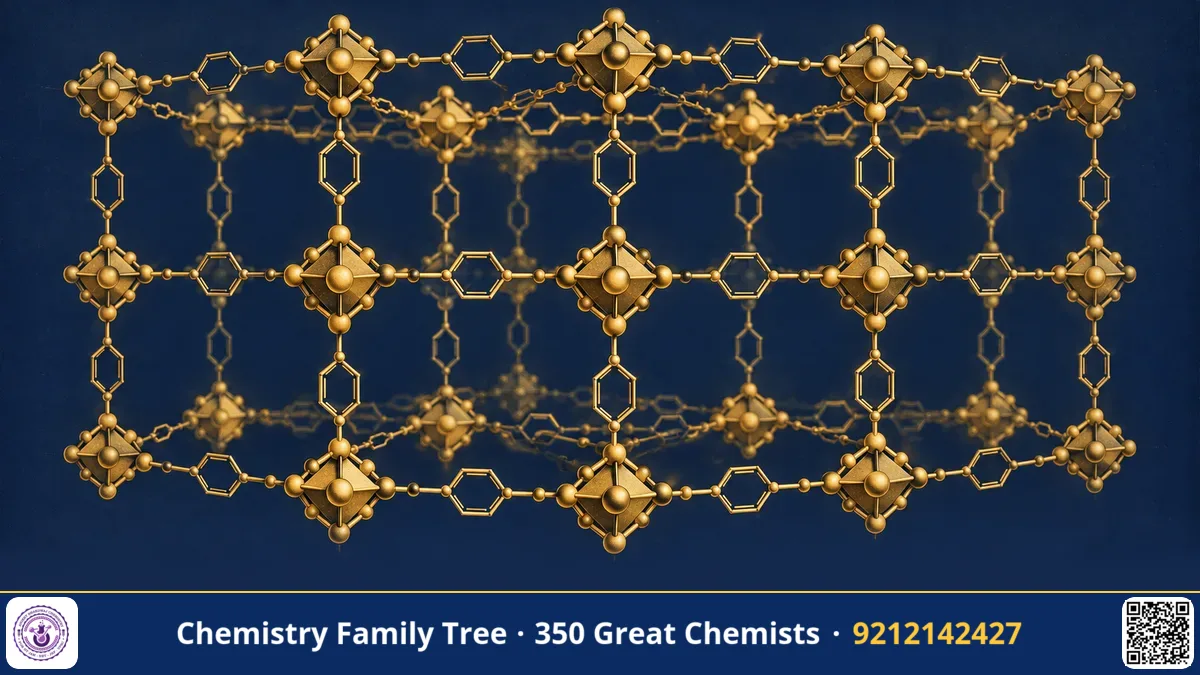
One gram of a material can have the surface area of a football field. This is not a typical sentence in chemistry, but it is true for MOF-5, a crystalline material reported in 1999 by Omar Yaghi and his co-workers at the University of Michigan. MOF-5 is built from zinc-oxygen clusters connected by organic linkers into a cubic scaffold that stays intact when emptied, leaving a huge internal surface. Yaghi had already introduced the term metal-organic framework (MOF) in 1995 and went on to develop reticular chemistry, the science of linking molecular building blocks into extended structures by strong bonds. In 2025 he shared the Nobel Prize in Chemistry with Susumu Kitagawa and Richard Robson.
This post explains MOF-5, the secondary building unit (SBU) concept, and Yaghi's later inventions, including covalent organic frameworks and water harvesting.
The Scientific Problem Before the Discovery
Robson's 1989 diamond-like network showed that crystals can be designed, and Kitagawa's 1997 work showed that coordination polymers can adsorb gas. But the earlier frameworks were typically held together by weak bonds between metal ions and neutral nitrogen donors, and they often collapsed when guests left the pores. A durable framework was needed that would keep its shape under heat and vacuum, so that real applications could be developed.
A second difficulty was structural control. Single metal ions are flexible in geometry, so the network that forms is hard to predict. A solution would be to use rigid, well-defined metal clusters as nodes, with fixed geometry, and rigid organic linkers. Chemists also needed a systematic way to describe and design the nets, which are similar to the topologies known in mathematics and crystallography.
The Discovery / Experiment
Yaghi studied carboxylate linkers. Carboxylate (-COO-) groups bind metals strongly, using two oxygen atoms, and they form a stable cluster of metal ions with the carboxylate groups fixed in a rigid geometry. He recognised that these clusters can serve as inorganic SBUs.
The synthesis of MOF-5 (Li, Eddaoudi, O'Keeffe and Yaghi, Nature, 1999) was straightforward:
- Dissolve zinc nitrate and 1,4-benzenedicarboxylic acid (terephthalic acid, H2BDC) in a polar solvent such as N,N-diethylformamide (DEF) with a base provided by the solvent.
- Heat gently, around 100 degrees C, for a few hours or days; colourless cubic crystals grow.
- Replace the solvent in the pores by a volatile one, then remove it under vacuum, leaving an open framework.
- Determine the structure by single-crystal X-ray diffraction and measure gas uptake.
4 Zn2+ + O2- (from water/base) + 3 BDC2-  →  Zn4O(BDC)3   (MOF-5)
Zn4O(CO2)6 octahedral cluster, linked by benzene rings along the cube edges
The structure: four tetrahedral zinc ions share a central oxygen atom (Zn4O), and six carboxylate groups bridge the edges of the Zn4 tetrahedron, creating an octahedral Zn4O(CO2)6 SBU. Each cluster is linked by benzene rings to six neighbours, giving a primitive cubic net (pcu) with a cell edge of about 2.6 nm. The framework has pores of around 1.2 to 1.5 nm, with the void space making up around 55-60% of the crystal volume. The report showed that the framework was stable to above 300 degrees C when emptied and had a very high surface area. The original measurement gave a Langmuir surface area of about 2900 m2 per gram, and later work with better activation gave much larger values.
The Chemistry Behind It
The SBU concept. Instead of thinking about single atoms, Yaghi used rigid clusters (SBUs) whose "points of extension" (the carboxylate carbon atoms) define the geometry. This makes the products predictable, as in a construction kit.
| Component | Role | In MOF-5 |
|---|---|---|
| Node (SBU) | Inorganic cluster, defines connectivity | Zn4O(CO2)6, six-connected octahedron |
| Linker | Organic strut, defines distance | Terephthalate (BDC), linear |
| Net | Topology of connections | Primitive cubic (pcu) |
Isoreticular chemistry. Because the topology is set by the node and not by the linker length, you can replace BDC with longer linkers (biphenyl, terphenyl dicarboxylate) and obtain frameworks with the same net but bigger pores. In 2002, Yaghi's group reported a series of 16 isoreticular MOFs (IRMOF-1 to IRMOF-16) with pore sizes from about 0.38 nm to 2.88 nm and, with functionalised linkers, tuned chemistry. This showed a rare ability: design of pore size and functionality at the molecular level.
Surface area. The BET or Langmuir methods analyse N2 adsorption isotherms at 77 K to obtain surface area. The best MOFs later reached over 7000 m2 per gram.
Beyond MOFs.
- Zeolitic imidazolate frameworks (ZIFs): zinc or cobalt linked by imidazolate, mimicking zeolite topologies, with high chemical stability; useful for CO2 capture.
- Covalent organic frameworks (COFs), 2005: Yaghi's group made the first crystalline 2D COFs from boronic acids by condensation, forming strong covalent B-O bonds with no metals, followed by 3D COFs and imine-linked COFs.
- Water harvesting: MOF-801 (zirconium-fumarate) was used in 2017 to absorb water vapour from air in a desert-like environment at low humidity and release it with sunlight-driven heating; a later MOF-303 improved this.
Applications Today
- Water from air. MOF-based devices can harvest drinking water in arid regions, using only sunlight; this is relevant for water-scarce regions of India.
- Carbon capture. MOFs, ZIFs and COFs capture CO2 from flue gas or directly from air.
- Hydrogen and methane storage. Storage at moderate pressure for clean energy.
- Catalysis and sensing. Defined pores and metal sites for selective reactions and detection.
- Toxic gas capture and drug delivery are further areas of research.
Exam Corner
- MOF-5: Zn4O(BDC)3; Zn4O(CO2)6 SBU; primitive cubic net; BDC is terephthalate (benzene-1,4-dicarboxylate).
- Carboxylate groups act as bridging bidentate ligands.
- Reticular synthesis: linking molecular building blocks into predetermined structures by strong bonds.
- Isoreticular: same topology, different linker length (pore size tuning).
- 2025 Nobel Prize in Chemistry: Kitagawa, Robson, Yaghi.
Common Misconceptions
- "MOFs are all unstable in water." MOF-5 is moisture sensitive, but many zirconium-based MOFs (UiO-66, MOF-801) are very stable.
- "MOF and COF are the same." MOFs contain metals; COFs are purely organic frameworks.
- "A high surface area means that the sample is a powder of tiny grains." The area is internal, within the pores of each crystal.
Quick Revision Box
- 1995: Yaghi coins "metal-organic framework" (MOF).
- 1999: MOF-5, Zn4O(BDC)3, stable and highly porous.
- Key idea: rigid SBUs plus linkers (reticular chemistry).
- 2002: isoreticular series (IRMOFs) with tunable pores.
- 2005: first COFs; 2017: MOF-801 harvests water from desert air.
- Nobel Prize in Chemistry 2025 with Kitagawa and Robson.
FAQ
What does reticular mean?
It means net-like, from the Latin for a net. Reticular chemistry links building blocks into extended nets.
Why use carboxylates?
They bind strongly to metals and form rigid clusters with fixed geometry, which makes frameworks robust and predictable.
How can a MOF harvest water?
Its pores adsorb water vapour from air at night or at low humidity, and when sunlight heats the material the water is released and condensed.
Is MOF-5 used industrially?
MOF-5 is mainly a benchmark; other MOFs, with greater stability, are used in pilot and commercial applications.
Published by ABC Chemistry — IIT-JAM | CSIR-NET | GATE Chemistry Coaching. Visit abcchemistry.com

About the chemist
Omar Yaghi
1965- · United States · Nobel Chemistry 2025
Reticular chemistry; MOFs and COFs