Biography · Chemist no. 53 of 350
Otto Diels: The Life and Legacy of the Chemist Behind the Diels-Alder Reaction
Otto Paul Hermann Diels (1876-1954) was a German organic chemist who spent most of his career at the University of Kiel. He is remembered for the Diels-Alder reaction, a ring-forming reaction that every chemistry student meets sooner or later. With his student Kurt Alder, he shared the 1950 Nobel Prize in Chemistry. But Diels was more than a one-reaction scientist: he discovered carbon suboxide, developed selenium dehydrogenation to study steroid structure, and trained a generation of organic chemists. In this post we look at his complete life, his work and the lessons it holds for students preparing for IIT-JAM, CSIR-NET and GATE.
Early Life and Family
Otto Diels was born on 23 January 1876 in Hamburg, Germany. His father, Hermann Diels, was a famous classical scholar, best known for collecting and editing the fragments of the pre-Socratic philosophers. The family moved to Berlin when Otto was a child, because his father took up a professorship at the University of Berlin. Growing up in a house full of books and academic debate gave Otto a serious, disciplined approach to study. His elder brother Ludwig became a well-known botanist, so science and scholarship ran in the family, though Otto chose chemistry rather than the classics.
Education and Mentors
Diels studied chemistry at the University of Berlin, where he came under the influence of Emil Fischer, the great organic chemist who won the Nobel Prize in 1902 for his work on sugars and purines. Fischer was a demanding teacher who expected rigorous experimental work. Diels completed his doctorate under Fischer in 1899 and remained in Berlin as his assistant. Working in Fischer's laboratory taught him careful experimentation, structure proof by chemical degradation, and the habit of following unexpected results. These habits would later lead to his most famous discovery.
Career Timeline
| Year | Event |
|---|---|
| 1876 | Born in Hamburg, Germany (23 January) |
| 1899 | Doctorate in chemistry at Berlin under Emil Fischer |
| 1906 | With a co-worker, reported carbon suboxide, C3O2 |
| 1906-1916 | Teaching and research in Berlin, rising to professor |
| 1916 | Appointed professor and director of the chemical institute at Kiel |
| 1927 | Used selenium dehydrogenation to obtain "Diels' hydrocarbon" from sterols |
| 1928 | With Kurt Alder, published the diene synthesis (Diels-Alder reaction) |
| 1945-1948 | Post-war period; retired from his chair |
| 1950 | Nobel Prize in Chemistry shared with Kurt Alder |
| 1954 | Died in Kiel (7 March) |
Major Scientific Contributions
1. Carbon suboxide
In 1906 Diels and a colleague prepared carbon suboxide, a gas with the formula C3O2 and the linear structure O=C=C=C=O. It is made by dehydrating malonic acid with phosphorus pentoxide, and it reacts with water to give back malonic acid:
CH2(COOH)2  --P2O5-->  C3O2 + 2 H2O
C3O2 + 2 H2O  →  CH2(COOH)2
It is an example of a cumulene-type oxide and is a good question for students on unusual oxides of carbon.
2. Selenium dehydrogenation of sterols
At the time, the structure of cholesterol and related steroids was a major puzzle. Diels heated sterols with selenium, which removes hydrogen and aromatises ring systems. From cholesterol he obtained a hydrocarbon now called Diels' hydrocarbon, which helped confirm the four-ring skeleton of steroids. This method was a valuable tool in the structure proof of natural products before modern spectroscopy.
3. The diene synthesis
His best-known contribution is the reaction of a conjugated diene with a dienophile to form a cyclohexene ring, the Diels-Alder reaction. Read our companion post on the Diels-Alder reaction for mechanism, endo rule and exam points. In short: a concerted [4+2] cycloaddition, stereospecific and thermally allowed.
4. Other work
Diels also showed that dienes react with azo compounds such as diethyl azodicarboxylate, extending the idea of the diene synthesis to heteroatom dienophiles. These Diels-type reagents remain useful in synthesis.
Awards, Honours and Nobel Prize
In 1950, Diels and Kurt Alder were jointly awarded the Nobel Prize in Chemistry "for their discovery and development of the diene synthesis". By then Diels was in his seventies, which shows how long it can take for a deep discovery to be fully recognised. The reaction had been used worldwide for over two decades, and chemists everywhere had shown its power in making complex ring systems. The insecticides aldrin and dieldrin, produced by Diels-Alder chemistry, were named after the two scientists.
Personality, Struggles and Lesser-Known Facts
- A scholarly family: His father was a leading classical philologist and his brother Ludwig a botanist. Otto was the one who took the path to organic chemistry.
- Teacher and student: Kurt Alder did his doctoral work with Diels at Kiel in 1926. When they published the diene synthesis in 1928, Alder was still a young researcher. Their partnership is one of the best-known teacher-student pairs in chemistry.
- A long career at one place: Diels led the chemical institute at Kiel for about three decades, building a strong school of organic chemistry in northern Germany.
- The cost of war: Kiel was a naval port and was heavily bombed during the Second World War. The chemistry institute where Diels had worked for so many years was badly damaged, and the war years were hard for him and his family.
- An earlier near-miss: Before Diels and Alder, an adduct of cyclopentadiene and quinone had been reported (1906) but with the wrong structure. Diels and Alder understood that this was a general reaction. The lesson is that correct interpretation matters as much as the first observation.
Legacy and Influence on Modern Chemistry
The Diels-Alder reaction changed how chemists plan syntheses. It is a standard example of atom economy, because all atoms of the reactants appear in the product, which fits well with modern green chemistry ideas. It also inspired the theory of pericyclic reactions: Woodward and Hoffmann in the 1960s explained it through orbital symmetry, and Kenichi Fukui through frontier orbitals. Both Hoffmann and Fukui won Nobel Prizes for this theory. Variants such as the hetero-Diels-Alder, intramolecular Diels-Alder, asymmetric catalytic Diels-Alder and inverse-electron-demand reactions are used today in drug research, polymer science and bioconjugation.
Lessons for Students
- Learn from your teachers: Diels absorbed the careful experimental style of Emil Fischer, then passed it on to Alder.
- Look at puzzling results again: An odd adduct reported in 1906 became a Nobel Prize-winning reaction after proper structure proof.
- Persistence pays: Diels waited more than twenty years from the discovery to the Nobel Prize and kept working.
- Connect theory and practice: The same reaction is a topic in mechanism, stereochemistry, orbital theory and industrial chemistry, a nice example of how topics link in the JAM and NET syllabus.
Quick Facts Box
- Born: 23 January 1876, Hamburg, Germany
- Died: 7 March 1954, Kiel, Germany
- Nationality: German
- Field: Organic chemistry
- Famous for: Diels-Alder reaction, carbon suboxide, selenium dehydrogenation of sterols
- Nobel Prize: Chemistry 1950 (shared with Kurt Alder)
FAQ
Where did Otto Diels work most of his life?
After his early career in Berlin, he served as professor and director of the chemical institute at the University of Kiel from 1916 until his retirement after the Second World War.
What did Otto Diels discover besides the Diels-Alder reaction?
He discovered carbon suboxide (C3O2) in 1906 and introduced selenium dehydrogenation for studying sterol structure, which gave Diels' hydrocarbon.
Who shared the Nobel Prize with Diels?
His former student Kurt Alder. They shared the 1950 Nobel Prize in Chemistry for the discovery and development of the diene synthesis.
Why were aldrin and dieldrin named after him?
These chlorinated insecticides are made by Diels-Alder reactions of hexachlorocyclopentadiene, so their names honour Diels and Alder.
Published by ABC Chemistry — IIT-JAM | CSIR-NET | GATE Chemistry Coaching. Visit abcchemistry.com
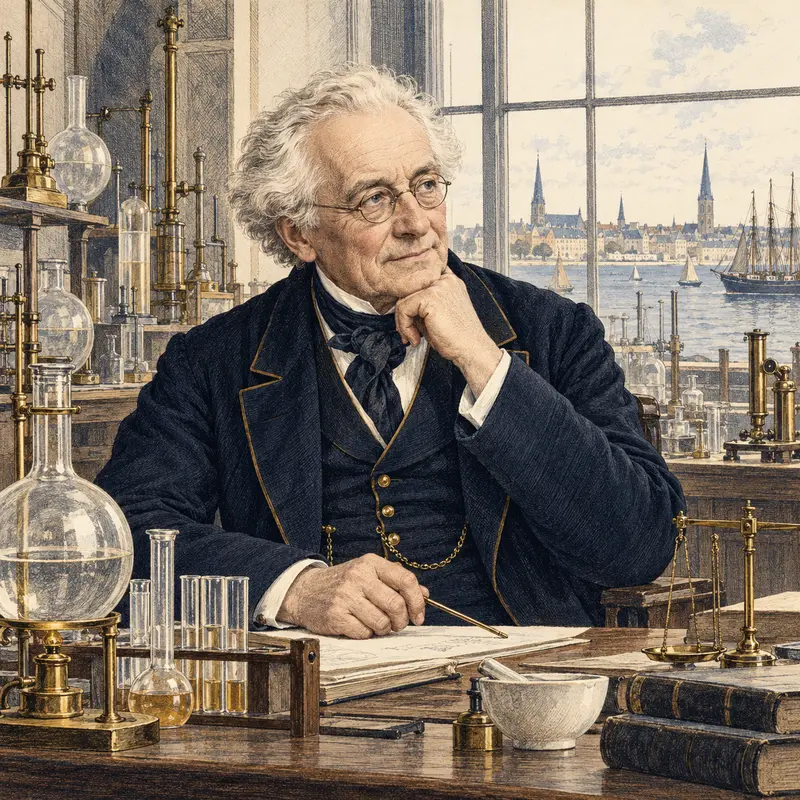
About the chemist
Otto Diels
1876-1954 · Germany · Nobel Chemistry 1950
Diels-Alder reaction