The discovery, explained · Chemist no. 53 of 350
The Diels-Alder Reaction: How Otto Diels Gave Chemists a Six-Membered Ring Maker
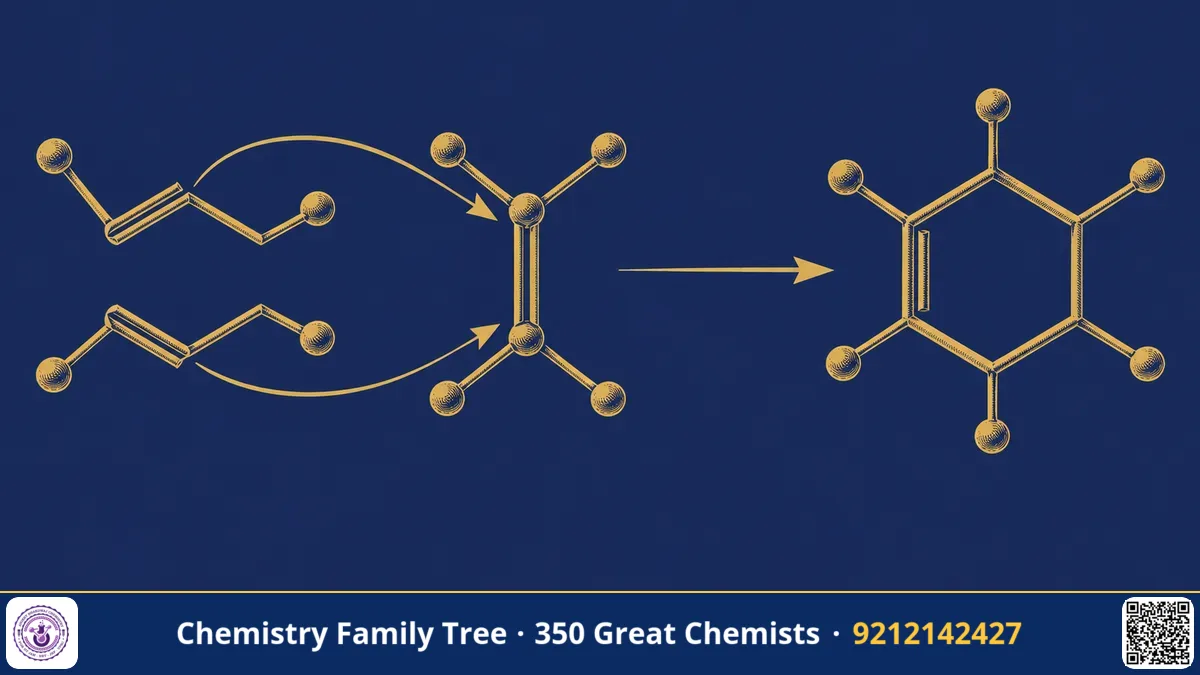
Imagine you could build a six-membered ring, with up to four new stereocentres, in a single step, in high yield, often just by warming two simple molecules together. That is exactly what the Diels-Alder reaction does. Discovered in 1928 by the German chemist Otto Diels and his student Kurt Alder at the University of Kiel, it is one of the most powerful reactions in all of organic chemistry. It earned both men the Nobel Prize in Chemistry in 1950 "for their discovery and development of the diene synthesis". Today it is taught in every organic chemistry course, from Class 12 to IIT-JAM, CSIR-NET and GATE, and it is used to make drugs, polymers, pesticides and natural products. In this post we follow the story step by step, with the chemistry explained in simple language.
The Scientific Problem Before the Discovery
By the 1920s organic chemists could make many compounds, but making rings was hard. Most ring-forming reactions needed harsh conditions, gave mixtures, or worked only for special substrates. Chemists also had no general way to control stereochemistry, the three-dimensional arrangement of atoms, during ring formation. The theory of bonding was still at an early stage: the electronic reason behind many reactions was not understood, and the idea of "concerted" reactions that happen in one step without intermediates had not yet been developed.
There were also puzzling observations. Cyclopentadiene was known to stand at room temperature and slowly turn into a dimer. In 1906, Walter Albrecht had treated cyclopentadiene with quinone and obtained an adduct, but he assigned it a wrong structure. Nobody recognised that a general reaction type was hiding here. Diels and Alder did.
The Discovery: Step by Step
Otto Diels was already an established professor at Kiel, known for discovering carbon suboxide (C3O2) and for his work on the structure of cholesterol using selenium dehydrogenation. He was studying the reaction of dienes with compounds containing electron-poor double bonds. Together with Kurt Alder, he examined the reaction of cyclopentadiene with p-benzoquinone, and then carefully proved the structure of the product.
- Mix and observe: Cyclopentadiene and quinone react readily, giving a crystalline 1:1 adduct (and with excess diene, a 2:1 adduct).
- Determine the structure: By degradation and analysis, they showed the product was a new bicyclic compound, not a simple addition product. Two new carbon-carbon sigma bonds had formed, and a ring had closed.
- Generalise: They tested many other conjugated dienes and many electron-poor alkenes such as maleic anhydride, acrylonitrile and acrolein. The same pattern held.
- Publish: Their 1928 paper in Justus Liebigs Annalen der Chemie described the "diene synthesis" and its wide scope. Over the next years they published a long series of papers developing it.
The simplest example is the reaction of 1,3-butadiene (the diene) with ethene (the dienophile) to give cyclohexene:
CH2=CH-CH=CH2 + CH2=CH2 → cyclohexene (C6H10)
A classic laboratory example is butadiene with maleic anhydride giving cis-4-cyclohexene-1,2-dicarboxylic anhydride. Another is the reaction of cyclopentadiene with maleic anhydride, which gives the endo adduct (a norbornene derivative) as the major product.
The Chemistry Behind It
Components
- Diene: a conjugated system with four π electrons. It must be able to adopt the s-cis conformation. Electron-donating groups (such as -CH3, -OR) on the diene increase the rate.
- Dienophile: the "diene-loving" partner with two π electrons. Electron-withdrawing groups (-CHO, -COR, -COOR, -CN, -NO2, anhydride) speed up the normal-demand reaction.
- Product: a cyclohexene ring. It is called a [4+2] cycloaddition because four π electrons of the diene and two π electrons of the dienophile take part.
Mechanism
The reaction is a concerted, pericyclic process. Two new σ bonds form at the same time through a single cyclic six-electron transition state. No ionic or radical intermediate is formed. In frontier molecular orbital language, the HOMO of the diene overlaps with the LUMO of the dienophile. The overlap is suprafacial on both components, and the reaction is thermally allowed with 4n+2 electrons (6 electrons, n = 1). This explanation came later from Woodward-Hoffmann rules and Fukui's frontier orbital theory.
Stereochemistry
- Stereospecific (syn addition): The geometry of the dienophile is retained. A cis-dienophile gives cis substituents in the ring; a trans-dienophile gives trans substituents.
- Endo rule (Alder): When the dienophile has a π-system substituent such as C=O, the endo product is usually the kinetic product because of secondary orbital interactions. The exo product is often more stable thermodynamically.
- Ortho/para rule: With substituted partners, "ortho" and "para" products are generally favoured over "meta".
Reversibility
At high temperature the reaction can run backwards, the retro-Diels-Alder reaction. This is why dicyclopentadiene is "cracked" by heating to give fresh cyclopentadiene monomer.
Applications Today
- Pesticides: The insecticides aldrin and dieldrin were made through Diels-Alder chemistry and were named in honour of Diels and Alder. They are now banned in most countries because they persist in the environment.
- Natural product and drug synthesis: The reaction was used in famous syntheses of steroids such as cortisone by R. B. Woodward, and many modern syntheses of terpenes, alkaloids and antibiotics.
- Polymers and materials: Dicyclopentadiene is used in polydicyclopentadiene resins. Reversible Diels-Alder bonds are used to make self-healing polymers.
- Chemical biology: Fast Diels-Alder variants, such as the inverse-electron-demand reaction between tetrazines and strained alkenes, are used to label molecules inside living systems.
- Teaching and analysis: Maleic anhydride is used as a reagent to detect and remove conjugated dienes from mixtures, for example in petroleum fractions.
In India, the reaction is a favourite in research labs at the IITs, IISc and CSIR institutes for building complex ring systems in natural product synthesis, and it appears in almost every university syllabus.
Exam Corner
- The Diels-Alder reaction is a [4+2] cycloaddition, a thermal, concerted, suprafacial pericyclic reaction (π4s + π2s).
- The diene must be in the s-cis conformation. Cyclopentadiene is very reactive because it is locked s-cis; 2,3-di-tert-butylbutadiene or a diene locked s-trans is unreactive.
- Stereospecific syn addition: cis-dienophile gives cis substituents, trans-dienophile gives trans substituents. Endo product is the kinetic product.
- Normal electron demand uses an electron-rich diene and electron-poor dienophile (small HOMO(diene)-LUMO(dienophile) gap). Inverse electron demand reverses this.
- Number of electrons: 6 in the transition state. Aromatic transition state, so the reaction is thermally allowed. Photochemical [4+2] is forbidden.
Common Misconceptions
- "It goes through a carbocation or radical." No. It is concerted with a single transition state and no intermediate.
- "Any diene works." Only dienes that can reach the s-cis conformation react. Many students forget this rule.
- "The exo product is always major." Under kinetic control the endo adduct is usually major, even though it is sterically more crowded.
Quick Revision Box
- Discovered in 1928 by Otto Diels and Kurt Alder at Kiel; Nobel Prize in Chemistry 1950.
- Diene (4π) + dienophile (2π) → cyclohexene, [4+2] cycloaddition.
- Concerted, thermally allowed, syn (suprafacial) addition, stereospecific.
- Diene must be s-cis; EWG on dienophile speeds up the reaction.
- Endo rule: kinetic product has the substituent under the diene.
- Retro-Diels-Alder is used to crack dicyclopentadiene to cyclopentadiene.
FAQ
Who discovered the Diels-Alder reaction?
Otto Diels and his student Kurt Alder discovered and developed it at the University of Kiel in 1928. They received the 1950 Nobel Prize in Chemistry for this work.
Why is the Diels-Alder reaction so important?
It forms two C-C bonds and a six-membered ring in one step, with excellent control of stereochemistry. This makes it ideal for building complex molecules efficiently.
What is the endo rule?
The endo rule says that when a dienophile has an unsaturated substituent, the product in which this group points toward the new double bond (endo) is formed faster, because of favourable secondary orbital interactions in the transition state.
Is the Diels-Alder reaction reversible?
Yes. At high temperatures the retro-Diels-Alder reaction can occur, which is why the reaction is often run at moderate temperatures. The reverse process is useful for generating reactive dienes such as cyclopentadiene.
Published by ABC Chemistry — IIT-JAM | CSIR-NET | GATE Chemistry Coaching. Visit abcchemistry.com
About the chemist
Otto Diels
1876-1954 · Germany · Nobel Chemistry 1950
Diels-Alder reaction