Biography · Chemist no. 35 of 350
Otto Hahn: The Radiochemist Who Split the Atom
Introduction
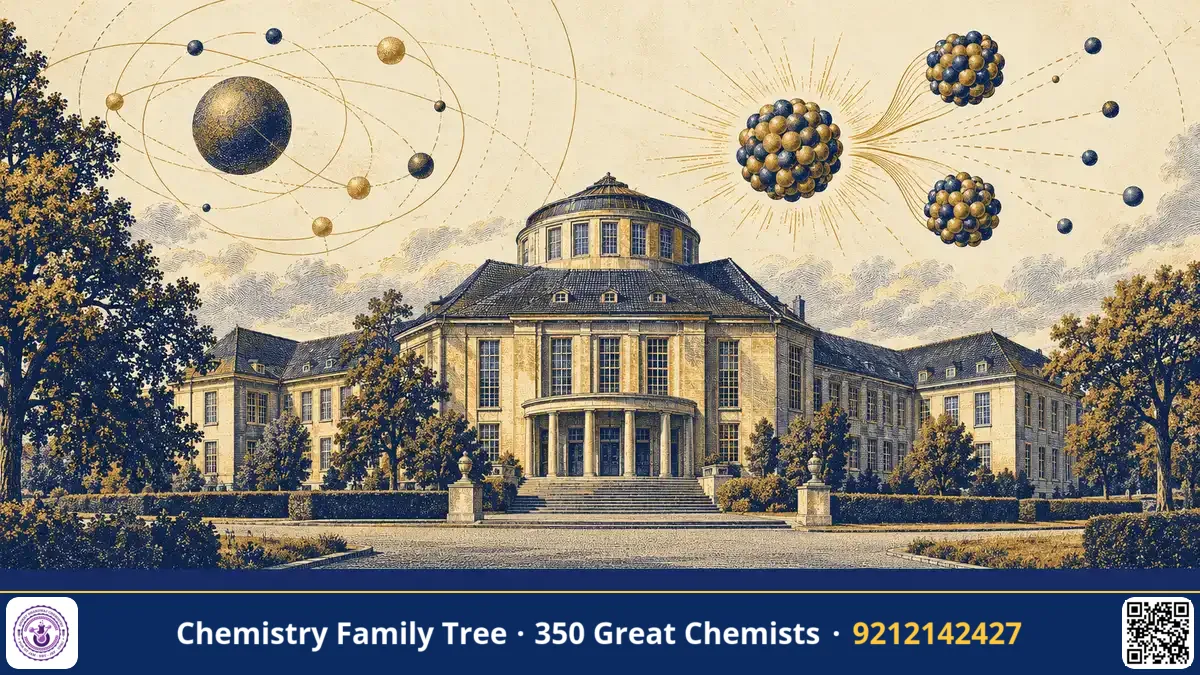
Otto Hahn (1879-1968) was a German chemist and a pioneer of radiochemistry. Over a long career he discovered several radioactive substances, helped to discover the element protactinium, and, with Fritz Strassmann, found the nuclear fission of uranium in 1938. He received the 1944 Nobel Prize in Chemistry. After the Second World War he became a leading voice against the use of nuclear weapons and the first president of the Max Planck Society. His legacy in one line: a careful analytical chemist who, by following the evidence to an unexpected answer, opened the nuclear age.
Early Life and Family
Hahn was born on 8 March 1879 in Frankfurt am Main, Germany. He was the youngest son of a prosperous glazier and businessman, Heinrich Hahn. The family was comfortable, and his parents were pious and hard-working. As a boy Hahn was interested in chemistry, and he carried out experiments at home in a laundry room. His parents wanted him to become an architect, but his love of chemistry was strong, and he chose to study the subject at university.
Education and Mentors
Hahn studied chemistry and mineralogy at the University of Marburg, where he worked under Theodor Zincke in organic chemistry. He received his doctorate in 1901. After military service and a period as an assistant, he decided to improve his English and learn more about the new radioactivity. In 1904 he went to University College London to work with Sir William Ramsay, who gave him the task of separating radium from barium salts. There he discovered a new radioactive substance, radiothorium. He then worked in 1905-06 at McGill University in Montreal with Ernest Rutherford, who became a lifelong friend and influence. Back in Germany, he moved to Berlin to join the group of Emil Fischer, and there he met the physicist Lise Meitner, with whom he began a partnership of about 30 years.
Career Timeline
| Year | Event |
|---|---|
| 1879 | Born in Frankfurt am Main (8 March) |
| 1901 | Doctorate at Marburg |
| 1904 | Works with William Ramsay in London; discovers radiothorium |
| 1905-06 | Works with Ernest Rutherford in Montreal; finds mesothorium |
| 1907 | Begins collaboration with Lise Meitner in Berlin |
| 1912 | Joins the new Kaiser Wilhelm Institute for Chemistry in Berlin-Dahlem |
| 1917-18 | With Meitner, discovers protactinium |
| 1921 | Discovers nuclear isomerism |
| 1928 | Becomes director of the Kaiser Wilhelm Institute for Chemistry |
| 1938 | With Fritz Strassmann, discovers the fission of uranium (December) |
| 1945 | Detained in England with other German scientists (Farm Hall); awarded the 1944 Nobel Prize |
| 1948 | Becomes first president of the Max Planck Society |
| 1957 | Signs the Göttingen Manifesto against nuclear arms for West Germany |
| 1968 | Dies in Göttingen (28 July) |
Major Scientific Contributions
- New radioactive substances: radiothorium (1905), mesothorium (1907), which was valuable as a cheaper substitute for radium in luminous paint and medicine.
- Radioactive recoil: with Meitner, he demonstrated that a nucleus recoils when it emits an alpha particle, an effect that helped to separate and identify new isotopes.
- Protactinium (1917-18): he and Meitner discovered the long-lived isotope protactinium-231, element 91. Soddy and Cranston found it at about the same time.
- Nuclear isomerism (1921): he found that two substances, uranium Z and uranium X2, have the same mass number and atomic number but different half-lives, the first example of nuclear isomers.
- Applied radiochemistry: the emanation method and the use of radioactive indicators in analysing chemical processes.
- Nuclear fission (1938): with Strassmann, the discovery of barium as a product of neutron-irradiated uranium.
For the chemistry and equations of fission, read our companion post on the discovery of nuclear fission.
Awards, Honours and Nobel Prize
- Nobel Prize in Chemistry, 1944 (announced in 1945): for his discovery of the fission of heavy nuclei. Hahn was in British detention at Farm Hall when he learned of the award.
- Enrico Fermi Award, 1966: shared with Lise Meitner and Fritz Strassmann.
- Honorary doctorates, honorary membership in many academies.
- Hahn is honoured in the name of the research ship Otto Hahn, one of the first nuclear-powered merchant ships,.
Personality, Struggles and Lesser-Known Facts
- Deeply troubled by fission. After learning of the Hiroshima bombing, Hahn was reported to be shocked and deeply distressed, and he is said to have felt personal responsibility.
- Friend and colleague of Meitner. He kept in close contact with her by letters after she left Germany in 1938, and it was to her that he first described the barium result.
- The Nobel controversy. Meitner was not included in the Nobel Prize, and historians have debated why. Many hold that the exclusion reflected the lack of understanding of interdisciplinary work and the political circumstances.
- Opposed the Nazi regime privately. He disliked National Socialism and helped some colleagues, but he did not resist publicly, and he later regretted this.
- Post-war voice. After the war, he warned about the dangers of nuclear weapons and was one of the "Göttingen Eighteen" who protested against equipping the West German army with atomic weapons in 1957.
- Family. He married Edith Junghans in 1913, and their son Hanno became an art historian.
Legacy and Influence on Modern Chemistry
Nuclear fission supplies electricity to hundreds of millions of people, produces medical isotopes and powers submarines, but it also led to the most destructive weapons ever built. Hahn's career shows both sides of scientific discovery. The Max Planck Society, which he led in its first years, is now one of the world's leading research organisations. His careful radiochemical methods influenced Glenn Seaborg and the discoverers of transuranium elements. The element hahnium was once the proposed name for element 105, but this name was eventually not adopted; the element is now dubnium.
Lessons for Students
- Trust careful measurements. Hahn did not expect barium, but he reported what he found.
- Give credit. Strassmann's analytical skill and Meitner's theory were vital. Science is a team activity.
- Think about ethics. Powerful discoveries bring responsibility.
- Be adaptable. Hahn moved from organic chemistry to radiochemistry and to nuclear science.
- Keep in touch with mentors. His friendships with Ramsay and Rutherford shaped his path.
Quick Facts Box
- Born: 8 March 1879, Frankfurt am Main, Germany
- Died: 28 July 1968, Göttingen, West Germany
- Nationality: German
- Field: Radiochemistry and nuclear chemistry
- Famous for: Discovery of nuclear fission, protactinium, nuclear isomerism
- Nobel Prize: Chemistry, 1944
FAQ
Who discovered nuclear fission?
Otto Hahn and Fritz Strassmann discovered it chemically in December 1938. Lise Meitner and Otto Frisch gave the theoretical explanation.
Why did Hahn receive the Nobel Prize alone?
The Nobel Committee for Chemistry awarded the 1944 prize to Hahn only. Many historians believe Meitner and Strassmann deserved recognition too.
Was Hahn involved in the atomic bomb?
No. He was not part of the German wartime nuclear project in a leading role and he was against nuclear weapons. After the war he was a prominent critic of them.
What is the Max Planck Society?
It is the German research organisation that succeeded the Kaiser Wilhelm Society, and Hahn was its first president from 1948 to 1960.
Published by ABC Chemistry — IIT-JAM | CSIR-NET | GATE Chemistry Coaching. Visit abcchemistry.com
About the chemist
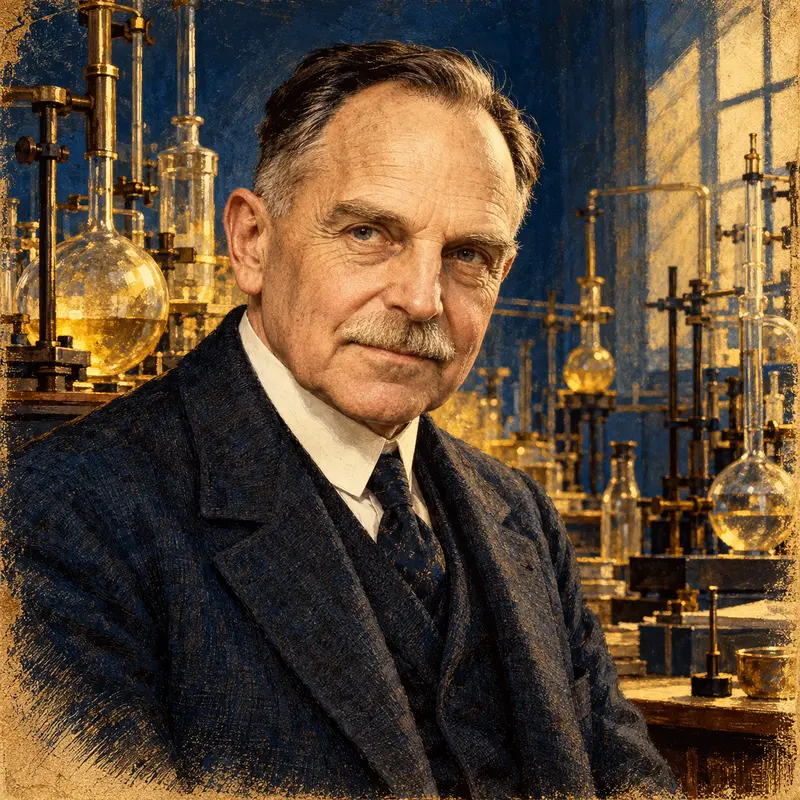
Otto Hahn
1879-1968 · Germany · Nobel Chemistry 1944
Discovery of nuclear fission