The discovery, explained · Chemist no. 35 of 350
Otto Hahn and the Discovery of Nuclear Fission
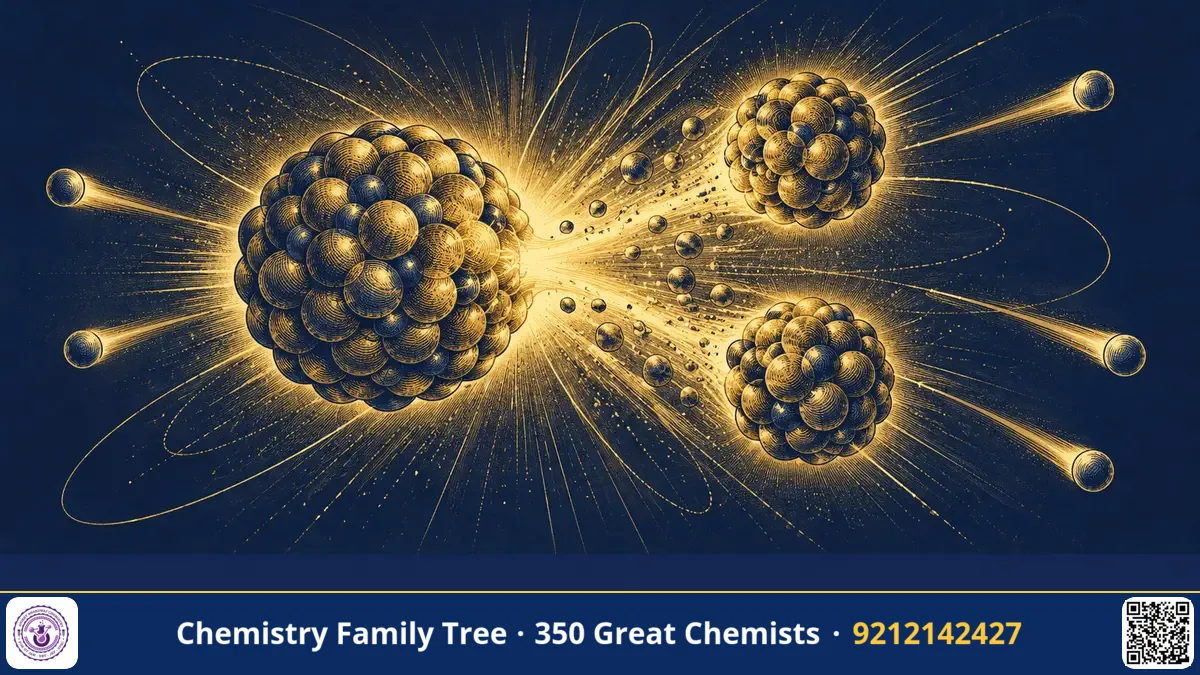
In December 1938, in a laboratory in Berlin-Dahlem, the German radiochemist Otto Hahn and his assistant Fritz Strassmann bombarded uranium with neutrons and then carried out a careful chemical analysis of the products. To their astonishment, one of the products was barium, an element with an atomic number of 56, far below uranium's 92. The uranium nucleus had split. Hahn wrote about this to his long-time collaborator Lise Meitner, who had just fled Germany, and within days she and her nephew Otto Frisch gave the physical explanation and named the process nuclear fission. Hahn received the 1944 Nobel Prize in Chemistry (announced in 1945) for the discovery of the fission of heavy nuclei. The discovery opened the way to nuclear power and nuclear weapons, and it remains one of the most consequential events in the history of chemistry.
The Scientific Problem Before the Discovery
After James Chadwick discovered the neutron in 1932, scientists realised that neutrons, being uncharged, could enter nuclei easily. In 1934 Enrico Fermi in Rome bombarded uranium with neutrons and found new radioactive substances. He believed that he had made transuranium elements, elements heavier than uranium (Z greater than 92), by neutron capture followed by beta decay:
²³⁸₉₂U + ¹₀n → ²³⁹₉₂U →(β⁻)→ ²³⁹₉₃Np
Several laboratories, including those of Irène Joliot-Curie in Paris and the team of Hahn, Meitner and Strassmann in Berlin, tried to identify the products. The results were confusing. A bewildering number of radioactive substances with different half-lives appeared. Radiochemists tried to assign them as elements 93, 94, 95 and so on. Irène Joliot-Curie and Pavle Savić reported a substance with properties similar to lanthanum, which puzzled everyone. Nobody expected that a nucleus could break into two medium-sized pieces. Physicists believed that a nucleus changes only by emitting small particles such as alpha or beta particles.
The Discovery: Step by Step
Step 1: The Berlin team
Hahn was the chemist, Meitner the physicist, and Strassmann an analytical chemist. They worked at the Kaiser Wilhelm Institute for Chemistry in Berlin. Meitner, who was Austrian and of Jewish descent, left Germany in July 1938 after the annexation of Austria and went to Sweden. Hahn and Strassmann continued the experiments, with Meitner in contact by letter.
Step 2: Carrying out the experiment
- Uranium was irradiated with slow neutrons from a source of radium and beryllium.
- The irradiated sample was dissolved, and carrier elements were added. In radiochemistry, a small amount of a non-radioactive isotope is added to help the radioactive isotope of the same element to precipitate.
- Radium was thought to be among the products, so a barium salt was added as a carrier, since radium and barium are chemically similar and precipitate together.
- By repeated fractional crystallisation, Hahn and Strassmann tried to separate radium from barium. They failed. The radioactivity stayed with barium.
- They concluded that the "radium" was in fact radioactive barium, and wrote in their paper of December 1938 that they were forced to conclude that the product was barium, an element far from uranium.
Step 3: The explanation
Lise Meitner and Otto Frisch, meeting in Sweden over Christmas 1938, used the liquid-drop model of the nucleus, proposed by Niels Bohr and others. A heavy nucleus is like a drop of liquid, held together by surface tension (the strong nuclear force) but pushed apart by the electrical repulsion between protons. When a neutron enters, the drop oscillates, becomes elongated, and splits. They calculated that the energy released would be about 200 MeV, using Einstein's relation E = mc² and the mass defect. Frisch borrowed the term "fission" from biology, where cells divide.
²³⁵₉₂U + ¹₀n → ²³⁶₉₂U* → ¹⁴¹₅₆Ba + ⁹²₃₆Kr + 3 ¹₀n + energy (about 200 MeV)
This is only one of many possible fission modes. Other pairs of fragments are also formed, and each fission releases two or three neutrons. Strassmann and Hahn identified the barium chemically; krypton was identified later. In 1939 other scientists realised that the released neutrons could cause further fissions, so a chain reaction is possible.
The Chemistry Behind It
Why uranium-235?
Natural uranium is about 99.3 percent U-238 and 0.7 percent U-235. U-235 is fissile with slow (thermal) neutrons. U-238 mostly absorbs neutrons without fission, converting into plutonium-239 after beta decays:
²³⁸₉₂U + ¹₀n → ²³⁹₉₂U →(β⁻)→ ²³⁹₉₃Np →(β⁻)→ ²³⁹₉₄Pu
Energy released
About 200 MeV is released per fission, mostly as kinetic energy of the fragments. This is millions of times more than a chemical reaction per atom. One kilogram of uranium-235 completely fissioned releases about 8 × 10¹³ joules, comparable to the burning of thousands of tonnes of coal.
Mass defect and binding energy
Binding energy per nucleon is highest (about 8.8 MeV) near iron-56 and nickel-62. Heavy nuclei like uranium have lower binding energy per nucleon (about 7.6 MeV), so splitting them into medium-mass fragments releases energy.
Chain reaction and criticality
Each fission releases about 2.5 neutrons on average. If, on average, at least one of these causes another fission, the reaction sustains itself. The multiplication factor k describes this: k less than 1 is subcritical, k equal to 1 is critical (steady reactor), and k greater than 1 is supercritical (explosive growth). A moderator such as water, heavy water or graphite slows the neutrons, and control rods of cadmium or boron absorb neutrons.
Applications Today
- Nuclear power: reactors supply a significant share of electricity worldwide. India operates pressurised heavy water reactors at places such as Tarapur, Kakrapar and Kudankulam (a different design).
- India's three-stage nuclear programme: envisioned by Homi Bhabha, it uses natural uranium in heavy-water reactors, then plutonium in fast breeder reactors, and finally thorium-232/uranium-233 cycles, using India's thorium reserves.
- Medical isotopes: reactors produce molybdenum-99 (the parent of technetium-99m), iodine-131 and cobalt-60.
- Nuclear weapons and arms control: the same fission process powers atomic bombs, which is why safeguards and non-proliferation treaties exist.
- Research: neutron beams from reactors are used in studying materials and structures.
Exam Corner
- Fission: a heavy nucleus splits into two lighter nuclei with 2-3 neutrons and about 200 MeV per fission. Fusion combines light nuclei.
- Typical fission equation: U-235 + n → Ba-141 + Kr-92 + 3n. Check that mass numbers (236 = 141 + 92 + 3) and atomic numbers (92 = 56 + 36) balance.
- Moderators slow neutrons (heavy water, graphite); control rods absorb neutrons (cadmium, boron).
- Fertile material (U-238, Th-232) becomes fissile (Pu-239, U-233) by neutron capture and beta decay.
- Hahn received the 1944 Nobel Prize in Chemistry; Meitner was not included. Element 109 (meitnerium) honours her; the name hahnium was once proposed for element 105.
Common Misconceptions
- "Fission and fusion are the same." Fission splits heavy nuclei; fusion joins light ones.
- "Hahn built the atomic bomb." He did not. He was horrified by the military use and was not part of the Manhattan Project.
- "Hahn found fission alone." The physical interpretation by Meitner and Frisch, and the work of Strassmann, were essential.
Quick Revision Box
- December 1938: Hahn and Strassmann detect barium after neutron bombardment of uranium.
- Meitner and Frisch explain it as fission using the liquid-drop model; they estimate about 200 MeV.
- Typical reaction: U-235 + n → Ba-141 + Kr-92 + 3n.
- Chain reaction needs multiplication factor k of at least 1.
- Moderator slows neutrons; control rods absorb them.
- Nobel Prize in Chemistry 1944 to Hahn alone.
FAQ
Why did Hahn use barium as a carrier?
He expected radium to be formed, and barium is chemically similar to radium, so it carries it down in precipitation. The unexpected result was that the radioactivity belonged to barium itself.
Who named the process fission?
Otto Frisch, working with Lise Meitner, used the term fission by analogy with biological cell division.
Why did Meitner not receive the Nobel Prize?
The Nobel committee awarded the 1944 prize in Chemistry to Hahn only. Historians have criticised this decision, and Meitner is widely credited with the theoretical interpretation of fission.
Does fission occur naturally?
Spontaneous fission occurs rarely, and in the Oklo region of Gabon natural reactors operated about two billion years ago.
Published by ABC Chemistry — IIT-JAM | CSIR-NET | GATE Chemistry Coaching. Visit abcchemistry.com
About the chemist
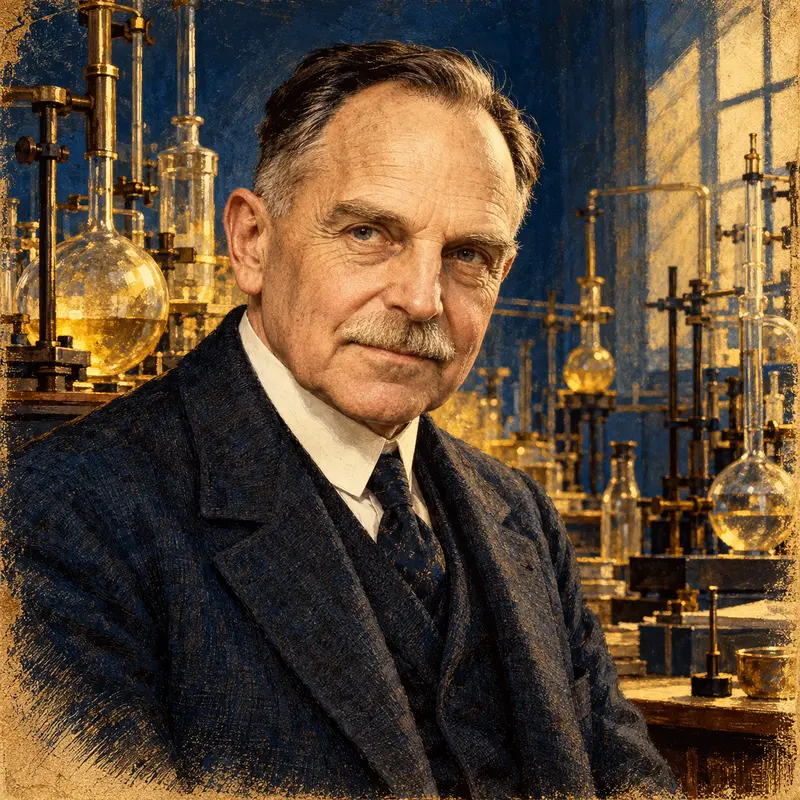
Otto Hahn
1879-1968 · Germany · Nobel Chemistry 1944
Discovery of nuclear fission