Biography · Chemist no. 102 of 350
Otto Wallach: Complete Life and Legacy
Introduction
Otto Wallach (1847–1931) was a German organic chemist who turned the fragrant oils of plants into a precise science. Before him, terpenes and essential oils were a confusing mass of liquids. After him, they were a well-defined family of compounds with known structures and relationships. For his work on alicyclic compounds he received the Nobel Prize in Chemistry in 1910. His name lives on in the Leuckart–Wallach reaction, the Wallach rearrangement and the isoprene rule, which every organic chemistry student meets in natural products. His legacy is the proof that patience, careful derivative-making and clear thinking can solve problems that look impossible.
Early Life and Family
Otto Wallach was born on 27 March 1847 in Königsberg, in the Kingdom of Prussia (the city is now Kaliningrad, Russia). His father held a post in the Prussian civil service, and the family later moved to Stettin and then to Potsdam, where Otto went to school. He was therefore raised in the educated, bureaucratic middle class of nineteenth-century Prussia, where classical education was highly valued.
At the Gymnasium in Potsdam he received a thorough education in languages and the classics, and he developed an interest in art history and the history of culture. It is often noted that Wallach's early leaning was toward the humanities, and that his later habit of careful, thorough observation owed something to this training. Chemistry came to him a little later, when he entered university.
Education and Mentors
Wallach began his studies at the University of Göttingen in 1867, where he attended the lectures of Friedrich Wöhler, who had synthesised urea in 1828 and made the first major crack in the vitalist idea that organic compounds could only be made by living things. Wallach received his doctorate there in 1869, with a thesis on toluidine isomers. He then continued in Berlin, working with August Wilhelm von Hofmann, a leader of organic chemistry.
In 1870 he moved to Bonn, to work as assistant to August Kekulé, famous for the structure of benzene. Kekulé's laboratory gave him an excellent training in structural organic chemistry. He became a lecturer in Bonn and, in 1876, an extraordinary professor, and was put in charge of the pharmaceutical institute in Bonn. The fact that he worked in a pharmaceutical setting is important: this was where he first came into contact with essential oils used as drugs, which led him towards terpenes.
Career Timeline
| Year | Event |
|---|---|
| 1847 | Born in Königsberg, Prussia, on 27 March. |
| 1869 | Doctorate at the University of Göttingen. |
| 1870 | Becomes assistant to August Kekulé at Bonn. |
| 1876 | Appointed extraordinary professor at Bonn and head of its pharmaceutical institute. |
| 1884 | Becomes full professor at Bonn. |
| 1887 | Publishes the idea that terpenes are built from isoprene-type units. |
| 1889 | Appointed director of the Chemical Institute at Göttingen, succeeding Victor Meyer. |
| 1909 | Publishes the book "Terpene und Campher" summarising his research. |
| 1910 | Awarded the Nobel Prize in Chemistry. |
| 1915 | Retires from his post at Göttingen; Adolf Windaus succeeds him. |
| 1931 | Dies in Göttingen on 26 February. |
Major Scientific Contributions
- Terpene chemistry: isolated and characterised many individual terpenes (pinene, limonene, terpinolene, phellandrene, sylvestrene and others) and demonstrated their relationships. See our discovery post for the isoprene rule and examples.
- Isoprene rule (1887): proposed that terpenes are formed by joining C5 isoprene units, a concept later refined by Leopold Ruzicka.
- Derivative method: used crystalline nitrosochlorides and other solid derivatives to identify oils, a practical and very reliable technique in the age before chromatography and spectroscopy.
- Leuckart–Wallach reaction: reductive amination of aldehydes and ketones with formic acid or formamide derivatives; a useful route to amines.
- Wallach rearrangement: acid-catalysed conversion of azoxybenzene to p-hydroxyazobenzene.
- Early work on oximes and alicyclic ketones: his studies of ring ketones helped to prepare the field for the chemistry of cyclohexane derivatives and terpenoid alcohols.
Awards, Honours and Nobel Prize
The Nobel Prize in Chemistry for 1910 was awarded to Otto Wallach "in recognition of his services to organic chemistry and the chemical industry by his pioneer work in the field of alicyclic compounds". The mention of industry is significant: his work gave the perfume and flavour industry a scientific foundation, because producers could now tell the active components from one another and begin to synthesise them.
He was also recognised by several scientific societies in Germany and abroad. The research he conducted at Göttingen attracted students and visitors from many countries, and his institute became one of the centres of organic chemistry in Europe. The most important thing for students to know is simply the prize, its year (1910) and its field (alicyclic compounds and terpenes).
Personality, Struggles and Lesser-Known Facts
- Arts before chemistry. He is recorded as having been fond of art and the humanities in his school years, and he kept a lifelong interest in culture.
- A late bloomer in terpenes. Although he was already in his late thirties and an established professor, he turned to terpenes only in the mid-1880s, and made them his life's work. It reminds students that great research can begin at any age.
- Method over speculation. His success rested on the rigorous use of melting points of derivatives. He preferred to establish identity by experiment before theorising about structure.
- Industrial links. His interest in essential oils began in the pharmaceutical institute at Bonn, and he later worked with the German fragrance industry, which benefited from his results.
- A teacher of future laureates. His successor in Göttingen, Adolf Windaus, would win the Nobel Prize in Chemistry in 1928, and Göttingen remained a chemical powerhouse long after him.
- Nobel lecture. In his Nobel lecture he explained the history of terpene chemistry and the way that one substance after another was identified, giving credit to the work of earlier investigators.
Legacy and Influence on Modern Chemistry
Wallach's influence is visible in every textbook chapter on natural products. His proposal that terpenes are built from isoprene units guided Leopold Ruzicka, who extended it into the biogenetic isoprene rule and won the 1939 Nobel Prize in Chemistry. Ruzicka's work in turn made it possible to understand the biosynthesis of steroids, since squalene, a triterpene, is the precursor of cholesterol. The mevalonate and non-mevalonate pathways, taught today in biochemistry, are the biological explanation of what Wallach saw by pure chemistry.
Terpene chemistry also gave us practical outcomes: menthol, camphor, citral and ionones for perfumery; vitamin A synthesis; the anti-malarial artemisinin; the anticancer drug taxol. His Leuckart–Wallach reaction is still taught as a method of making amines, and variants are still used in laboratories. Perhaps most importantly, he set an example of how to deal with an apparently chaotic mixture: separate, derivatise, compare, and then build a theory.
Lessons for Students
- Do not accept "a single substance" without proof of purity. Wallach showed how many "pure" oils were mixtures.
- Use simple, reliable tests. A sharp melting point of a derivative is still a powerful proof of identity.
- Organise your knowledge: classification (monoterpene, sesquiterpene, and so on) turns hundreds of facts into one pattern.
- Be willing to change fields. A pharmaceutical setting led an aromatic chemist to alicyclic chemistry.
- Great science is cumulative: Wöhler, Kekulé, Wallach, Ruzicka and later biochemists each added a layer.
Quick Facts Box
- Born: 27 March 1847, Königsberg, Prussia.
- Died: 26 February 1931, Göttingen, Germany.
- Nationality: German.
- Field: Organic chemistry; terpenes and alicyclic compounds.
- Famous for: Terpene research, isoprene unit idea, Leuckart–Wallach reaction.
- Nobel: Chemistry, 1910.
FAQ
Who was Otto Wallach's teacher?
He studied under Friedrich Wöhler at Göttingen, worked with A. W. von Hofmann in Berlin, and was assistant to August Kekulé at Bonn.
Why did Otto Wallach win the Nobel Prize?
He received the 1910 Nobel Prize in Chemistry for his pioneering work on alicyclic compounds, mainly terpenes and essential oils, which also served the chemical industry.
What is the Leuckart–Wallach reaction?
It is a reductive amination in which an aldehyde or ketone is converted into an amine using formic acid or its derivatives such as ammonium formate or formamide as the reducing agent.
Who succeeded Wallach at Göttingen?
Adolf Windaus took over the Chemical Institute in 1915 after Wallach retired. Windaus later won the Nobel Prize in Chemistry in 1928 for his work on sterols.
Published by ABC Chemistry — IIT-JAM | CSIR-NET | GATE Chemistry Coaching. Visit abcchemistry.com
About the chemist
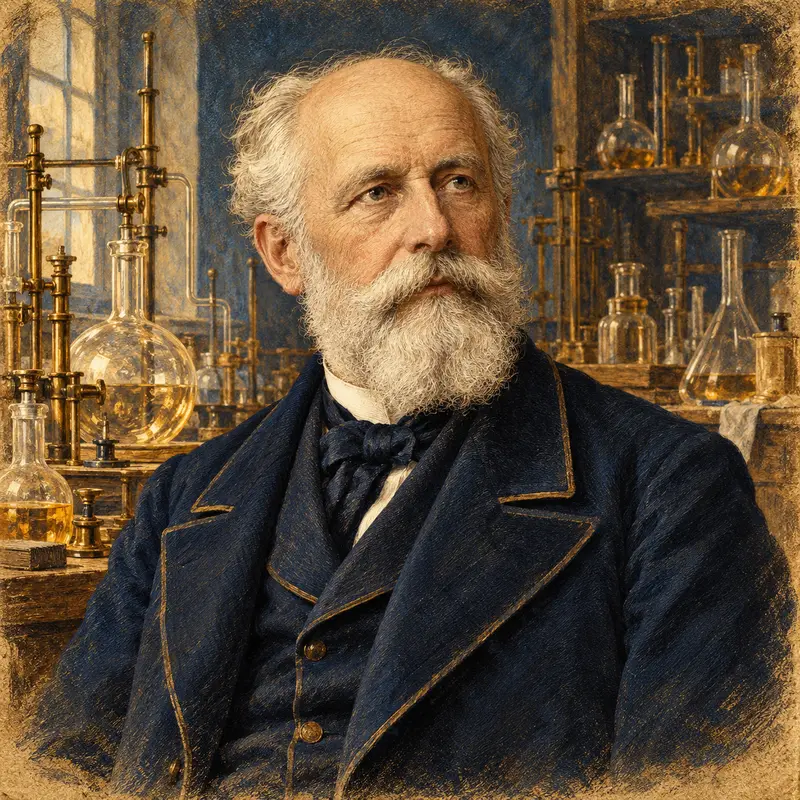
Otto Wallach
1847-1931 · Germany · Nobel Chemistry 1910
Terpene and alicyclic chemistry