The discovery, explained · Chemist no. 102 of 350
Otto Wallach and the Chemistry of Terpenes
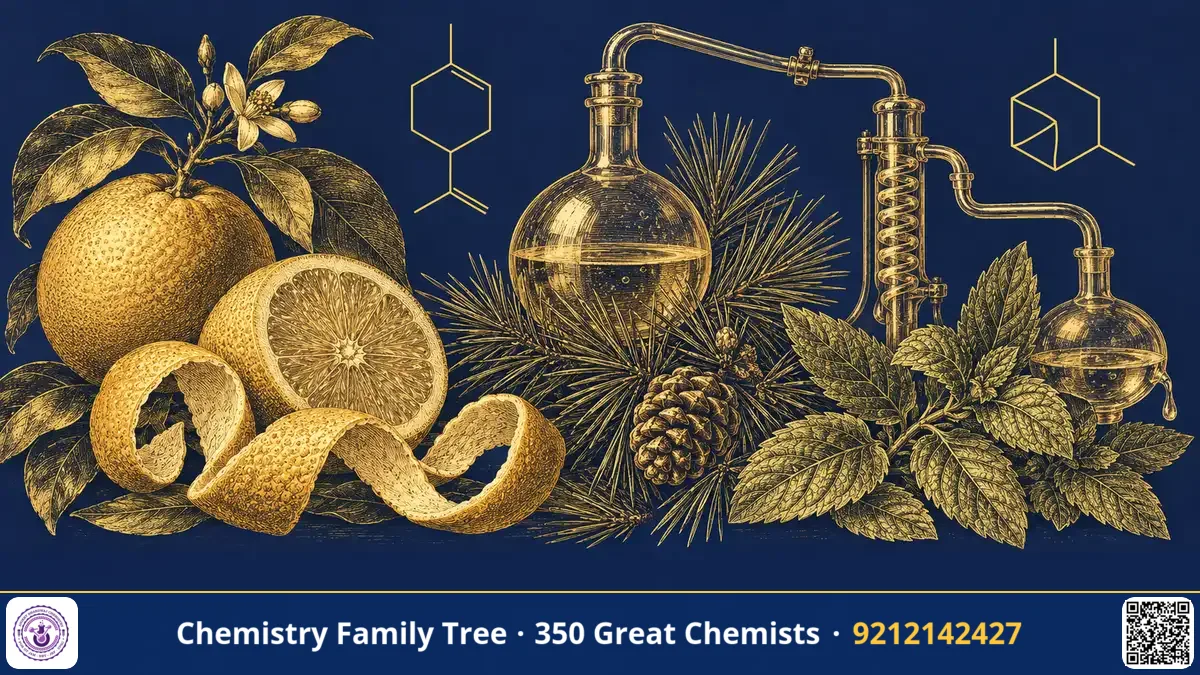
When you peel an orange, the sharp smell that fills the air comes from limonene. The cool freshness of mint is menthol. The scent of pine is pinene. These fragrant substances are called terpenes, and until the late nineteenth century they were a hopeless tangle of oily liquids that could hardly be separated, let alone understood. The German chemist Otto Wallach spent more than two decades bringing order to this chaos. He separated individual compounds, identified their structures, established the relationships between them and laid the foundation of what became known as the isoprene rule. For this work, which opened up the field of alicyclic (non-aromatic ring) compounds, he received the Nobel Prize in Chemistry in 1910.
The Scientific Problem Before the Discovery
Essential oils had been extracted from plants for centuries by steam distillation and used as perfumes, flavours and medicines. By the 1850s chemists knew that many of these oils had the empirical formula C10H16, but they could not tell how many different compounds were present. Names such as "oil of turpentine", "oil of lemon" and "oil of orange" were used as if each were a single substance. Boiling points overlapped, and the compounds changed on heating. Chemists often thought they had obtained a pure substance when they actually had a mixture.
Aromatic chemistry, after Kekulé's benzene structure of 1865, was advancing quickly, but compounds that were ring-shaped without being aromatic were poorly understood. There were no reliable methods to prove whether a given oil was a new compound or a known one. Chemists also lacked a sense of how the carbon skeletons of such natural products were built. Wallach, working in Göttingen from 1889, took up the challenge.
The Discovery: Step by Step
Wallach's approach was patient and systematic. He did not rely on boiling points alone. Instead, he made crystalline derivatives of each oil and used their melting points as a fingerprint. This made it possible to tell different terpenes apart.
- Separation by fractional distillation. Essential oils were carefully fractionated to obtain portions with narrow boiling ranges.
- Derivative formation. Terpenes were treated with nitrosyl chloride (NOCl), with hydrogen halides such as HCl and HBr, and with nitrosates. These reagents add across the double bonds and give solid products, such as nitrosochlorides, with sharp melting points.
- Comparison. By comparing the derivatives, Wallach showed that many oils that had been given different names were identical, while others, previously thought to be single compounds, were mixtures. He established that substances such as pinene, limonene, camphene, sylvestrene, terpinolene and phellandrene were distinct individuals.
- Structure determination. By oxidation, hydration and rearrangement reactions, he broke the molecules into smaller fragments of known structure and worked back to the skeleton.
- Interconversion. He showed that one terpene can be converted into another, for example pinene into terpineol and terpineol into other forms, by acid-catalysed rearrangements. This proved that they share a related carbon framework.
In 1887 he suggested that the terpenes are built from repeating five-carbon units related to isoprene (2-methylbuta-1,3-diene). He published a large part of his work in the series "Terpene und Campher" and collected his results in a book of that title in 1909.
The Chemistry Behind It
The structural basis is the isoprene unit, C5H8:
CH2=C(CH3)-CH=CH2 (isoprene, 2-methylbuta-1,3-diene)
Terpenes are made by joining two or more isoprene units, mostly head to tail. The classification is based on the number of units:
| Class | Carbons | Isoprene units | Example |
|---|---|---|---|
| Monoterpenes | C10 | 2 | Limonene, pinene, menthol, geraniol |
| Sesquiterpenes | C15 | 3 | Farnesol, caryophyllene |
| Diterpenes | C20 | 4 | Retinol (vitamin A), phytol |
| Triterpenes | C30 | 6 | Squalene |
| Tetraterpenes | C40 | 8 | Beta-carotene |
Wallach's isoprene rule was later extended by Leopold Ruzicka into the "biogenetic isoprene rule", which explains how the units are assembled in nature from isopentenyl pyrophosphate (IPP) and dimethylallyl pyrophosphate (DMAPP). Ruzicka received the Nobel Prize in Chemistry in 1939 for this and related work.
Typical reactions Wallach used and studied include:
- Addition of HCl to limonene to give a dihydrochloride,
C10H16 + 2HCl → C10H18Cl2. - Hydration of pinene or limonene in acid to give terpineol and terpin hydrate.
- Oxidative cleavage of the double bond with permanganate or ozone to give keto acids that reveal the position of the double bond.
- Acid-catalysed rearrangement of bicyclic pinene to monocyclic terpenes, a classic carbocation process involving Wagner–Meerwein shifts.
Wallach is also remembered for two named reactions in organic chemistry. The Leuckart–Wallach reaction is the reductive amination of aldehydes and ketones with formic acid (or ammonium formate) and an amine, giving amines: R2C=O + HCONH2/HCOOH → R2CH-NH2. The Wallach rearrangement converts azoxybenzene to p-hydroxyazobenzene on treatment with concentrated sulfuric acid.
Applications Today
- Fragrance and flavour industry: synthetic and natural terpenes such as limonene, linalool, geraniol and menthol are widely used in perfumes, soaps, food flavours and toothpaste.
- Pharmaceuticals: terpene-based drugs include the anti-malarial artemisinin (a sesquiterpene lactone), the anticancer drug taxol (a diterpene) and menthol-based topical preparations.
- Vitamins and pigments: vitamin A and the carotenoids are terpenoids.
- Rubber and polymers: natural rubber is polyisoprene, a very long chain of isoprene units.
- Indian context: India is a major producer of mint oil (Mentha arvensis) from Uttar Pradesh, and also of citronella, eucalyptus and sandalwood oils. Menthol crystals from India are exported worldwide.
- Green chemistry: limonene from citrus waste is used as a bio-based solvent.
Exam Corner
- Otto Wallach won the Nobel Prize in Chemistry in 1910 for his work on alicyclic compounds, especially terpenes and essential oils.
- The isoprene rule: terpenes are made from C5 isoprene units, usually joined head to tail. A monoterpene has 10 carbons, a sesquiterpene 15, a diterpene 20, a triterpene 30.
- Molecular formula of a bicyclic monoterpene such as pinene is C10H16 with two degrees of unsaturation from rings plus one double bond (three in total).
- Leuckart–Wallach reaction: reductive amination using formic acid or formamide as the hydride source.
- Wallach rearrangement: azoxybenzene to p-hydroxyazobenzene in concentrated H2SO4.
Common Misconceptions
- "Wallach discovered isoprene." Isoprene had been obtained earlier by the destructive distillation of rubber. Wallach recognised the isoprene unit as the building block of terpenes.
- "The isoprene rule means terpenes are made from isoprene gas." In nature the building blocks are IPP and DMAPP, not free isoprene.
- "Terpenes are aromatic." Most are alicyclic or open chain; Wallach's Nobel citation specifically refers to alicyclic compounds.
Quick Revision Box
- Terpenes: general formula (C5H8)n, built from isoprene units.
- Wallach separated and identified limonene, pinene, camphene, terpineol and others using crystalline derivatives such as nitrosochlorides.
- Nobel Prize in Chemistry, 1910, for work on alicyclic compounds.
- Ruzicka's biogenetic isoprene rule extended his idea; Ruzicka got the 1939 Nobel Prize.
- Leuckart–Wallach reaction gives amines from carbonyls and formic acid.
- Examples: menthol, camphor, citral, geraniol, limonene.
FAQ
What is the isoprene rule?
It states that the carbon skeleton of terpenes can be divided into five-carbon branched units like isoprene, joined mainly head to tail. Exceptions exist, but the rule is very useful for working out structures.
Why was it so hard to study terpenes in the 1880s?
Oils were mixtures of compounds with similar boiling points and similar formulas. There were no chromatographic or spectroscopic methods, so Wallach had to use chemical derivatives and melting points.
What is the difference between a terpene and a terpenoid?
Terpenes are hydrocarbons built from isoprene units. Terpenoids (isoprenoids) are their oxygenated or otherwise modified derivatives such as alcohols, aldehydes and ketones, for example menthol and camphor.
How is Wallach's work useful for JAM, NET and GATE?
Natural products, terpene classification, the isoprene rule and name reactions such as Leuckart–Wallach are common topics in the organic chemistry sections of these examinations.
Published by ABC Chemistry — IIT-JAM | CSIR-NET | GATE Chemistry Coaching. Visit abcchemistry.com
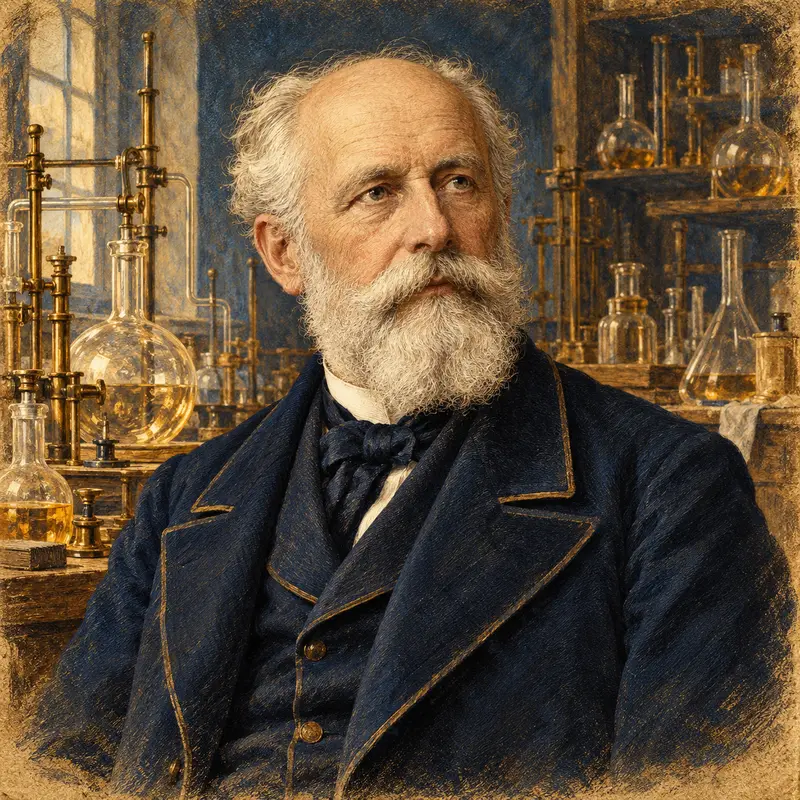
About the chemist
Otto Wallach
1847-1931 · Germany · Nobel Chemistry 1910
Terpene and alicyclic chemistry