Biography · Chemist no. 315 of 350
Otto Warburg: Complete Life and Legacy of the Respiration Pioneer
Otto Heinrich Warburg (1883-1970) was a German physician-chemist who became one of the most influential biochemists of the twentieth century. He discovered the iron-containing respiratory enzyme, developed manometric methods that made cell metabolism measurable, and described the high glucose fermentation of tumour cells that carries his name. He won the 1931 Nobel Prize in Physiology or Medicine. His legacy: he taught the world that life's chemistry can be measured, step by step, with a pressure gauge and a clever mind.
Early Life and Family
Otto Warburg was born on 8 October 1883 in Freiburg im Breisgau, Germany. His father, Emil Warburg, was a distinguished physicist who later became president of the Physikalisch-Technische Reichsanstalt in Berlin. His mother, Elisabeth Gaertner, came from a family of officials and Black Forest landowners. The Warburg family was of Jewish descent on the father's side, though the family had long been assimilated, and Otto was raised in a Protestant household. Growing up among physicists and visiting scholars, he met many scientists at home as a child, which shaped his early confidence that science was a normal and exciting way of life.
Education and Mentors
Warburg first studied chemistry in Freiburg, then moved to Berlin, where he worked under the great organic chemist Emil Fischer. He earned a doctorate in chemistry in 1906, with work on peptides. Not satisfied with chemistry alone, he then studied medicine at Heidelberg, taking his medical degree in 1911. There he worked with the physician-physiologist Ludolf von Krehl. This double training, a chemist's precision and a physician's interest in living cells, is the key to his later success. He also spent time at the Naples marine station, where he used sea urchin eggs to study how oxygen consumption rises after fertilisation.
Career Timeline
| Year | Event |
|---|---|
| 1883 | Born in Freiburg, Germany |
| 1906 | Doctorate in chemistry under Emil Fischer, Berlin |
| 1911 | Medical degree, Heidelberg |
| 1914-1918 | Served as a cavalry officer in the First World War, awarded the Iron Cross; later called back to scientific work |
| 1913-1920s | Joined Kaiser Wilhelm Society research; studied respiration with the manometer |
| 1920s | Studied tumour metabolism and aerobic glycolysis |
| 1931 | Nobel Prize in Physiology or Medicine |
| 1931 | Became director of the Kaiser Wilhelm Institute for Cell Physiology in Berlin-Dahlem |
| 1930s | Isolated the yellow enzyme and described nicotinamide as hydrogen carrier |
| 1944 | Nominated again for the Nobel Prize; he could not accept because of the Nazi decree forbidding Germans to accept it |
| 1970 | Died in Berlin on 1 August |
Major Scientific Contributions
Warburg's work can be grouped in four themes, each connecting to the concepts in our discovery post on the Warburg effect:
- Manometric methods: The Warburg apparatus measured oxygen uptake and carbon dioxide output using gas-law calculations.
- Respiratory enzyme: He showed that respiration needs a haem iron enzyme (now cytochrome c oxidase), and proved this by CO inhibition reversed by light.
- Coenzymes: He identified the yellow flavoprotein and the role of nicotinamide in NADP+, and developed the optical test based on NADH absorption at 340 nm.
- Tumour metabolism: He described the high aerobic glycolysis of cancer cells, now called the Warburg effect.
He also did notable work on photosynthesis, studying the quantum requirement for oxygen evolution by the green alga Chlorella. His estimate of the number of light quanta needed per O2 molecule was a long-running scientific controversy with other researchers.
Awards, Honours and Nobel Prize
The 1931 Nobel Prize in Physiology or Medicine was awarded to Warburg "for his discovery of the nature and mode of action of the respiratory enzyme". Note that this is a Medicine prize, though the work is pure biochemistry. He was nominated for the Nobel Prize many times in later years. In 1944 he was again chosen, but German citizens had been forbidden to accept Nobel Prizes at that time, so the 1944 prize in Physiology or Medicine went to Joseph Erlanger and Herbert Gasser. Warburg also received the Pour le Mérite for Sciences and Arts (civil class) and was a member of many academies. He is also remembered through the Otto Warburg Medal of the German Society for Biochemistry and Molecular Biology.
Personality, Struggles and Lesser-Known Facts
- Demanding perfectionist: Warburg was known as a strict, tough director who expected exact experiments and little small talk. His co-workers later included several future Nobel laureates, and many remembered his high standards with respect.
- Survival under the Nazi regime: Because of his Jewish ancestry he was in danger, but he continued to direct his institute. He was protected for a time by officials who valued his research, and the matter of his status was handled with special arrangements. He did not leave Germany.
- Love of horses: He had served as a cavalry officer in the First World War and loved riding for most of his life.
- Doctor of chemistry and medicine: Few people of his time held both degrees and used both so effectively.
- Never married: He remained unmarried and was devoted to his work, and had a famously quiet private life.
- Strong views on diet and cancer: In later life he argued firmly about cancer prevention and nutrition, in particular the importance of respiratory enzymes in food, and his most extreme ideas about the origin of cancer were not accepted by later science.
Legacy and Influence on Modern Chemistry
Warburg's manometer was the standard tool of metabolism laboratories for decades. His respiratory enzyme opened the way to the entire study of the electron transport chain, which was completed by David Keilin, Peter Mitchell and many others. His student Hans Krebs, who worked in his laboratory in the late 1920s, went on to describe the urea cycle and the citric acid cycle and won the 1953 Nobel Prize in Physiology or Medicine. Another student, Hugo Theorell, who worked in his lab in the 1930s, won the 1955 Nobel Prize in Physiology or Medicine for oxidation enzymes. The Warburg effect is now a central idea in modern cancer metabolism and the foundation of FDG-PET scanning. In this way, a hundred-year-old observation still saves lives in hospitals across India and the world.
Lessons for Students
- Measure carefully. Warburg's greatest strength was quantitative accuracy. A good method is half the discovery.
- Combine fields. Chemistry plus medicine plus physics (light experiments) gave him his edge. Do not stay in one subject box.
- Use clever inhibitors. Cyanide and carbon monoxide were tools to reveal the enzyme, a lesson for biochemistry exams too.
- Be ready to be corrected. His central cancer theory was only partly correct. Good science keeps the data and revises the explanation.
Quick Facts Box
- Born: 8 October 1883, Freiburg, Germany
- Died: 1 August 1970, Berlin
- Nationality: German
- Field: Biochemistry and cell physiology
- Famous for: Respiratory enzyme, Warburg apparatus, Warburg effect
- Nobel: 1931, Physiology or Medicine
FAQ
Did Otto Warburg win the Nobel Prize in Chemistry?
No. He won the 1931 Nobel Prize in Physiology or Medicine, for discovering the nature and mode of action of the respiratory enzyme.
Who was Otto Warburg's most famous student?
Hans Krebs, discoverer of the citric acid cycle, is the best-known student. Hugo Theorell also worked with him.
Why did Warburg not receive a second Nobel Prize?
He was selected for the 1944 prize, but German citizens were forbidden by the Nazi government from accepting Nobel Prizes at that time.
What is Warburg best remembered for today?
For the Warburg effect, the observation that tumour cells convert glucose to lactate even in the presence of oxygen, which underlies PET imaging and modern cancer metabolism research.
Published by ABC Chemistry — IIT-JAM | CSIR-NET | GATE Chemistry Coaching. Visit abcchemistry.com
About the chemist
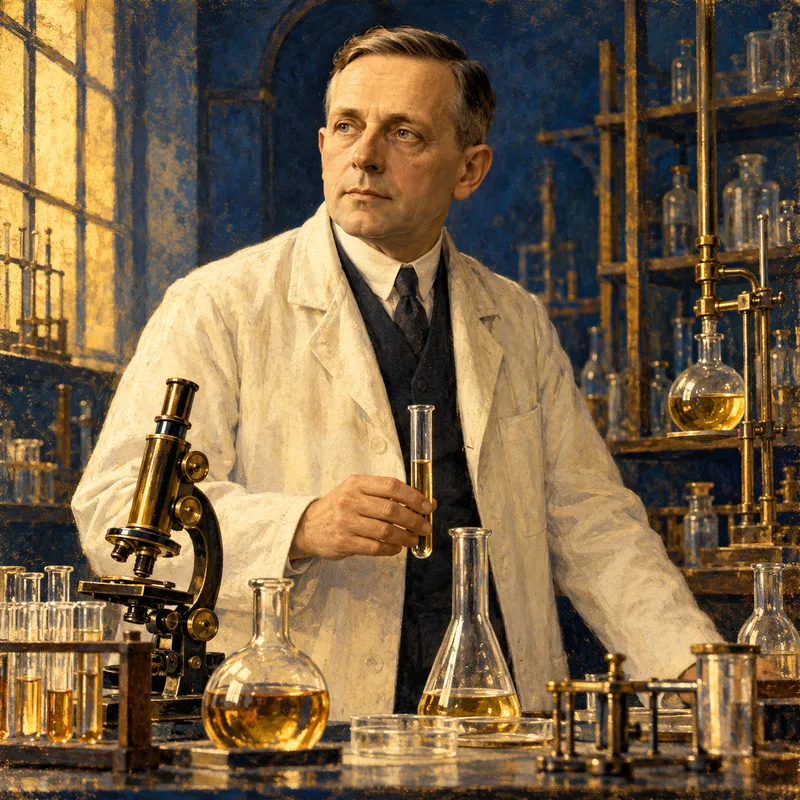
Otto Warburg
1883-1970 · Germany · Nobel Physiology/Medicine 1931
Cellular respiration; Warburg effect