The discovery, explained · Chemist no. 315 of 350
Otto Warburg: The Respiratory Enzyme and the Warburg Effect
How does a living cell "burn" food using oxygen? Why do many tumour cells prefer a wasteful way of getting energy, even when oxygen is plentiful? Both questions were attacked, and largely answered, by the German biochemist Otto Heinrich Warburg (1883-1970). He showed that cellular respiration depends on an iron-containing enzyme, which he called the Atmungsferment (respiratory enzyme), and he described a strange metabolic habit of cancer cells that we now call the Warburg effect. For this work on the nature and mode of action of the respiratory enzyme he received the 1931 Nobel Prize in Physiology or Medicine (not Chemistry). His methods, especially manometry, turned biochemistry into a precise, quantitative science, and his ideas still guide cancer metabolism research, including the PET scans used in hospitals today.
The Scientific Problem Before the Discovery
By 1900 chemists knew that animals take in oxygen and give out carbon dioxide. Lavoisier had already compared respiration to slow combustion. But a major puzzle remained: ordinary glucose does not burn in air at body temperature (37 °C). In a flame it needs several hundred degrees. How can a cell oxidise it gently, step by step, in water?
Two schools of thought existed. Heinrich Wieland argued that cells activate and remove hydrogen from substrates (dehydrogenation). Warburg argued instead that the key step is the activation of oxygen itself, by a catalyst containing heavy metal, and that this catalyst is the real "respiratory enzyme". Nobody had measured the process accurately enough to decide, because the tools to follow tiny changes in oxygen uptake did not exist.
The Discovery / Experiment
Step 1: Measuring respiration with the manometer
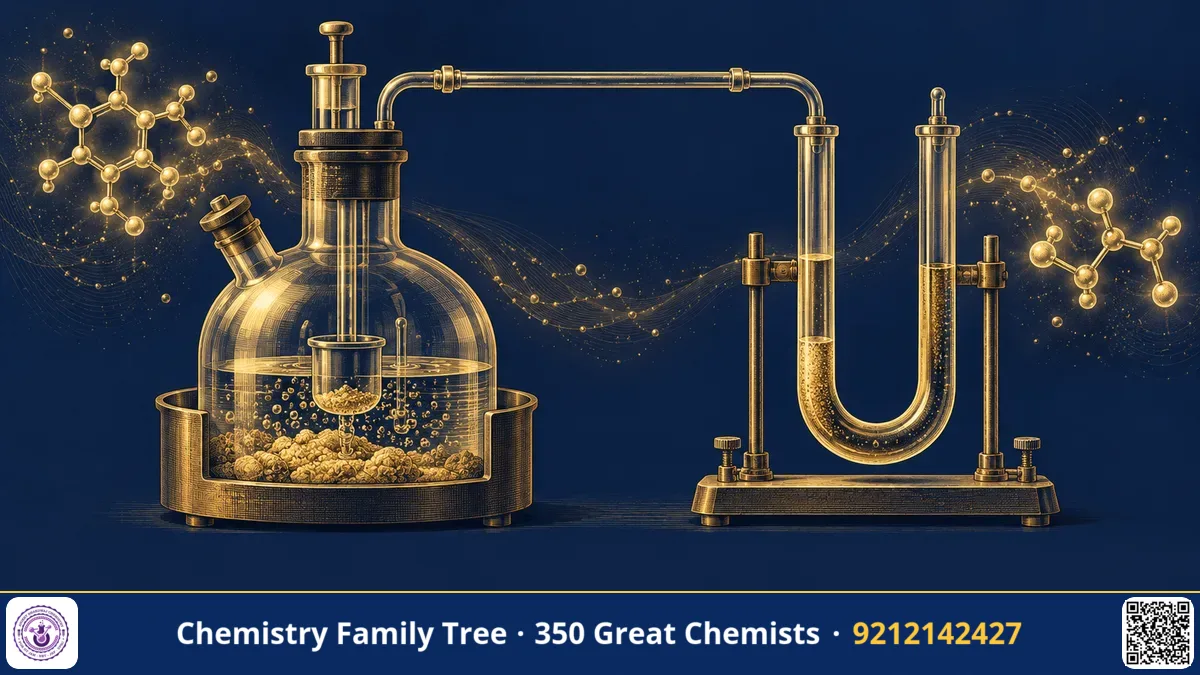
Warburg adapted the manometer, a sealed flask connected to a U-shaped pressure gauge. A thin tissue slice or a suspension of cells (he often used sea urchin eggs and liver slices) is placed in the flask in a shaking water bath. A small cup holds potassium hydroxide, KOH, which absorbs the CO2 produced. Then any fall in pressure equals oxygen consumed. Using the gas laws (Boyle's law and the ideal gas equation), the volume of oxygen used can be calculated with the flask constant. This Warburg apparatus allowed him to measure respiration in micro-litres per hour.
Step 2: Inhibitors point to iron
Warburg noticed that cyanide and carbon monoxide strongly stop cell respiration. Both are well known to bind to iron. He concluded that the enzyme must contain iron. Cells containing iron salts, such as the iron-containing charcoal models he studied, behaved similarly.
Step 3: The light experiment
His most famous experiment used a property of carbon monoxide. The compound of CO with the iron enzyme is split by light. So if respiration blocked by CO could be restored by illumination, the enzyme must be a CO-binding iron compound. He shone light of different wavelengths on CO-inhibited cells and plotted how effectively each wavelength restored respiration. The resulting photochemical absorption spectrum matched that of an iron-porphyrin (haem) compound. The respiratory enzyme was therefore a haem protein. We now call it cytochrome c oxidase (Complex IV of the electron transport chain).
O2 + 4H+ + 4e- (from cytochrome c) → 2H2O
Enzyme block:  Fe(II)-enzyme + CO ⇌ Fe(II)-CO complex  (reversed by light)
               Fe(III)-enzyme + CN- → Fe(III)-CN complex (inhibited)
Step 4: Yellow enzyme and nicotinamide
In the 1930s Warburg and his co-workers also isolated the "yellow enzyme" (a flavoprotein, containing riboflavin phosphate) and found that nicotinamide acts as a hydrogen-carrying part of coenzymes (today's NADP+, and related NAD+). These discoveries showed that respiration is a chain of enzymes and coenzymes carrying hydrogen and electrons to oxygen.
Step 5: The tumour observation
In the 1920s Warburg measured slices of tumour tissue and compared them with normal tissue. He found that tumour slices took up large amounts of glucose and produced a lot of lactic acid, even when oxygen was available. Normal tissues make lactate mainly when oxygen is short (anaerobic glycolysis). This is called aerobic glycolysis, or the Warburg effect.
The Chemistry Behind It
Compare the energy yield of the two routes for one molecule of glucose:
| Pathway | Overall reaction | ATP produced |
|---|---|---|
| Complete oxidation | C6H12O6 + 6O2 → 6CO2 + 6H2O | about 30-32 |
| Glycolysis to lactate | C6H12O6 → 2CH3CH(OH)COOH | 2 |
Glycolysis is about 15 times less efficient. So why would a cancer cell choose it? Modern research suggests that rapidly dividing cells need not only ATP but also carbon skeletons and NADPH to build nucleotides, amino acids and lipids. Glycolysis and the pentose phosphate pathway supply these building blocks. Also, the lactate released acidifies the surroundings, which helps tumour invasion. Warburg himself believed that damaged mitochondrial respiration was the cause of cancer. Most scientists now think this is not generally true: many tumours have working mitochondria, and the metabolic change is largely a result of oncogene signalling (for example Ras, Myc, PI3K/Akt and HIF-1). Still, the observation itself is correct and very useful.
Applications Today
- FDG-PET scanning: Tumours take up a lot of glucose. The tracer 18F-fluorodeoxyglucose is taken in by cells and trapped as FDG-6-phosphate, so hot spots on the scan show tumours. This is used in many Indian cancer hospitals.
- Cancer drug research: Inhibitors of lactate dehydrogenase, hexokinase II and pyruvate dehydrogenase kinase are studied as anticancer agents.
- Enzyme assays: Warburg's observation that NADH absorbs at 340 nm while NAD+ does not is the basis of many routine laboratory tests (the "optical test").
- Cyanide poisoning: Understanding that cyanide blocks cytochrome oxidase explains its toxicity and guides treatment.
- Respirometry: Modern oxygen electrodes follow the same idea as the manometer.
Exam Corner
- Warburg won the 1931 Nobel Prize in Physiology or Medicine for the respiratory enzyme.
- The Warburg effect = aerobic glycolysis: glucose to lactate even in presence of O2.
- Cyanide and CO inhibit cytochrome c oxidase (Complex IV, containing haem a, a3 and copper centres).
- The Warburg manometer measures gas exchange as pressure change; KOH absorbs CO2.
- Net ATP in anaerobic glycolysis is 2 per glucose; in aerobic respiration about 30-32.
Common Misconceptions
- "Warburg won the Nobel Prize in Chemistry." No, it was Physiology or Medicine, 1931.
- "Cancer cells have no mitochondria." Wrong. Most cancer cells have functioning mitochondria; they simply prefer glycolysis for growth.
- "The Warburg effect proves that cancer is caused by lack of oxygen." Not true. The effect occurs even in the presence of oxygen, which is the whole point.
Quick Revision Box
- Respiratory enzyme (Atmungsferment) = iron-haem protein, now cytochrome c oxidase.
- Evidence: inhibition by CN-/CO and light reversal of CO inhibition.
- Warburg effect: tumour cells show high glucose uptake and lactate production in oxygen.
- Glycolysis gives 2 ATP; oxidative phosphorylation gives about 30-32 ATP per glucose.
- Warburg manometer: constant volume, pressure change measures O2 uptake.
- Application: FDG-PET imaging of tumours.
FAQ
What is the Warburg effect in simple words?
Many cancer cells convert glucose to lactic acid even when plenty of oxygen is present, instead of burning it fully in mitochondria. This looks wasteful but supports rapid growth.
What did Warburg find out about the respiratory enzyme?
He showed that it contains iron, binds oxygen, and is inhibited by cyanide and carbon monoxide. He proved the haem nature through light-reversal of CO inhibition. It is now called cytochrome c oxidase.
Why is the Warburg effect important for PET scans?
Because tumours consume much more glucose than most normal tissues, a radioactive glucose analogue (FDG) accumulates in them and makes them visible on a PET scan.
Is the Warburg effect asked in IIT-JAM, CSIR-NET or GATE?
Yes. Questions on glycolysis, ATP yield, electron transport inhibitors (CN-, CO, azide) and cancer metabolism often appear in life-science and chemistry (biochemistry) sections.
Published by ABC Chemistry — IIT-JAM | CSIR-NET | GATE Chemistry Coaching. Visit abcchemistry.com
About the chemist
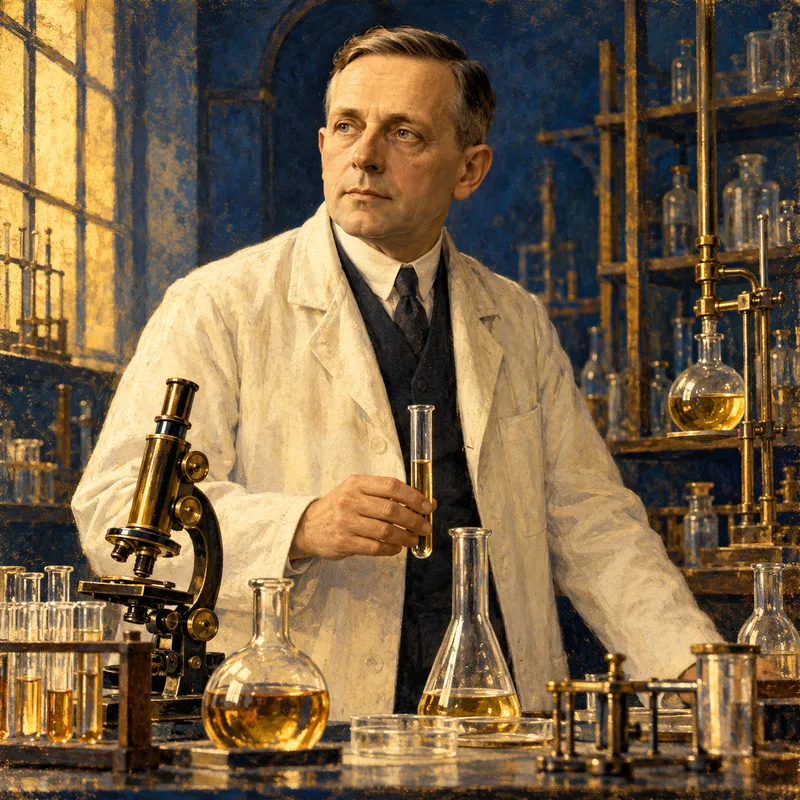
Otto Warburg
1883-1970 · Germany · Nobel Physiology/Medicine 1931
Cellular respiration; Warburg effect