Biography · Chemist no. 232 of 350
Paracelsus: The Restless Physician Who Gave Chemistry a Medical Mission
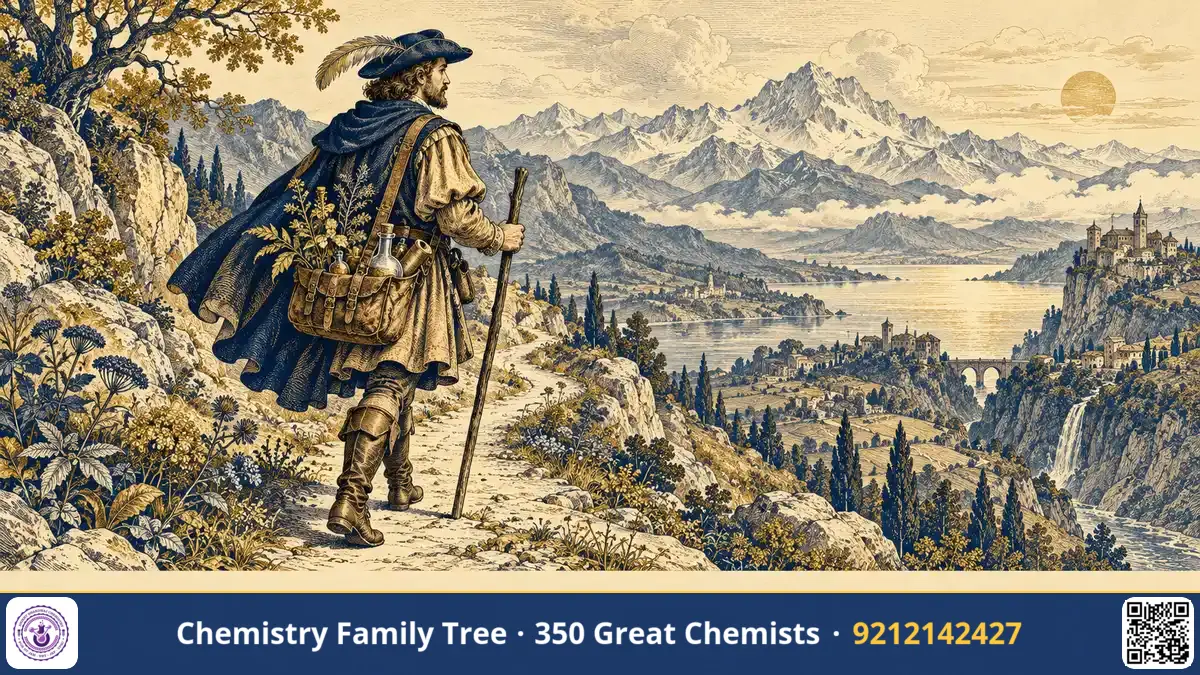
Paracelsus was loud, quarrelsome, brilliant and wandering. He lectured in German when scholars used Latin, he attacked the authority of ancient medical writers, and he insisted that a doctor must learn from mines, workshops and patients. Born Theophrastus Bombastus von Hohenheim, he lived from 1493 to 1541 and became the central figure in the movement of iatrochemistry. His one-line legacy: he turned alchemy towards medicine and taught that the dose makes the poison.
Early Life and Family
He was born in 1493 (the exact date is uncertain) near Einsiedeln in Switzerland. His father, Wilhelm von Hohenheim, was a physician of noble Swabian origin, and his mother is believed to have been connected with the nearby abbey. When he was a child, the family moved to Villach in Carinthia, now in Austria, a mining region. There Wilhelm taught at a mining school, and the boy grew up amid mines, smelters and ores. This early contact with metals and minerals later shaped his belief that mineral substances could be medicines. The name "Paracelsus" was adopted later; its meaning is debated, and some say it signified "beyond Celsus", the Roman medical writer.
Education and Mentors
His first teacher was his father, who taught him medicine, natural history and basic chemistry. He is also said to have studied with local clergy and, according to tradition, with the alchemically inclined abbot Johannes Trithemius of Sponheim. He attended universities in Italy, with Ferrara usually named as the place where he obtained a doctorate in medicine, but documentary proof is thin and historians do not agree. What is clear is that he was deeply dissatisfied with university teaching and chose to learn from barber-surgeons, miners, midwives and travelling healers. He wrote that experience is the best teacher.
Career Timeline
| Year | Event |
|---|---|
| 1493 | Born near Einsiedeln, Switzerland. |
| c. 1502 | Family settles in Villach, a mining region of Carinthia. |
| 1510s | Studies medicine and works in mining and metallurgy settings; travels in Italy. |
| 1520s | Years of wandering across Europe as a physician and military surgeon. |
| 1527 | Appointed town physician and lecturer in Basel; reported to have publicly burned a medical textbook, and lectured in German. |
| 1528 | Leaves Basel after a conflict with the local authorities and physicians. |
| 1530s | Further travels and writing in southern Germany, Switzerland and Austria. |
| 1536 | Publishes a surgical work, the Grosse Wundarznei (Great Surgery Book). |
| 1541 | Dies in Salzburg. |
Major Scientific Contributions
- Iatrochemistry: chemistry applied to the preparation of medicines; see our discovery post for the details.
- Tria prima: salt, sulfur and mercury as the three principles of matter.
- Dose-response idea: the amount decides toxicity, the basis of toxicology.
- Mineral remedies: promotion of metal-based medicines, including compounds of mercury and antimony, and an opium preparation known as laudanum.
- Occupational diseases: he wrote on illnesses of miners and smelters, one of the earliest systematic descriptions of what we now call occupational medicine.
- Clinical observation: a stress on examining the patient and treating specific diseases with specific remedies.
For a chemistry example, remember that purification by distillation and extraction in his workshops anticipates the isolation of active compounds, such as morphine from opium, which came centuries later.
Awards, Honours and Nobel Prize
There was no Nobel Prize in the 16th century. In his lifetime he received no major official honours, and his career was marked by conflict. After death his reputation grew steadily. He is widely regarded as a founder of toxicology and a key figure of Renaissance medicine, and followers known as Paracelsians spread his ideas across Europe. His tomb in Salzburg, in the cemetery of St Sebastian, became a place of remembrance.
Personality, Struggles and Lesser-Known Facts
- The Basel textbook burning. Tradition says that in 1527 he threw a copy of Avicenna's medical canon into a St John's Day bonfire. The story comes from an account written long afterwards, so treat it as probable but not certain.
- Lecturing in German. He taught in the vernacular so that surgeons and apothecaries, not only university men, could follow.
- A wanderer. He rarely stayed long in one place, partly by choice and partly because he made enemies among local physicians and apothecaries.
- Prolific, but little printed in life. Many of his works were published after his death by followers, which makes it hard to know exactly what he wrote and what was added.
- Cause of death. Stories of murder by enemies circulate, but the cause of his death in 1541 is not firmly established. Skeletal studies and chemical analyses have been done, but the results are debated.
Legacy and Influence on Modern Chemistry
Paracelsus did not give chemistry its modern theory, but he changed its purpose. After him, the pharmacy became a major home of chemical work, and his followers such as Oswald Croll and Jan Baptist van Helmont brought laboratory methods into medicine. Robert Boyle later criticised the tria prima in The Sceptical Chymist (1661), which helped to start modern ideas of elements. In today's labs the dose-response curve, the LD₅₀ and the careful testing of drug safety are the practical results of the question he asked: when does a substance heal and when does it harm?
Lessons for Students
- Question authority with evidence. He challenged ancient texts, but he did so by observing patients and workplaces.
- Link chemistry to society. Chemistry gains meaning when it helps health and industry.
- Know the limits of your theories. His principles of salt, sulfur and mercury were wrong. Good science corrects itself.
- Communicate widely. Writing in the language people actually use spreads knowledge faster.
Quick Facts Box
- Born: 1493, near Einsiedeln, Switzerland (born Theophrastus von Hohenheim)
- Died: 24 September 1541, Salzburg
- Nationality: Swiss (German-speaking), worked across Central Europe
- Field: Medicine, alchemy, early chemistry and toxicology
- Famous for: Iatrochemistry, tria prima, dose-response principle
- Nobel Prize: None (pre-dates the prize)
FAQ
Why is he called Paracelsus?
The name was adopted by him; it is often interpreted as "beyond Celsus", though the exact meaning is uncertain.
Did he really study at a university?
He attended universities, but records of his degrees are incomplete, and he strongly criticised academic medicine.
What is iatrochemistry?
It is the school of thought that chemistry should be used mainly for preparing medicines and understanding disease.
How is Paracelsus relevant to JAM, NET and GATE?
He appears in history-of-chemistry questions, and his dose principle supports toxicology and environmental chemistry topics such as permissible limits for arsenic, fluoride and heavy metals.
Published by ABC Chemistry — IIT-JAM | CSIR-NET | GATE Chemistry Coaching. Visit abcchemistry.com
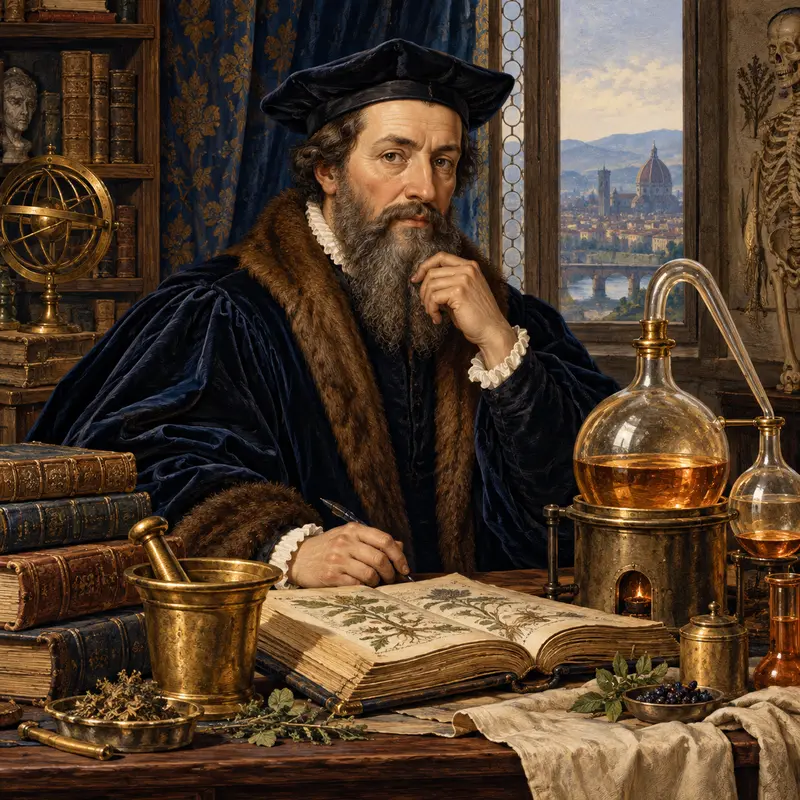
About the chemist
Paracelsus
1493-1541 · Switzerland
Iatrochemistry; medical chemistry