The discovery, explained · Chemist no. 232 of 350
Paracelsus and the Idea That the Dose Makes the Poison
Why can a tiny amount of arsenic act as a drug while a larger amount kills? Why is oxygen life-giving but hyperbaric oxygen can be harmful? The answer is dose, and the person who stated the principle most forcefully in Europe was Paracelsus, the 16th-century Swiss physician and alchemist. He argued that the purpose of alchemy was not to make gold but to prepare medicines. That shift, called iatrochemistry (from the Greek iatros, physician), moved chemistry into the pharmacy and laid the ground for modern pharmacology and toxicology. In this post we look at his ideas, what they got right, and what they got wrong.
The Scientific Problem Before the Discovery
Medicine in the early 1500s followed Galen and Avicenna. Disease was explained by an imbalance of the four humours (blood, phlegm, yellow bile, black bile), and treatment was mainly herbal, plus bleeding and purging. Mineral and metal substances were considered dangerous and were seldom used. At the same time, alchemists devoted themselves to transmutation of metals into gold, which had little benefit for patients. Physicians and alchemists belonged to different worlds, and neither could explain why the same substance might heal in one case and harm in another.
The Discovery: What Paracelsus Actually Proposed
Paracelsus (born Theophrastus von Hohenheim) taught that the body is a chemical system and that illness arises from specific chemical disturbances, not from a general humoural imbalance. His main ideas can be summarised in four steps.
Step 1: A new aim for alchemy
He wrote that the task of alchemy is to make medicines. Distillation, extraction and calcination were to be used to separate the active "essence" of a plant or mineral from the inert part. This is a clear ancestor of the idea of purifying an active ingredient.
Step 2: The tria prima
To the older sulfur-mercury theory of metals he added a third principle, salt. The three principles, salt, sulfur and mercury, were said to make up all bodies. Burning wood offered the example: the flame is sulfur (combustibility), the smoke is mercury (volatility) and the ash is salt (fixity). These are not the modern elements, but they were an attempt to link observable behaviour on heating with composition.
Step 3: Specific remedies from minerals
Paracelsus and his followers promoted the medical use of preparations of metals such as antimony, mercury and iron, and he is credited with using mercury compounds against syphilis, as well as with popularising laudanum, an opium preparation. The exact formula of his laudanum is not documented. These treatments were dangerous at high doses, which led to the next idea.
Step 4: The dose principle
In his defence of his methods, he wrote in German that all things are poison and nothing is without poison; only the dose makes a thing not a poison. In Latin form this is sola dosis facit venenum. This is the earliest influential statement of what we now call a dose-response relationship.
The Chemistry Behind It
Modern toxicology expresses Paracelsus' insight with numbers. The key terms are:
- LD₅₀: the dose that kills 50% of a test population, usually in mg per kg body weight. A lower LD₅₀ means a more toxic substance.
- NOAEL: the highest dose with no observed adverse effect.
- Therapeutic index: ratio of the toxic dose to the effective dose. A narrow index means the drug is dangerous to overdose.
- Hormesis: in some systems low doses stimulate and high doses inhibit. This is debated but is often linked to his idea.
An example in chemical terms is fluoride. At about 1 ppm in drinking water it strengthens enamel by forming fluorapatite: Ca₅(PO₄)₃OH + F⁻ → Ca₅(PO₄)₃F + OH⁻. At very high intake it causes skeletal fluorosis, a serious problem in parts of Rajasthan, Andhra Pradesh and other Indian regions where groundwater is high in fluoride. The same ion helps or harms depending on dose. Similarly, iron is essential for haemoglobin but excess iron is toxic, and sodium chloride is a nutrient yet dangerous in large amounts.
The tria prima, by contrast, did not survive. Burning wood actually produces CO₂, water vapour and mineral ash: C₆H₁₀O₅ + 6O₂ → 6CO₂ + 5H₂O. Lavoisier's work showed that combustion is a reaction with oxygen, not the release of a "sulfur" principle.
Applications Today
The dose-response idea underpins drug development, food safety limits, pesticide residue limits (for example the MRLs set by Indian regulators) and drinking water standards. Clinical trials begin with dose-finding. Chemotherapy uses compounds that are toxic to cells at higher doses, such as cisplatin, a platinum compound carefully dosed. Antimony and arsenic compounds survive in specific medicines; arsenic trioxide is used to treat acute promyelocytic leukaemia. In India, the Central Pollution Control Board and the Bureau of Indian Standards use the same logic when they set permissible limits for arsenic, lead and fluoride. The broader idea, that chemistry should serve medicine, led to the entire pharmaceutical industry.
Exam Corner
- Paracelsus is associated with iatrochemistry: using chemistry to prepare medicines.
- Tria prima = salt, sulfur, mercury (three principles). Do not confuse it with the Aristotelian four elements.
- "Sola dosis facit venenum": the dose makes the poison. Link it to LD₅₀ and therapeutic index in toxicology questions.
- Lower LD₅₀ means higher toxicity. A drug with a narrow therapeutic index needs careful monitoring.
- Fluoride is beneficial near 1 ppm in drinking water and harmful at high levels (above about 1.5 ppm in the WHO guideline value); this is a common dose-response example.
Common Misconceptions
- "Natural means safe." The principle applies equally to natural and synthetic substances.
- "Paracelsus invented modern chemistry." He changed its aims, but his explanations were mostly mystical. Quantitative chemistry came later.
- "A small dose of any poison is always harmless." Some substances, such as certain carcinogens or bioaccumulating toxins like lead and mercury, build up over time, so safe intake can be extremely low.
Quick Revision Box
- Paracelsus (1493–1541): Swiss physician-alchemist, founder figure of iatrochemistry.
- Aim of alchemy redefined: prepare medicines, not gold.
- Tria prima: salt, sulfur, mercury.
- Dose principle: sola dosis facit venenum.
- Modern measures: LD₅₀, NOAEL, therapeutic index.
- Combustion is oxidation, not release of "sulfur" (Lavoisier).
FAQ
What did Paracelsus mean by "the dose makes the poison"?
He meant that no substance is harmful or harmless by nature alone; the amount decides the effect. This is the basis of toxicology.
Was Paracelsus an alchemist or a chemist?
He was both a physician and an alchemist. His chemistry was practical and medical, but his explanations were still alchemical.
Did he discover zinc?
He is often credited with giving zinc its name and describing it as a distinct metal, but the metal was known in India much earlier, where zinc smelting at Zawar in Rajasthan is well documented. It is safer to say he helped introduce it to European writing.
Is the tria prima still used in chemistry?
No. It is a historical theory, replaced by Lavoisier's elements and then Dalton's atomic theory.
Published by ABC Chemistry — IIT-JAM | CSIR-NET | GATE Chemistry Coaching. Visit abcchemistry.com
About the chemist
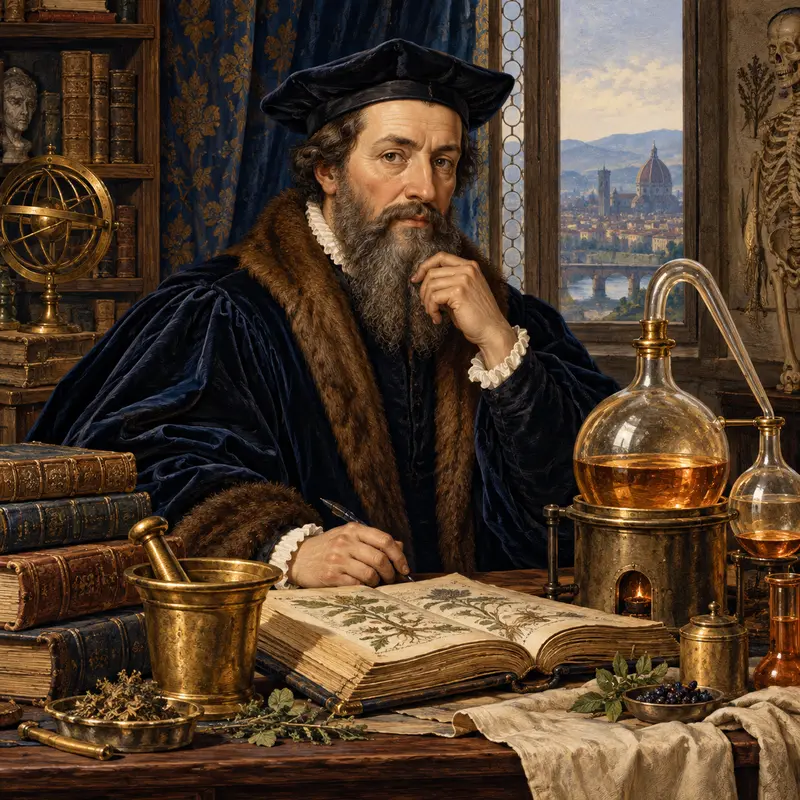
Paracelsus
1493-1541 · Switzerland
Iatrochemistry; medical chemistry