The discovery, explained · Chemist no. 86 of 350
Paul Crutzen and the Discovery That Nitrogen Oxides Destroy the Ozone Layer
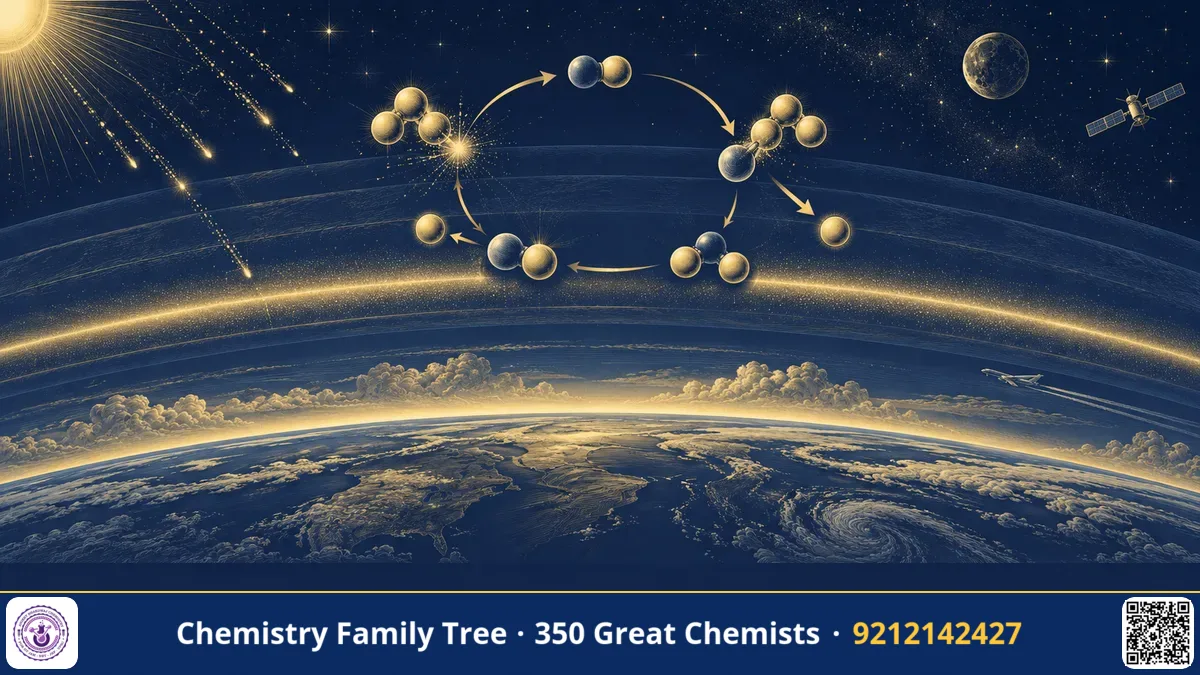
The ozone layer is a thin shield of O3 molecules, mostly 15 to 35 km above the Earth, that absorbs most of the harmful ultraviolet-B radiation from the Sun. If it were compressed to ordinary air pressure at sea level, it would be only about 3 mm thick. In 1970 a young Dutch scientist, Paul Crutzen, then working at Stockholm University, showed that the natural ozone layer is controlled by tiny amounts of nitrogen oxides, NO and NO2, acting as catalysts. His discovery explained why the Chapman theory of ozone was incomplete and opened the way to understanding how human activities, from supersonic aircraft to fertilisers, could change the ozone layer. For this, Crutzen shared the 1995 Nobel Prize in Chemistry with Mario Molina and F. Sherwood Rowland.
The Scientific Problem Before the Discovery
In 1930 the British scientist Sydney Chapman proposed a simple set of reactions for the formation and destruction of ozone in the stratosphere, now called the Chapman cycle:
1)  O2 + hν (λ less than 242 nm) → O + O
2)  O + O2 + M → O3 + M
3)  O3 + hν (λ about 200 to 320 nm) → O2 + O
4)  O + O3 → 2 O2
Reactions 1 and 2 produce ozone; reactions 3 and 4 remove it. Step 3 is not a net loss, because the oxygen atom produced quickly regenerates O3 by step 2. The real loss is step 4. M is a third body (N2 or O2) that carries away excess energy.
The problem was that when scientists put the measured rate constants into the Chapman model, it predicted too much ozone, about twice the amount measured in the real atmosphere. Something else was destroying ozone. Researchers suspected that hydrogen radicals (HOx) took part, but the numbers still did not match. Crutzen looked at a different family of molecules.
The Discovery / Experiment — Step by Step
Crutzen's work was a combination of laboratory kinetic data, measurements of trace gases and careful modelling. The logic can be followed in steps:
- Nitrous oxide at the surface. N2O is made by soil bacteria in nitrification and denitrification. It is very unreactive in the lower atmosphere, so it survives long enough to rise into the stratosphere.
- Conversion to NO. In the stratosphere a small fraction of N2O reacts with excited oxygen atoms:
N2O + O(¹D) → 2 NO. - Catalytic cycle. NO destroys ozone in a chain that regenerates NO:
NO + O3 → NO2 + O2
NO2 + O → NO + O2
-------------------------
Net:   O3 + O → 2 O2
Because NO is regenerated, one molecule can destroy thousands of ozone molecules before it is removed. This is why the effect is so large even when NOx is present in parts per billion. In 1970 Crutzen published the calculation, showing that when the NOx cycle is added to the Chapman scheme, the predicted ozone amount agrees with observation. He also proposed that anything that raises stratospheric NOx would reduce ozone.
The first warnings
In 1971 Crutzen, and independently Harold Johnston in the United States, pointed out that fleets of supersonic transport aircraft, flying in the stratosphere and emitting NO from their engines, could cause measurable ozone loss. This was an early example of atmospheric science affecting technology policy. Crutzen later studied the effect of nuclear war on the atmosphere (the "nuclear winter" idea, 1982, with John Birks) and the global impact of biomass burning. In 2000, with Eugene Stoermer, he popularised the term Anthropocene for a new geological age shaped by human activities.
The Chemistry Behind It
What makes a good catalyst in the atmosphere?
A catalytic cycle needs a species that reacts with O3, and a second step that regenerates the catalyst using O atoms. A general form is:
X + O3 → XO + O2
XO + O → X + O2
Net: O3 + O → 2 O2     (X = NO, Cl, Br, OH, H)
The same scheme with X = Cl was proposed in 1974 by Molina and Rowland for chlorofluorocarbons. So Crutzen's NOx cycle is the first member of a family of ozone-destroying catalytic cycles. The importance of each catalyst varies with altitude. Near 40 km, HOx and Clx matter; around 25 km, NOx is the main catalyst of natural ozone loss.
| Catalyst X | Main source | Notes |
|---|---|---|
| NO (NOx) | N2O from soils, aircraft, fertilisers | Crutzen, 1970 |
| Cl (Clx) | CFCs and other chlorine compounds | Molina and Rowland, 1974 |
| OH, H (HOx) | Water vapour and methane | Studied in the late 1960s and 1970s |
| Br (Brx) | Halons, methyl bromide | Very efficient per atom |
Applications Today
- Policy: the knowledge of catalytic cycles supported the Montreal Protocol (1987), which phased out ozone-depleting substances.
- Air quality: Crutzen showed that in the lower atmosphere (troposphere), NOx actually produces ozone in the presence of sunlight and hydrocarbons, which is the basis of photochemical smog in cities such as Delhi.
- Agriculture: N2O from fertilised soils is both a greenhouse gas and a source of stratospheric NOx, so nitrogen management matters for climate and ozone.
- Aviation and rockets: engine emissions in the stratosphere are assessed with models that include the NOx cycle.
- Climate science: the idea of the Anthropocene and discussion of geoengineering, such as stratospheric sulfate injection, are linked to Crutzen's later writings.
Exam Corner — 5 Likely Points
- Chapman cycle: O2 photolysis (below 242 nm), O + O2 + M → O3 + M, O3 photolysis, and O + O3 → 2O2.
- NOx cycle: NO + O3 → NO2 + O2; NO2 + O → NO + O2.
- Catalyst NO is not consumed; one NO can destroy many O3 molecules.
- Source of stratospheric NO: N2O + O(1D) → 2NO.
- Nobel Prize 1995: Crutzen, Molina, Rowland, for work on formation and decomposition of ozone.
Common Misconceptions
- "Ozone in the stratosphere and ozone near the ground are the same problem." Same molecule, opposite roles: stratospheric ozone protects, tropospheric ozone is a pollutant.
- "Only CFCs destroy ozone." Natural NOx and HOx cycles also remove ozone, and CFCs add to this loss.
- "The ozone hole is the same as global warming." They are different problems, although some gases (like CFCs and N2O) play a role in both.
Quick Revision Box
- Chapman (1930) overestimated stratospheric ozone.
- Crutzen (1970): NO and NO2 catalyse ozone destruction.
- Net: O3 + O → 2O2, with NO regenerated.
- Source of NO: N2O from soil microbes reacting with O(1D).
- Supersonic aircraft warning in 1971 by Crutzen and by Johnston.
- Nobel Prize in Chemistry 1995 shared with Molina and Rowland.
FAQ
Is the ozone layer made only of ozone?
No. It is a region of the stratosphere where ozone is relatively concentrated, but even there ozone is only a few parts per million of the air.
What is a Dobson unit?
One Dobson unit is the amount of ozone that would make a layer 0.01 mm thick at 0 °C and 1 atm. The global average is about 300 DU.
Why does a catalyst matter so much for ozone?
A catalyst is regenerated in each cycle, so a tiny amount of NO or Cl can destroy a very large number of ozone molecules.
Did Crutzen discover the ozone hole?
No. The Antarctic ozone hole was reported in 1985 by Farman, Gardiner and Shanklin. Crutzen's 1970 work gave part of the chemical background.
Published by ABC Chemistry — IIT-JAM | CSIR-NET | GATE Chemistry Coaching. Visit abcchemistry.com
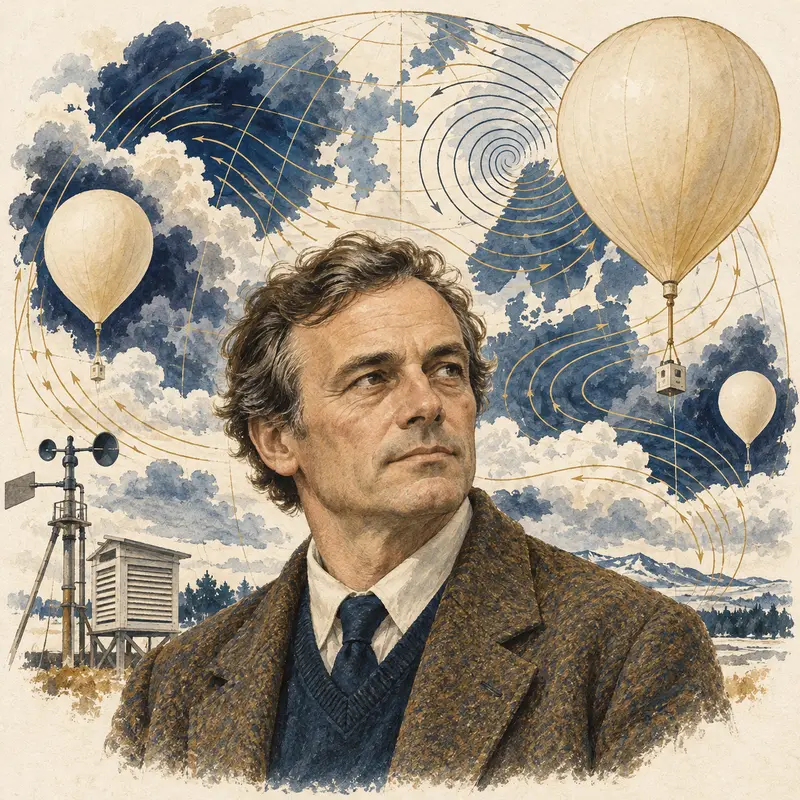
About the chemist
Paul Crutzen
1933-2021 · Netherlands · Nobel Chemistry 1995
Ozone chemistry; nitrogen oxides