Biography · Chemist no. 283 of 350
Paul Ehrlich (1854–1915): Dyes, Antibodies and the Dream of the Magic Bullet
Introduction
Paul Ehrlich was a German physician and scientist who looked at the coloured stains used by chemists and saw the future of medicine. He is the founder of chemotherapy, a pioneer of immunology and haematology, and the creator of Salvarsan, the first synthetic drug against syphilis. He shared the 1908 Nobel Prize in Physiology or Medicine. In one line: Ehrlich showed that chemicals could be designed to hit disease like a magic bullet.
Early Life & Family
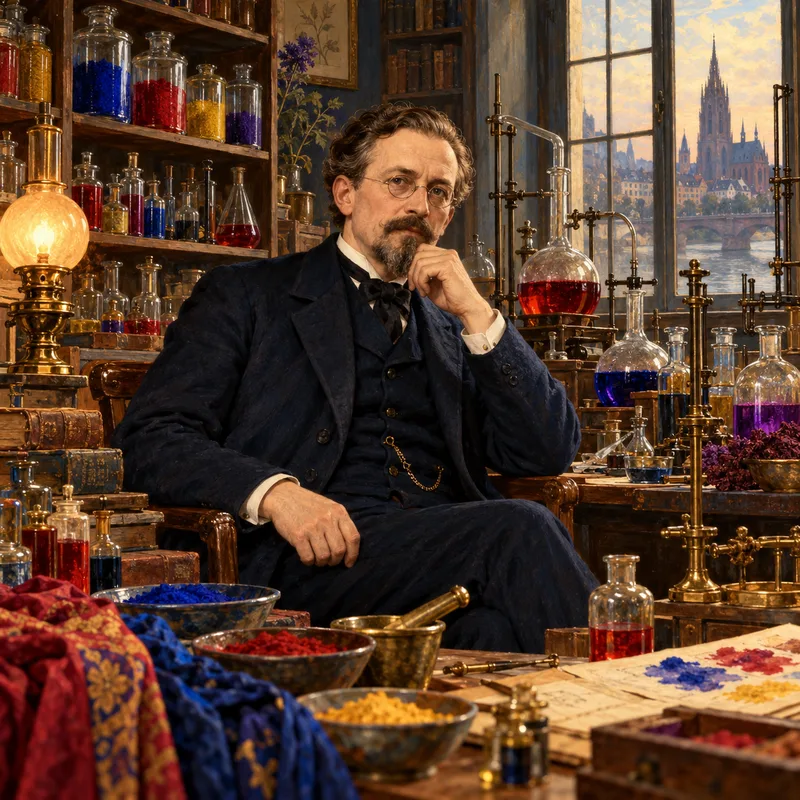
Paul Ehrlich was born on 14 March 1854 in Strehlen, Silesia, then in Prussia (now Strzelin in Poland). He came from a Jewish family; his father Ismar was a local innkeeper and lottery collector, and his cousin Carl Weigert, who was a pathologist and later a close supporter, introduced him to the technique of staining tissues. As a schoolboy he was fascinated by the idea of how a substance could colour a specimen, and this curiosity shaped his entire career. He kept this lifelong passion for colour and chemistry from his school days.
Education & Mentors
Ehrlich studied medicine at several universities, including Breslau, Strasbourg, Freiburg and Leipzig. In Strasbourg he worked under the anatomist Wilhelm von Waldeyer, who allowed him to spend hours experimenting with dyes. At Breslau, his cousin Carl Weigert influenced him strongly. He completed his medical degree at Leipzig in 1878 with a thesis on the theory and practice of histological staining. He then worked in Berlin at the Charité Hospital under Friedrich Theodor von Frerichs, and later under Robert Koch, whose work in bacteriology shaped his understanding of infectious disease.
Career Timeline
| Year | Event |
|---|---|
| 1854 | Born in Strehlen, Silesia |
| 1878 | Receives medical degree at Leipzig; begins work at Charité, Berlin |
| 1882 | Develops an improved staining method for the tuberculosis bacillus after Koch's discovery |
| 1885 | Publishes on the oxygen requirement of the organism |
| 1891 | Joins Koch's Institute for Infectious Diseases; tries methylene blue against malaria |
| 1896 | Becomes director of the Institute for Serum Research and Serum Testing near Berlin |
| 1897 | Proposes the side-chain theory of antibody formation |
| 1899 | Moves to Frankfurt as director of the Royal Institute for Experimental Therapy |
| 1908 | Shares the Nobel Prize in Physiology or Medicine with Élie Metchnikoff |
| 1909 | Compound 606 shown effective against syphilis with Sahachiro Hata |
| 1910 | Salvarsan released |
| 1915 | Dies on 20 August in Bad Homburg |
Major Scientific Contributions
- Staining and haematology: He distinguished types of white blood cells (such as eosinophils, basophils and neutrophils) by their staining properties, laying the foundation of modern blood cell classification.
- Standardisation of diphtheria antitoxin: He developed a method to measure the strength of serum so that doses were consistent and reliable, a major step in biological standardisation.
- Side-chain theory: a chemical picture of how cells bind toxins and produce antibodies, a precursor to receptor theory.
- Chemotherapy: the idea and practice of using synthetic chemicals against infectious agents. The word itself was introduced by him.
- Salvarsan and Neosalvarsan: organoarsenic drugs against syphilis.
- Blood-brain barrier hint: his experiments with injected dyes that failed to stain the brain hinted at a barrier between blood and brain tissue.
The chemistry behind these ideas is explained in our companion discovery post on Paul Ehrlich.
Awards, Honours & Nobel Prize
In 1908 Ehrlich shared the Nobel Prize in Physiology or Medicine with Élie Metchnikoff "in recognition of their work on immunity". He received many honours in Germany and abroad, and the Frankfurt institute he led was later renamed in his honour as the Paul Ehrlich Institute, today the German federal agency for vaccines and biomedicines. The Nobel Prize recognised immunology rather than Salvarsan, which came later.
Personality, Struggles & Lesser-Known Facts
- Messy genius. Colleagues described his laboratory and desk as famously crowded with papers, bottles and half-finished experiments.
- Passion for cigars and mineral water. He was a heavy cigar smoker and drank large amounts of mineral water, habits mentioned in several biographies.
- Infected in the laboratory. In the 1880s, he contracted tuberculosis while working with the bacillus, and he travelled to Egypt to recover in 1888–1889.
- Hata's role. The test of compound 606 that revealed its power was done in Ehrlich's institute by Sahachiro Hata, who deserves equal credit for the careful screening.
- Controversy over Salvarsan. The drug had toxic side effects, and Ehrlich faced criticism, including attacks in the press, during which he defended its use and sought to improve safety.
- Family fate. Ehrlich was of Jewish origin; he died in 1915, before the Nazi period, but his institute and family were later affected by it.
Legacy & Influence on Modern Chemistry
Ehrlich's thinking underlies every modern drug discovery programme. When a medicinal chemist makes a series of analogues and measures activity against a target, that is Ehrlich's method. When oncologists use an antibody to deliver a toxin to a tumour cell, that is the magic bullet. The receptor concept evolved into modern pharmacology, and the idea of selective toxicity guides antibiotic and antiviral design. The Paul Ehrlich Institute in Germany remains an important regulator, and the Paul Ehrlich and Ludwig Darmstaedter Prize is a major award in biomedical science.
Lessons for Students
- Observe patterns in everyday tools, like dyes, because they can reveal deeper principles.
- Systematic testing beats luck: hundreds of compounds were screened before 606.
- Share credit. Ehrlich worked with chemists and bacteriologists and relied on each.
- Be ready to improve a product after criticism, as Neosalvarsan shows.
- Cross the boundaries of fields: Ehrlich used chemistry for medicine, and medicine for chemistry.
Quick Facts Box
- Born: 14 March 1854, Strehlen, Silesia (Prussia)
- Died: 20 August 1915, Bad Homburg, Germany
- Nationality: German
- Field: Medicine, immunology, medicinal chemistry
- Famous for: Magic bullet concept, Salvarsan, side-chain theory
- Nobel: Physiology or Medicine 1908 (shared with Metchnikoff)
FAQ
Did Paul Ehrlich win a Nobel Prize in Chemistry?
No. He won the 1908 Nobel Prize in Physiology or Medicine, shared with Élie Metchnikoff, for work on immunity.
What is Salvarsan?
It is an organoarsenic drug, arsphenamine, developed by Ehrlich and Sahachiro Hata and used from 1910 to treat syphilis.
What is the side-chain theory?
It proposed that cells carry chemical side chains (receptors) that bind specific toxins or nutrients, and that overproduction of these side chains forms antibodies.
Why is he called the father of chemotherapy?
Because he introduced the idea of using synthetic chemicals to kill microbes selectively and showed it could work in practice.
Published by ABC Chemistry — IIT-JAM | CSIR-NET | GATE Chemistry Coaching. Visit abcchemistry.com
About the chemist
Paul Ehrlich
1854-1915 · Germany · Nobel Physiology/Medicine 1908
Chemotherapy; Salvarsan; side-chain theory