The discovery, explained · Chemist no. 283 of 350
Paul Ehrlich: The Magic Bullet and the Birth of Chemotherapy
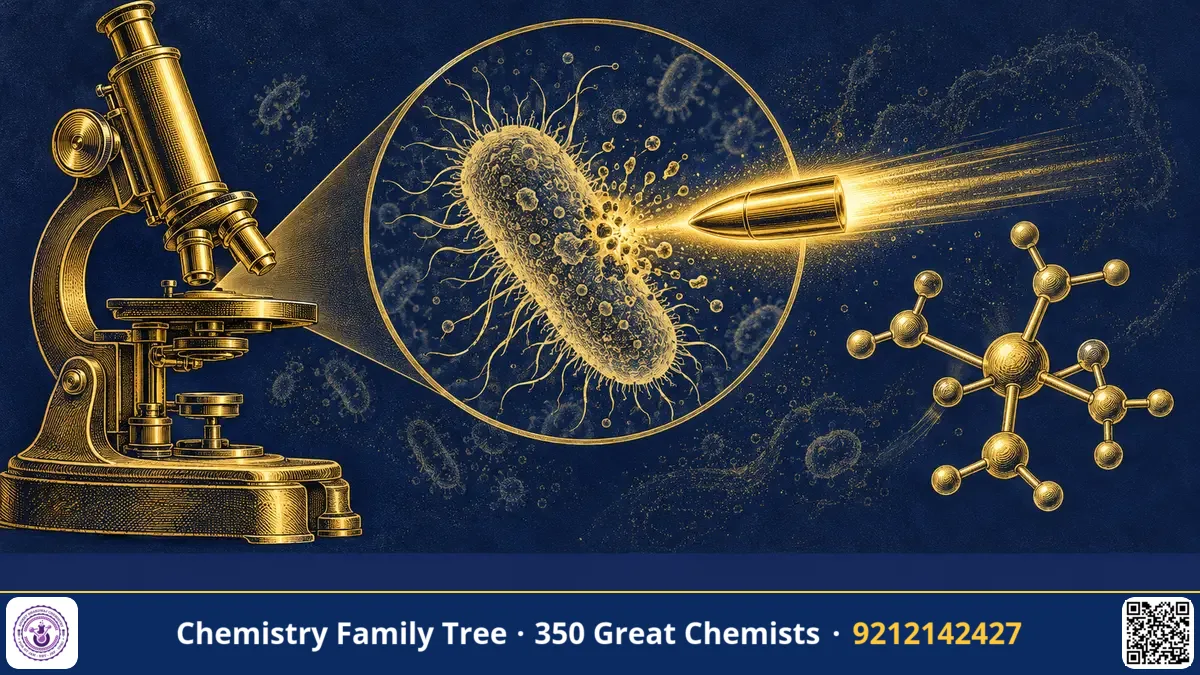
In 1909, a laboratory in Frankfurt tested a compound numbered 606 on rabbits infected with the spirochaete that causes syphilis. It worked. Marketed as Salvarsan, it became the first modern synthetic drug designed to attack a specific microbe. Behind it stood Paul Ehrlich, a German physician and chemist who dreamed of a "magic bullet" (Zauberkugel): a chemical that would seek out and kill disease-causing organisms without harming the patient. His ideas about cell receptors, selective toxicity and structure–activity relationships are the roots of medicinal chemistry and drug design. For Indian students, this is the story of how chemistry became medicine.
The Scientific Problem Before the Discovery
In the 1890s, doctors had few effective drugs against infectious diseases. Quinine worked against malaria, mercury was used (with heavy toxicity) against syphilis, and vaccines and antitoxins were being developed. Emil von Behring had shown that antitoxin serum could treat diphtheria, but no one knew how antibodies and toxins interact. And there was no rational way to find chemical drugs against bacteria and protozoa: all drug discovery was trial and error.
Ehrlich noticed something while staining tissues. Certain dyes stuck to particular cells and not to others. Methylene blue, for example, stained nerve endings. If dyes could choose their targets, he reasoned, perhaps a toxic chemical could also be directed to a parasite without hurting the host.
The Discovery / Experiment
Step 1: Selective staining. Ehrlich used synthetic dyes to stain bacteria, blood cells and tissues. He observed selective binding and proposed that chemical groups on cells ("side chains" or receptors) bind specific molecules.
Step 2: Dye as drug. He tried methylene blue against malaria in 1891, one of the first uses of a synthetic dye as a drug in humans. He then tested the dye trypan red against trypanosomes (sleeping-sickness parasites) in mice.
Step 3: Organo-arsenic compounds. Atoxyl, an arsenic compound, was known to affect trypanosomes but caused blindness. Ehrlich and chemist Alfred Bertheim worked out its correct structure (an arsanilic acid, not an anilide as first believed), and this knowledge allowed them to modify the molecule systematically.
Step 4: Systematic screening. Ehrlich's team, including the Japanese bacteriologist Sahachiro Hata, prepared and tested hundreds of arsenic derivatives. Compound number 606, arsphenamine, was found by Hata in 1909 to cure syphilis in infected rabbits. It was released in 1910 as Salvarsan.
Arsphenamine (Salvarsan): 3,3'-diamino-4,4'-dihydroxyarsenobenzene
Early structure drawn as  HO–C₆H₃(NH₂)–As=As–C₆H₃(NH₂)–OH  (as the dihydrochloride)
Later studies suggested that the real species in solid and solution are cyclic oligomers (rings of three to five arsenic atoms), a correction made in the twenty-first century by mass spectrometry. The drug is converted in the body to an active arsenoxide.
The Chemistry Behind It
Side-chain (receptor) theory. Ehrlich proposed that cells possess side chains that bind nutrients, toxins or drugs, like a lock and key (an idea that echoes Emil Fischer's enzyme lock-and-key model). When a toxin binds, the cell produces more side chains, which are released into the blood as antibodies. This was an early picture of the immune response and of receptors, now central to pharmacology.
Selective toxicity. A good chemotherapeutic agent must have a high therapeutic index:
Therapeutic index = maximum tolerated dose / minimum curative dose
Ehrlich spoke of the "chemotherapeutic index" and aimed for drugs where the curative dose is far below the toxic dose.
Structure–activity relationships. By changing groups on the arsenic compound, such as replacing –OH and –NH₂, or changing oxidation state of arsenic (As(V) in atoxyl versus As(III) in the active form), Ehrlich showed that biological effect depends on molecular structure. As(III) compounds bind thiol (–SH) groups in parasite enzymes, blocking them. This is the same reason arsenic is poisonous, which is why dosing and selectivity mattered.
Salvarsan was soon replaced by Neosalvarsan (1912), more soluble and easier to use, and later by penicillin in the 1940s.
Applications Today
- Drug discovery: Systematic screening of many analogues, the Ehrlich method, is the basis of modern pharmaceutical research.
- Targeted therapy: The magic bullet is now realised in monoclonal antibodies, antibody–drug conjugates and kinase inhibitors for cancer, such as imatinib.
- Antibiotics and antimicrobials: Sulpha drugs, developed from the dye prontosil in the 1930s, followed Ehrlich's philosophy.
- Staining techniques: Ehrlich developed methods used in haematology, including differentiating blood cells; stains for tuberculosis bacilli were improved on his work.
- Arsenic in medicine: Arsenic trioxide is used today to treat acute promyelocytic leukaemia, a reminder that carefully dosed arsenic compounds remain valuable.
Exam Corner
- Salvarsan = arsphenamine = compound 606, an organoarsenic drug for syphilis (1909–1910).
- Ehrlich coined "magic bullet" and is the founder of chemotherapy.
- Side-chain theory: cell receptors bind toxins and drugs; precursor of antibody and receptor theory.
- Therapeutic index: ratio of toxic dose to effective dose, higher is safer.
- Arsenic(III) acts by binding –SH groups of enzymes.
Common Misconceptions
- "Salvarsan was discovered by accident." It came from years of systematic synthesis and testing of hundreds of compounds.
- "Salvarsan is a simple As=As compound." Modern analysis shows it exists mainly as cyclic oligomers, though the As=As drawing is common in textbooks.
- "Ehrlich discovered penicillin." No. Penicillin came later from Fleming, Florey and Chain; Ehrlich is the father of the concept of chemotherapy.
Quick Revision Box
- Salvarsan (606) was the first synthetic antimicrobial drug.
- Discovered with Sahachiro Hata; introduced in 1910.
- Magic bullet = selective toxicity.
- Side-chain theory: receptors on cells.
- Neosalvarsan (914) followed in 1912.
- Nobel Prize in Physiology or Medicine 1908 (shared with Metchnikoff) for immunity work.
FAQ
What is a magic bullet in medicine?
A magic bullet is a drug that attacks only the disease-causing organism or cell without damaging healthy tissue, an ideal that Ehrlich proposed and that targeted therapies pursue today.
Why was Salvarsan called 606?
It was the 606th compound in the arsenic series prepared and tested by Ehrlich's group.
What is Salvarsan used to treat?
Syphilis, caused by the bacterium Treponema pallidum, until penicillin replaced it.
Is Paul Ehrlich a chemist or a doctor?
He trained as a physician, but his work was chemical in spirit, using dyes and synthetic compounds, so he is claimed by both medicine and chemistry.
Published by ABC Chemistry — IIT-JAM | CSIR-NET | GATE Chemistry Coaching. Visit abcchemistry.com
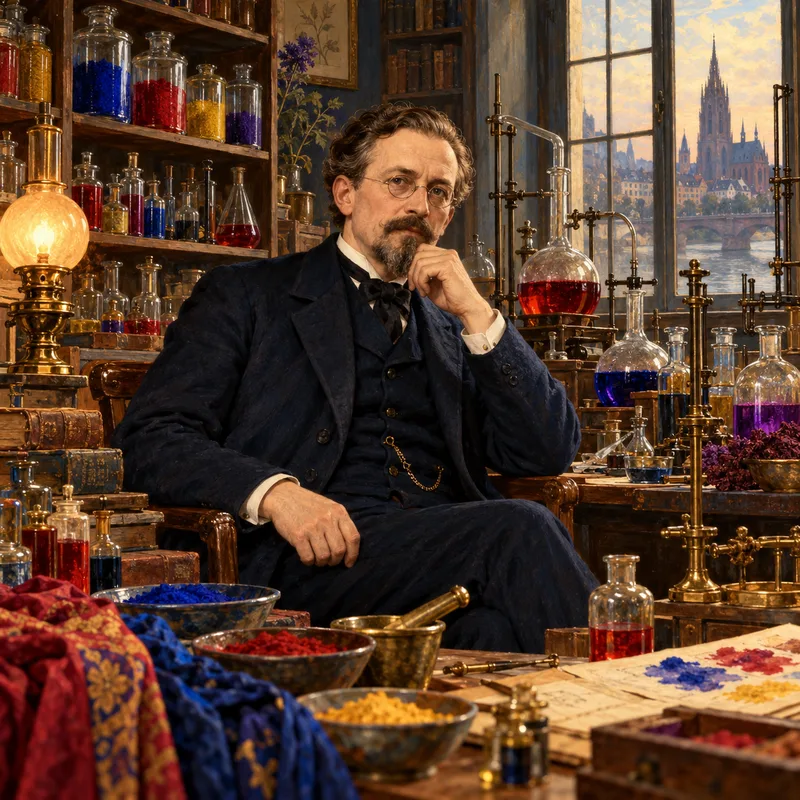
About the chemist
Paul Ehrlich
1854-1915 · Germany · Nobel Physiology/Medicine 1908
Chemotherapy; Salvarsan; side-chain theory