Biography · Chemist no. 115 of 350
Paul Karrer: The Swiss Chemist Who Decoded Vitamins and Plant Pigments
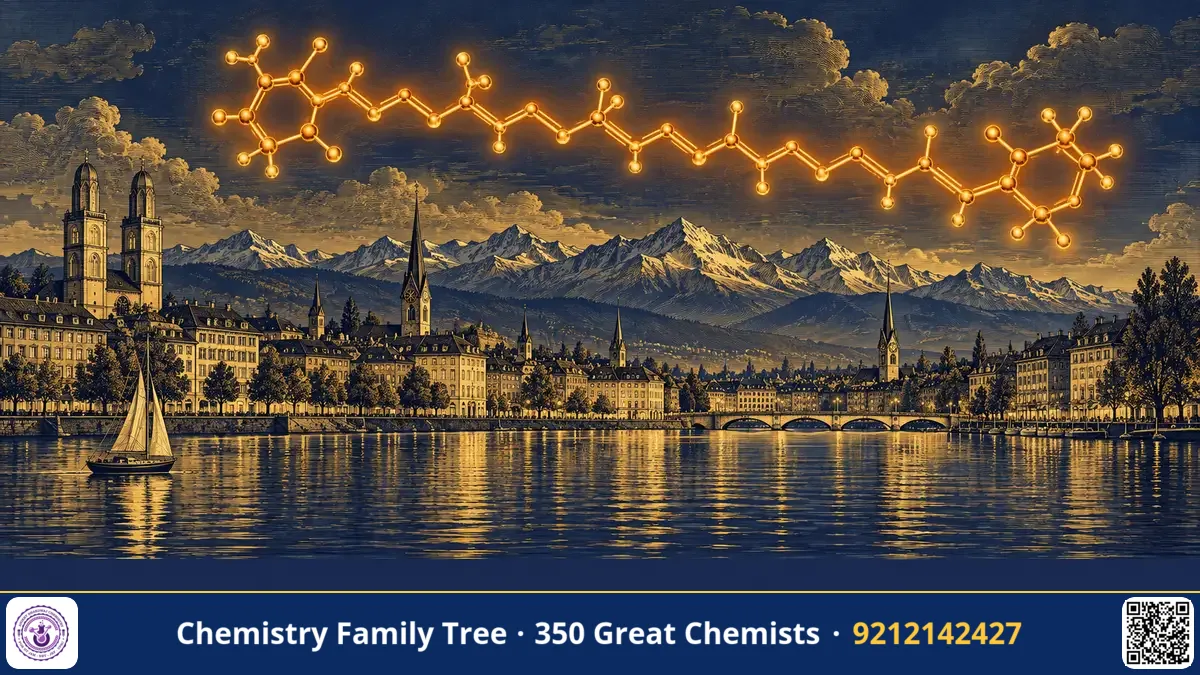
Paul Karrer (1889-1971) was a Swiss organic chemist who spent almost his entire career at the University of Zürich. He worked out the structures of beta-carotene, vitamin A, riboflavin (vitamin B₂) and several other vitamins, and wrote one of the most widely used organic chemistry textbooks of his time. In 1937 he shared the Nobel Prize in Chemistry with Norman Haworth. His legacy is the proof that the colourful pigments of plants and the vitamins of our food can be understood as molecules with exact structures.
Early Life & Family
Paul Karrer was born on 21 April 1889 in Moscow, where his Swiss parents were living at the time. His father was a dentist. When Paul was still a small child, around three years old, the family returned to Switzerland and settled in the canton of Aargau, in the small town of Wildegg. He grew up as a Swiss citizen and received his school education there, finishing at the cantonal school in Aarau.
As a boy he was interested in nature and in the sciences. The Swiss school system of the time offered strong training in the natural sciences, and this helped him to move toward chemistry. Later in life he married Helena Frölich, and the couple had three sons. Karrer was known as a private, disciplined person with a strong sense of duty.
Education & Mentors
Karrer studied chemistry at the University of Zürich, where he came under the influence of Alfred Werner, the founder of coordination chemistry and Nobel laureate of 1913. Werner supervised his doctoral work, which was on organic arsenic compounds, and he received his doctorate in 1911. Although Karrer later moved to organic natural products, Werner's emphasis on clear structural thinking stayed with him.
After his doctorate Karrer went to Frankfurt am Main and worked at the Georg-Speyer-Haus, a research institute for chemotherapy led by Paul Ehrlich, famous for arsenic drugs such as Salvarsan against syphilis. Here he learned about medicinal chemistry and the idea that a carefully designed molecule could act in a living body. He worked there until 1918, when he returned to Zürich.
Career Timeline
| Year | Event |
|---|---|
| 1889 | Born in Moscow to Swiss parents |
| 1911 | Doctorate at Zürich under Alfred Werner |
| 1911-1918 | Research at the Georg-Speyer-Haus, Frankfurt, with Paul Ehrlich's institute |
| 1918 | Appointed professor of chemistry at the University of Zürich |
| 1919 | Succeeds Alfred Werner as director of the Chemical Institute |
| 1928 | Publishes his textbook of organic chemistry (Lehrbuch der organischen Chemie) |
| 1930 | Establishes the structure of beta-carotene |
| 1931 | Gives the structure of vitamin A |
| 1935 | Synthesises riboflavin (vitamin B₂) |
| 1937 | Nobel Prize in Chemistry, shared with Norman Haworth |
| 1938 | Completes synthesis of vitamin E (tocopherol) |
| 1959 | Retires from the chair of chemistry |
| 1971 | Dies in Zürich |
Major Scientific Contributions
Karrer's best-known achievement is the structure of beta-carotene and its link to vitamin A. He showed that beta-carotene has eight isoprene units, eleven conjugated double bonds and two β-ionone rings, and that vitamin A is formed from it by splitting at the centre. This is covered in detail in our discovery post on carotenoids and vitamin A.
His other contributions include:
- Riboflavin. Structure and synthesis of vitamin B₂, an important part of the flavin coenzymes.
- Vitamin E and K. Structure and synthesis of tocopherol, and structural work on vitamin K₁.
- Coenzymes. Structural work on nicotinamide-containing coenzymes, which carry hydride in biological redox reactions.
- Plant pigments. Studies of anthocyanins (flower and fruit colours) and flavones.
- Cellulose and starch chemistry, and alkaloids. Wider work on natural products across more than 1000 scientific papers.
Awards, Honours & Nobel Prize
Karrer received the Nobel Prize in Chemistry for 1937 "for his investigations on carotenoids, flavins and vitamins A and B₂". He shared it with Norman Haworth, who was honoured for carbohydrates and vitamin C. He received many other honours in his career, including honorary doctorates from several universities and membership in scientific academies, and he was a Foreign Member of the Royal Society. He was also awarded the Marcel Benoist Prize in Switzerland. Many chemistry buildings and lectures in Zürich honour his period at the university.
Personality, Struggles & Lesser-Known Facts
- Born in Russia, Swiss at heart. Although born in Moscow, he left as a small child and always considered himself Swiss.
- Heir to Werner. He took over the Zürich chemical institute at only 30 years of age after the illness of Alfred Werner, a very large responsibility for a young professor.
- Friendly rivalry with Kuhn. His work on riboflavin and vitamin A ran in parallel with that of Richard Kuhn in Heidelberg. Both men won Nobel Prizes, and their competition pushed the speed of vitamin chemistry.
- Textbook author. His organic chemistry textbook went through many editions and was translated into several languages, which taught structural organic chemistry to generations of students.
- Productive team leader. He trained a large number of doctoral students, and his laboratory was known for its output of papers on natural products.
Legacy & Influence on Modern Chemistry
Karrer showed that vitamins are not mysterious "life forces" but well-defined organic molecules. This opened the way to large-scale chemical production of vitamins, which has helped to prevent deficiency diseases around the world. His work on carotenoids also supports modern studies of the visual cycle, antioxidants, food colouring and polyene spectroscopy. The retinoid drugs used today for skin disease and some cancers come from the line of research that started with vitamin A structure. In Indian exam syllabi, his name appears with polyenes, isoprene rule, vitamins and coenzymes.
Lessons for Students
- Good teachers shape careers. Werner and Ehrlich both left a mark on Karrer's thinking.
- Combine methods. He used degradation, synthesis and adsorption chromatography together.
- Choose problems with real meaning. The structure of vitamins connects pure chemistry to human health.
- Write clearly. A good textbook can spread an idea further than a research paper.
Quick Facts Box
- Born: 21 April 1889, Moscow, Russian Empire
- Died: 18 June 1971, Zürich, Switzerland
- Nationality: Swiss
- Field: Organic chemistry, natural products, vitamins
- Famous for: Structures of beta-carotene, vitamin A and riboflavin; synthesis of vitamin E
- Nobel: Chemistry, 1937 (shared with Norman Haworth)
FAQ
Who was Paul Karrer's teacher?
Alfred Werner, the founder of coordination chemistry, supervised his doctoral work at Zürich.
For what did Karrer win the Nobel Prize?
For his investigations on carotenoids, flavins and vitamins A and B₂, in the Chemistry prize of 1937.
Where did Karrer work?
Mostly at the University of Zürich, where he was professor from 1918 and head of the chemical institute from 1919 until his retirement in 1959.
How is Karrer connected to Indian exams?
Questions on vitamins, polyene colour, isoprene rule, retinal and the visual cycle use the structures that Karrer worked out.
Published by ABC Chemistry — IIT-JAM | CSIR-NET | GATE Chemistry Coaching. Visit abcchemistry.com
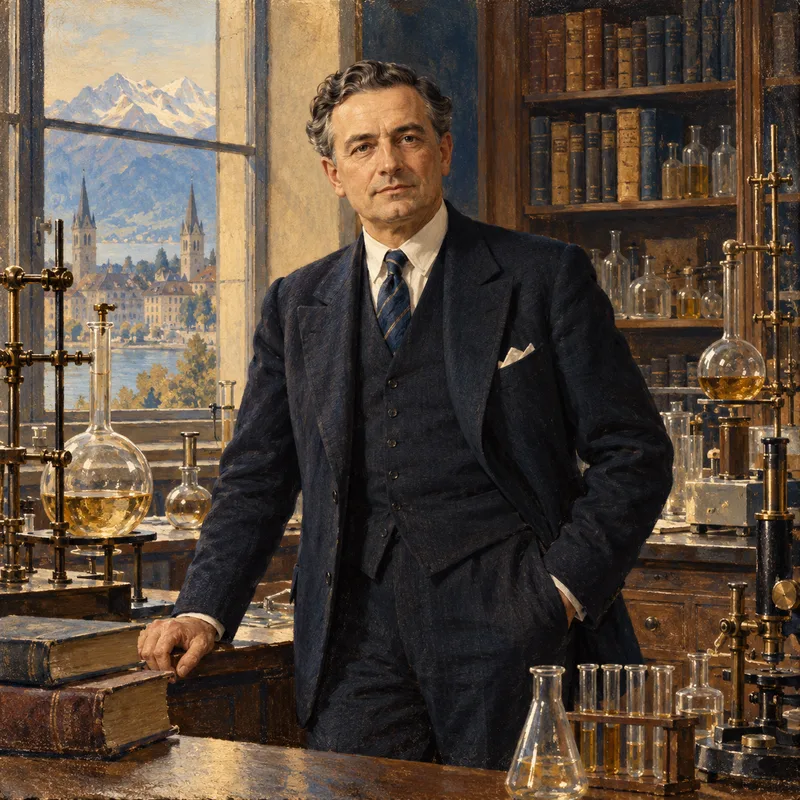
About the chemist
Paul Karrer
1889-1971 · Switzerland · Nobel Chemistry 1937
Carotenoids and vitamins A, B2