The discovery, explained · Chemist no. 115 of 350
Paul Karrer and the Chemistry of Carotenoids: How Carrots Became Vitamin A
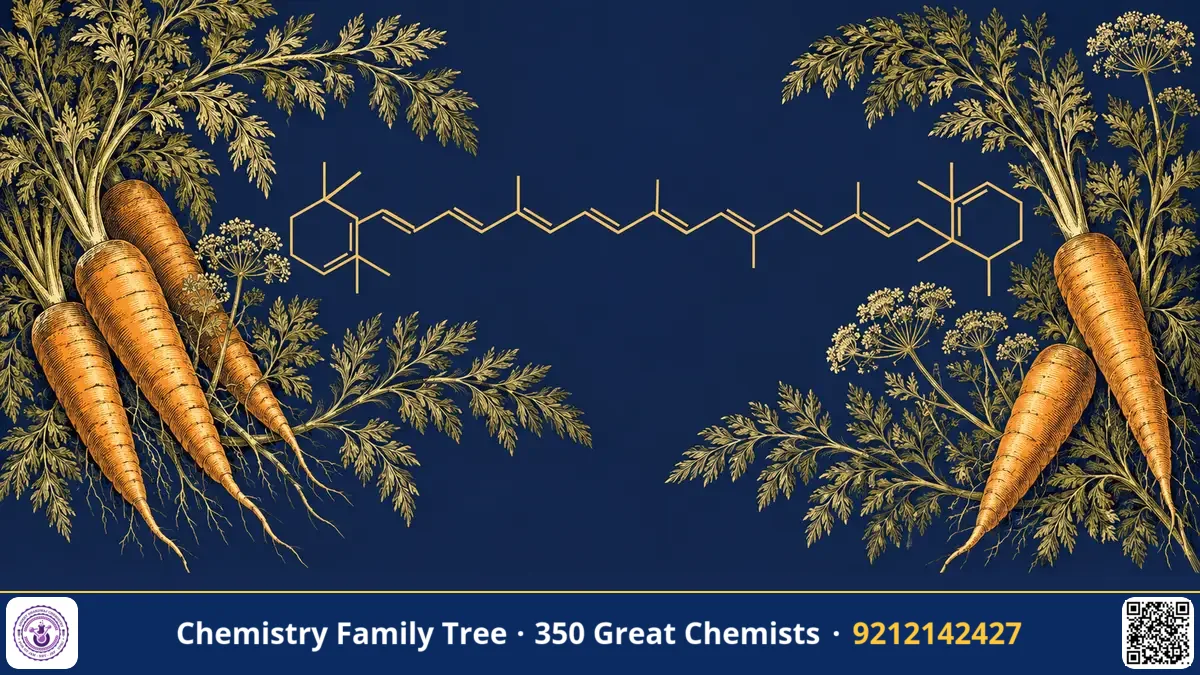
Why are carrots orange, and why do doctors tell children with night blindness to eat them? The answer to both questions was found in the Zürich laboratory of Paul Karrer. In 1930 he worked out the structure of beta-carotene, the orange pigment of carrots, and in 1931 he showed that it is closely related to vitamin A. He later worked on riboflavin (vitamin B₂), vitamin E, vitamin K and other natural products. For his work on carotenoids, flavins and vitamins A and B₂ he shared the Nobel Prize in Chemistry in 1937 with Norman Haworth. His story shows how structure determination in organic chemistry links directly to nutrition and medicine.
The Scientific Problem Before the Discovery
By the 1920s nutrition scientists knew that diets lacking certain "accessory factors" caused disease. A fat-soluble factor was needed for growth and for healthy eyes, and was called vitamin A. Yellow and orange plant pigments, called carotenoids, were known to follow the same distribution in food and to cure the deficiency in animals. Richard Willstätter had shown that carotene has the formula C₄₀H₅₆, and the Russian botanist Tswett had separated plant pigments by adsorption. But nobody knew how the 40 carbon atoms and 56 hydrogen atoms were arranged.
- Carotene took up eleven molecules of hydrogen in catalytic hydrogenation, so it had many double bonds.
- It was a deep orange solid, unstable to air and light, and very hard to crystallise and purify.
- The relation between plant pigment and animal vitamin was only a guess.
The degrees of unsaturation give a clue. C₄₀H₅₆ would be C₄₀H₈₂ if fully saturated and acyclic. The difference of 26 hydrogens means 13 degrees of unsaturation. Eleven are double bonds, and two are rings, one at each end of the molecule.
The Discovery: Step by Step
Karrer used classical degradation, which was the main tool before modern spectroscopy. The steps for beta-carotene can be summarised as follows.
- Purify. Carotene was extracted from carrots and purified by chromatographic adsorption, a method that Tswett had introduced and that Kuhn and Karrer used with great success.
- Hydrogenate. Full hydrogenation gave perhydro-carotene, C₄₀H₇₈. Since an acyclic C₄₀ alkane would have two more hydrogens than this (C₄₀H₈₂), the molecule must contain two rings.
- Oxidise with chromic acid. Karrer found acetic acid, and other fragments including geronic acid and a ketone from the ring end. Cleavage products told him that the ends contain a trimethylcyclohexene ring (the β-ionone ring).
- Spot the isoprene pattern. The carbon skeleton could be divided into eight isoprene units, five carbons each, joined head to tail in the centre and tail to tail at the middle, which matches the pattern of biosynthesis from isoprenoid precursors.
- Write the structure. The final answer was a symmetrical chain of eleven conjugated C=C bonds ending in two β-ionone rings.
In 1931 Karrer also gave the structure of vitamin A (now called retinol), C₂₀H₃₀O. It is half of beta-carotene with an extra water: one β-ionone ring, a conjugated chain of four double bonds, and a terminal primary alcohol, –CH₂OH. This fits with what nutrition studies had seen. The animal body splits beta-carotene in the middle of the central double bond.
β-carotene (C₄₀H₅₆)  +  O₂  →  2 retinal (C₂₀H₂₈O)   [central cleavage]
retinal  +  2[H]  →  retinol (vitamin A, C₂₀H₃₀O)
retinal (all-trans)  ⇌  11-cis-retinal  (visual cycle)
Riboflavin and other vitamins
In the 1930s Karrer's laboratory also determined and synthesised riboflavin (vitamin B₂), a yellow-green fluorescent pigment made of an isoalloxazine ring joined to the sugar alcohol ribitol. His synthesis was published at about the same time as Richard Kuhn's, and the two chemists competed strongly. Karrer further worked on vitamin E (tocopherol), where he completed a synthesis in 1938, on vitamin K₁, and on the structure of the coenzymes NAD and NADP, which contain nicotinamide.
The Chemistry Behind It
Conjugation and colour. The long alternating pattern C=C–C=C–C=C… in carotenoids is called a conjugated polyene. The π electrons are spread over the whole chain, so the energy gap between the highest occupied and lowest empty π orbitals is small. Beta-carotene therefore absorbs blue light, near 450 nm (with bands at about 425, 450 and 480 nm), and appears orange. As conjugation length increases the absorption moves to longer wavelength. Ethene absorbs in the far UV, butadiene at 217 nm, and a chain of eleven double bonds in the visible region.
Isoprene rule. Carotenoids are tetraterpenes made from eight isoprene (C₅H₈) units. Retinol is a diterpene derivative. This fits the isoprene rule that Ružička later stated in full.
Visual cycle. In the retina, 11-cis-retinal is bound to the protein opsin through a protonated imine (Schiff base) with a lysine residue to form rhodopsin. Light isomerises 11-cis to all-trans, which starts the nerve signal. Without vitamin A the pigment cannot be replaced, which leads to night blindness (nyctalopia).
Riboflavin. It is the precursor of FMN and FAD, coenzymes in redox enzymes. The isoalloxazine ring accepts two electrons and two protons, going from the yellow oxidised form to the colourless FADH₂.
Applications Today
- Nutrition and health. Vitamin A deficiency remains a public health problem in South Asia, and India runs a national vitamin A supplementation programme for young children. Beta-carotene-rich foods include carrot, papaya, mango and spinach.
- Food industry. Beta-carotene (E160a) is used as a natural colouring in butter, margarine, juices and sweets.
- Supplements and feed. Synthetic vitamin A acetate and riboflavin are made at industrial scale for fortified foods and animal feed.
- Medicine. Retinoids, derived from vitamin A, are used in dermatology for acne and skin ageing.
- Antioxidant research. Carotenoids quench singlet oxygen, a property studied in photochemistry and biochemistry.
Exam Corner
- Beta-carotene: C₄₀H₅₆, tetraterpene, 11 conjugated C=C and two β-ionone rings; it gives two molecules of retinol on central cleavage.
- Retinol (vitamin A): C₂₀H₃₀O, primary alcohol; retinal is the aldehyde; retinoic acid is the acid.
- 11-cis-retinal binds opsin through a protonated Schiff base (lysine) to form rhodopsin.
- Riboflavin = isoalloxazine + ribitol; forms the cofactors FMN and FAD.
- Longer conjugation gives a bathochromic shift (red shift) in the UV-visible spectrum, an idea tested in JAM and GATE spectroscopy questions.
Common Misconceptions
- "Carrots give vitamin A directly." They give provitamin A (beta-carotene), which the body converts to vitamin A. Very large intakes do not give unlimited vitamin A.
- "All carotenoids are vitamin A precursors." Only those with at least one unsubstituted β-ionone ring, such as alpha- and beta-carotene, can be converted. Lycopene, the red pigment of tomato, cannot.
- "Karrer discovered vitamin A." The existence of a fat-soluble growth factor was recognised earlier. Karrer established its chemical structure.
Quick Revision Box
- Karrer: Nobel Prize in Chemistry, 1937 (shared with Haworth).
- Beta-carotene = C₄₀H₅₆, structure fixed in 1930.
- Vitamin A = retinol C₂₀H₃₀O, structure given 1931.
- Colour arises from conjugated polyene chain absorbing near 450 nm.
- Riboflavin (B₂) is a part of FMN and FAD.
- Deficiency of vitamin A: night blindness; of B₂: cracked lips and sore tongue.
FAQ
Why is beta-carotene orange?
Its long conjugated chain absorbs blue-green light around 450 nm, so the light we see reflected is orange.
What is the difference between retinol and retinal?
Retinol has a primary alcohol group, –CH₂OH, and retinal has an aldehyde group, –CHO. They interconvert by oxidation and reduction in the body.
How many isoprene units are in beta-carotene?
Eight. Eight units of five carbons give the 40 carbons of a tetraterpene.
Was Karrer's Nobel Prize in Medicine?
No. It was the Nobel Prize in Chemistry, shared with Norman Haworth. The 1937 Medicine prize went to Albert Szent-Györgyi.
Published by ABC Chemistry — IIT-JAM | CSIR-NET | GATE Chemistry Coaching. Visit abcchemistry.com
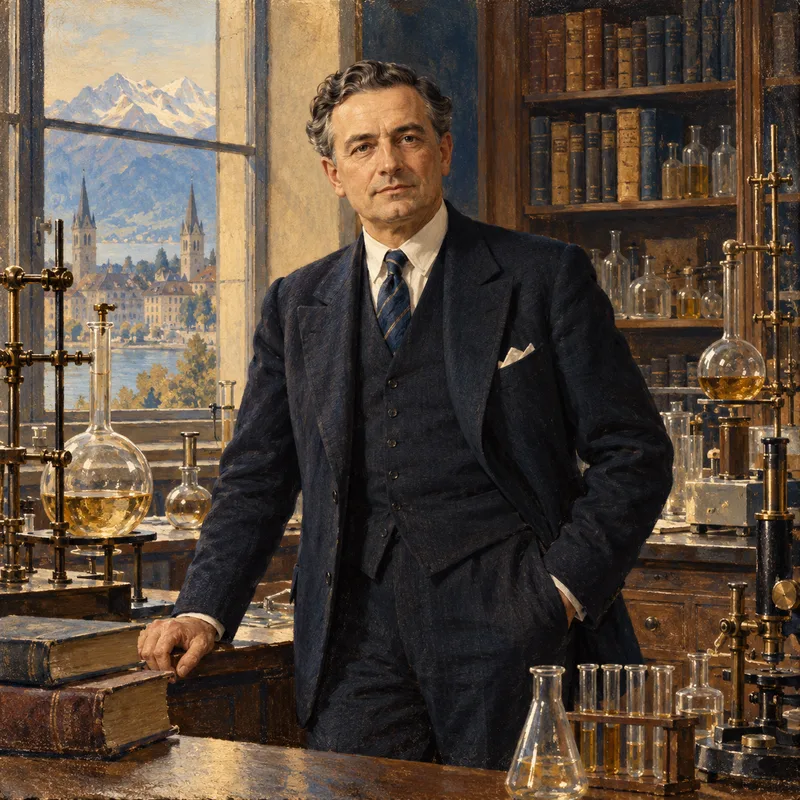
About the chemist
Paul Karrer
1889-1971 · Switzerland · Nobel Chemistry 1937
Carotenoids and vitamins A, B2