Biography · Chemist no. 27 of 350
Paul Sabatier: The Life and Legacy of the Catalysis Pioneer
Introduction
Paul Sabatier (1854-1941) was a French chemist who spent almost his entire working life in Toulouse. He taught generations of students, led his university for many years, and gave chemistry one of its most useful tools: catalytic hydrogenation over finely divided metals. In 1912 he received the Nobel Prize in Chemistry. His legacy in one line: he showed that a pinch of metal powder can make hydrogen react with almost any unsaturated organic compound. For students preparing for IIT-JAM, CSIR-NET and GATE, his name is linked with catalysis, hydrogenation and the Sabatier reaction (CO₂ + 4H₂ → CH₄ + 2H₂O).
Early Life and Family
Paul Sabatier was born on 5 November 1854 in Carcassonne, a historic walled town in the south of France. He grew up in the Occitan region, far from the Parisian centres of science. Carcassonne is known for its medieval fortifications, and the surroundings of Languedoc shaped the quiet, steady character that colleagues later described in him. His family was of modest background, and from an early age he showed ability in mathematics and the sciences. Like many bright students of the period, he was able to rise through the French public education system, which rewarded merit through competitive examinations.
Education and Mentors
Sabatier studied at the Lycée in Carcassonne and then at the Lycée in Toulouse, where he prepared for the entrance examination to the elite Ecole Normale Supérieure in Paris. He entered the ENS in 1874 and later passed the agrégation in physical sciences, a demanding national teaching qualification. In Paris he worked in the laboratory of the great chemist Marcellin Berthelot at the Collège de France. Berthelot was a famous organic and thermochemist, and under his guidance Sabatier completed research on metallic sulphides and obtained his doctorate in 1880. He then moved to the south of France and soon settled in Toulouse.
Career Timeline
| Year | Event |
|---|---|
| 1854 | Born in Carcassonne, France (5 November) |
| 1874 | Enters the Ecole Normale Supérieure in Paris |
| 1880 | Receives doctorate for work on metallic sulphides |
| 1884 | Appointed professor of chemistry at the University of Toulouse |
| 1897 | Begins catalytic hydrogenation with nickel, with Jean-Baptiste Senderens |
| 1905 | Becomes Dean of the Faculty of Sciences at Toulouse |
| 1912 | Wins the Nobel Prize in Chemistry (shared with Victor Grignard) |
| 1913 | Publishes his book on catalysis in organic chemistry |
| 1915 | Receives the Davy Medal of the Royal Society |
| 1941 | Dies in Toulouse (14 August) |
Major Scientific Contributions
Sabatier's early research dealt with sulphur compounds and with metal oxides and nitrogen oxides. He studied how gases interact with metals and their oxides, and this experience led naturally to his most important work. Around 1897 he and Senderens found that ethene and hydrogen, passed over finely divided nickel, give ethane. They went on to show that benzene could be hydrogenated to cyclohexane, that carbonyl compounds could be converted to alcohols, and that carbon monoxide and carbon dioxide react with hydrogen over nickel to give methane.
He also studied catalytic dehydrogenation and dehydration of alcohols over metals and metal oxides, showing that the same catalyst can often promote both a reaction and its reverse, depending on temperature and conditions. His ideas about reactive intermediate compounds formed on the catalyst surface were an early step towards modern surface chemistry. In 1913 he summarised this work in a book on catalysis in organic chemistry, which became a standard reference. You can read the detailed chemistry in our companion post on the discovery of catalytic hydrogenation.
Awards, Honours and the Nobel Prize
- Nobel Prize in Chemistry, 1912: awarded for his method of hydrogenating organic compounds in the presence of finely divided metals, which greatly advanced organic chemistry. The other half of the prize went to Victor Grignard for the Grignard reagent.
- Davy Medal, 1915: awarded by the Royal Society of London.
- Member of the French Academy of Sciences, and of several foreign scientific societies.
Notably, Sabatier's collaborator Senderens did not share the Nobel Prize. Sabatier himself publicly acknowledged his co-worker's role in the early work, and the two names are often joined as the Sabatier-Senderens process.
Personality, Struggles and Lesser-Known Facts
- A provincial professor by choice. Sabatier chose to remain in Toulouse for decades, turning a regional university laboratory into a world centre for catalysis.
- Long service as dean. He served as Dean of the Faculty of Sciences at Toulouse for many years, building facilities and supporting younger colleagues.
- Sharing the prize with a younger man. In 1912 he shared the Nobel Prize with Victor Grignard of Lyon, who was much younger. The two had very different areas of work: one in catalysis, the other in organometallic reagents.
- Discovery through simple tools. The first hydrogenation experiments used glass tubes, a furnace and freshly reduced metal. Careful observation, not expensive equipment, was the key.
- Nature of the Nobel citation. The prize recognised a method, not a single compound. This is a good reminder that methods can matter as much as new elements or molecules.
Legacy and Influence on Modern Chemistry
Sabatier's work opened the door to heterogeneous catalysis as a systematic discipline. Today, catalytic hydrogenation is used to produce margarine and vanaspati, to refine petroleum, to make pharmaceuticals and to manufacture fine chemicals. Later Nobel Prizes in catalysis, including those for Haber, Bosch, Ziegler, Natta, Knowles, Noyori and Ertl, all stand on foundations he helped to build.
The Sabatier reaction has found new relevance in the twenty-first century. A Sabatier reactor on the International Space Station recovers water from exhaled carbon dioxide, and the same reaction is being studied for future missions to Mars, where carbon dioxide is abundant in the atmosphere. On Earth, the reaction is central to power-to-gas schemes that store renewable electricity as methane.
Lessons for Students
- Stay curious about simple things. A gas, a hot tube and some metal powder were enough to start a new field.
- Surface area matters. Think of this each time you meet a catalyst question in physical chemistry.
- Give credit generously. Sabatier's partnership with Senderens is a model of scientific collaboration.
- Great science can come from anywhere. You do not need a famous capital city; you need a good question and patient work.
- Learn mechanisms, not only names. Know why a nickel surface speeds up hydrogenation, not only who discovered it.
Quick Facts Box
- Born: 5 November 1854, Carcassonne, France
- Died: 14 August 1941, Toulouse, France
- Nationality: French
- Field: Organic chemistry and catalysis
- Famous for: Catalytic hydrogenation with finely divided nickel; the Sabatier reaction
- Nobel Prize: Chemistry, 1912 (shared with Victor Grignard)
FAQ
Why did Paul Sabatier win the Nobel Prize?
He won the 1912 Nobel Prize in Chemistry for his method of hydrogenating organic compounds in the presence of finely divided metals, especially nickel.
Who worked with Sabatier on hydrogenation?
Jean-Baptiste Senderens, a priest and chemist, was his close collaborator in the early hydrogenation experiments. The process is often called the Sabatier-Senderens process.
Where did Sabatier work?
He trained in Paris, but spent nearly all his career at the University of Toulouse, where he was professor and later Dean of the Faculty of Sciences.
What is Sabatier best remembered for in exams?
Two points: catalytic hydrogenation of alkenes over nickel (syn addition) and the Sabatier reaction, CO₂ + 4H₂ → CH₄ + 2H₂O.
Published by ABC Chemistry — IIT-JAM | CSIR-NET | GATE Chemistry Coaching. Visit abcchemistry.com
About the chemist
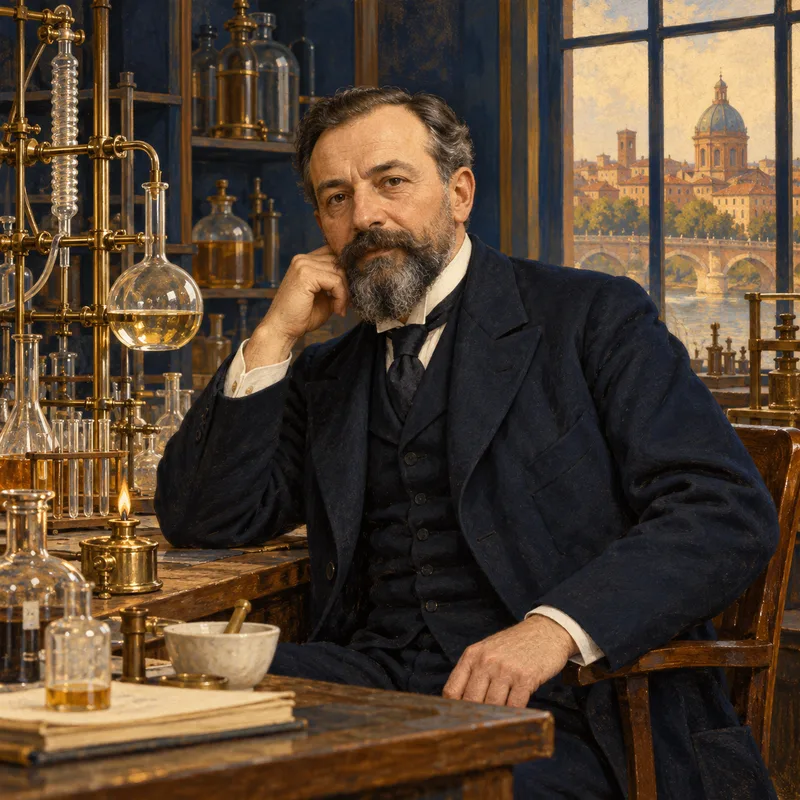
Paul Sabatier
1854-1941 · France · Nobel Chemistry 1912
Catalytic hydrogenation; Sabatier reaction