The discovery, explained · Chemist no. 27 of 350
Paul Sabatier and the Discovery of Catalytic Hydrogenation
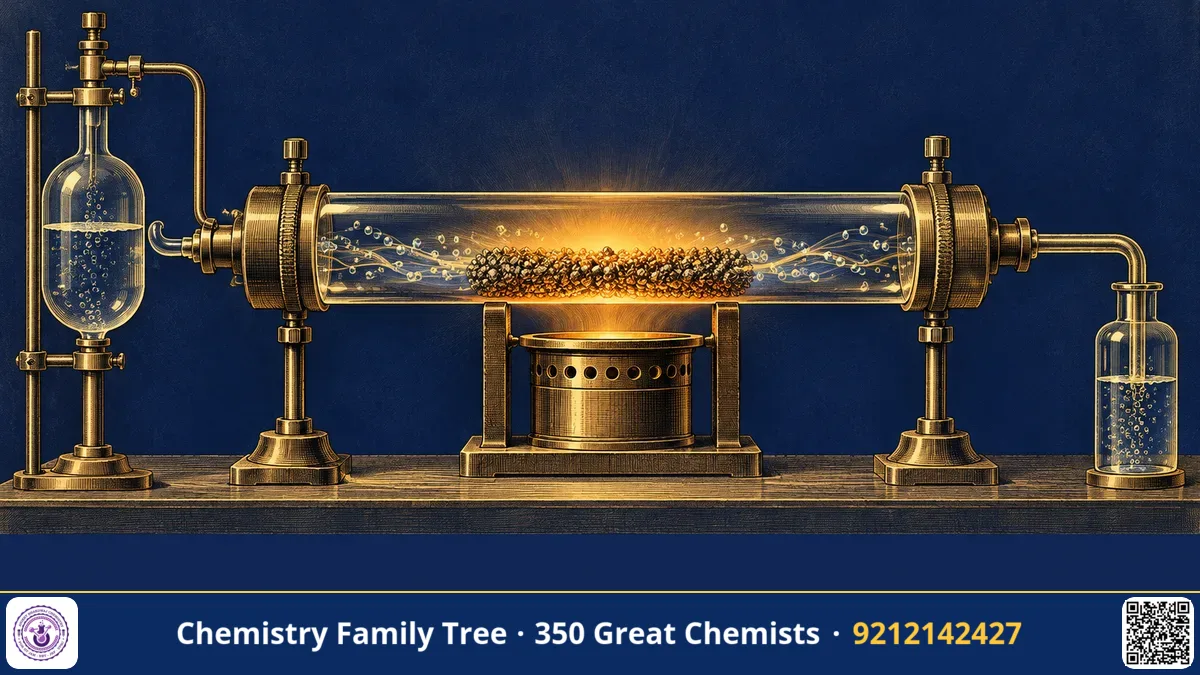
Every time you eat vegetable ghee, every time an oil refinery upgrades its fuel, and even when astronauts on the International Space Station recycle their carbon dioxide, a reaction first understood by a French professor from Toulouse is at work. Paul Sabatier showed, around 1897, that finely divided nickel can make hydrogen add to carbon compounds at moderate temperatures. This is called catalytic hydrogenation, and it changed organic chemistry from a science of small laboratory flasks into a science that could be used on an industrial scale. For this work Sabatier shared the 1912 Nobel Prize in Chemistry with Victor Grignard. In this post we follow the problem, the experiment, the chemistry and the exam points you must remember.
The Scientific Problem Before the Discovery
In the nineteenth century, chemists knew that unsaturated compounds such as ethene (ethylene) and benzene could in principle take up hydrogen. The reaction is exothermic, so thermodynamics favours it. But in practice, a mixture of ethene and hydrogen simply sits there at room temperature. The activation energy is very high, because the strong H-H bond must be broken before any new C-H bonds can form.
Earlier workers had used extremely harsh reagents. Marcellin Berthelot, for example, reduced organic compounds with concentrated hydroiodic acid at high temperature, a messy method that gave mixtures. Metals such as platinum black were known to absorb hydrogen and help it react, but this was mostly used for simple gas reactions. Nobody had shown that cheap, common metals could be turned into general hydrogenation catalysts for organic molecules. Chemists needed a clean, controllable method to add hydrogen to double bonds, triple bonds, aromatic rings and functional groups.
The Discovery: Step by Step
Sabatier was professor at the University of Toulouse and had been studying metal oxides and their reactions with gases. Around 1897, together with his collaborator Jean-Baptiste Senderens, he began to test what happens when ethene and hydrogen are passed together over a freshly reduced metal. The procedure was simple but clever:
- Prepare nickel oxide and reduce it with hydrogen in a heated tube. This gives nickel as a very fine, porous, black powder with a huge surface area.
- Cool the tube to a moderate temperature (for many alkenes, roughly 150 to 200 degrees Celsius).
- Pass a gas mixture of the unsaturated compound and hydrogen slowly over the nickel.
- Collect and analyse the product coming out.
The result was striking. Ethene was converted smoothly into ethane:
CH₂=CH₂ + H₂ →(Ni, ~150 °C)→ CH₃-CH₃
The nickel was not consumed; it remained at the end, ready to work again. Sabatier and Senderens quickly extended the idea to many other compounds. Benzene vapour with hydrogen over nickel gave cyclohexane. Aldehydes and ketones gave alcohols. Nitro compounds gave amines. Carbon monoxide and carbon dioxide could be converted to methane.
C₆H₆ + 3H₂  →(Ni, ~180 °C)→  C₆H₁₂
CH₃CHO + H₂  →(Ni)→  CH₃CH₂OH
C₆H₅NO₂ + 3H₂  →(Ni)→  C₆H₅NH₂ + 2H₂O
The reaction of carbon dioxide with hydrogen is now widely called the Sabatier reaction:
CO₂ + 4H₂ →(Ni, about 300-400 °C)→ CH₄ + 2H₂O (ΔH is about -165 kJ/mol)
The Chemistry Behind It
What a catalyst really does
A catalyst provides a new reaction path with a lower activation energy. It does not change the overall enthalpy change (ΔH) or the equilibrium constant. In hydrogenation, nickel does not "push" the reaction thermodynamically; it only makes it fast enough to observe.
The surface mechanism
Modern textbooks explain hydrogenation on a metal surface in these stages, often called the Horiuti-Polanyi mechanism:
- Adsorption: H₂ molecules strike the nickel surface and are adsorbed. The H-H bond breaks, leaving individual hydrogen atoms bound to the metal.
- Alkene adsorption: the alkene sticks to the surface through its pi electrons.
- Stepwise transfer: one hydrogen atom is transferred to the alkene, forming a half-hydrogenated intermediate bound to the surface; a second hydrogen is then transferred.
- Desorption: the saturated alkane leaves the surface, freeing the active sites.
Because both hydrogens usually add from the same face of the double bond, catalytic hydrogenation is typically syn addition. Finely divided metal is used because catalytic activity depends on surface area: the smaller the particles, the more active sites are available.
Catalyst poisoning
Sabatier noticed that traces of sulphur compounds destroyed the activity of nickel. This is called catalyst poisoning. Sulphur binds strongly to the metal surface and blocks the active sites. This is still a major concern in industry, and feedstocks are carefully desulphurised before they reach a catalyst bed.
Heterogeneous catalysis
In Sabatier's experiments the catalyst (solid nickel) was in a different phase from the reactants (gases). This is heterogeneous catalysis, and it is a favourite topic in physical chemistry papers.
Applications Today
- Food industry: Vegetable oils contain C=C bonds. Partial hydrogenation over nickel converts liquid oils into semi-solid fats used for vanaspati (vegetable ghee) and margarine. The German chemist Wilhelm Normann patented the liquid-phase version of this process in 1901, building on the ideas of hydrogenation over nickel.
- Petroleum and petrochemicals: Hydrogenation and hydrotreating remove unsaturated impurities and sulphur from fuels.
- Pharmaceuticals and fine chemicals: Reduction of nitro groups to amines, and of alkenes and carbonyls, is routine in drug synthesis.
- Space exploration: A Sabatier reactor on the International Space Station combines carbon dioxide exhaled by the crew with hydrogen to make water and methane, helping to recycle life-support resources.
- Power-to-gas energy storage: Surplus renewable electricity makes hydrogen by electrolysis, and the Sabatier reaction turns it, with carbon dioxide, into methane that can be stored in gas pipelines.
- India context: The Indian vanaspati and edible oil industry, and fertiliser plants that purify hydrogen streams by methanation, depend on nickel catalysts of exactly this type.
Exam Corner: Likely Questions for JAM, NET, GATE and Boards
- Sabatier and Senderens' method uses finely divided nickel to hydrogenate unsaturated organic compounds; Sabatier received the Nobel Prize in Chemistry in 1912 (shared with Grignard).
- Catalytic hydrogenation of alkenes proceeds by syn addition and gives alkanes; benzene gives cyclohexane under more forcing conditions than simple alkenes.
- The Sabatier reaction is CO₂ + 4H₂ → CH₄ + 2H₂O, which is exothermic. Remember the 1:4 mole ratio.
- Catalysts lower activation energy but do not change ΔH, ΔG or the equilibrium constant.
- Poisons such as sulphur compounds and carbon monoxide deactivate metal catalysts by blocking active sites. Know the difference between a poison and an inhibitor.
Common Misconceptions
- "A catalyst makes an unfavourable reaction possible." No. It only speeds up a reaction that is already thermodynamically allowed.
- "The catalyst is used up." The nickel is regenerated at the end of each cycle, although it may slowly lose activity through poisoning or sintering.
- "Hydrogenation adds hydrogen in two random directions." On a metal surface the two hydrogens normally add to the same face, giving syn addition.
Quick Revision Box
- Discovery: about 1897, Sabatier with Senderens, University of Toulouse.
- Catalyst: finely divided nickel (later also Pt, Pd, Cu, Co).
- Typical reaction: alkene + H₂ → alkane, syn addition.
- Sabatier reaction: CO₂ + 4H₂ → CH₄ + 2H₂O.
- Type of catalysis: heterogeneous; poisons include sulphur compounds.
- Nobel Prize in Chemistry 1912, shared with Victor Grignard.
FAQ
Why did Sabatier use finely divided nickel?
A fine powder has a very large surface area, so many more hydrogen and substrate molecules can be adsorbed at the same time. Nickel is also cheap compared with platinum or palladium, which made large-scale use realistic.
What is the difference between the Sabatier reaction and the Sabatier-Senderens process?
The Sabatier-Senderens process refers broadly to catalytic hydrogenation of organic compounds over nickel. The Sabatier reaction is the specific methanation of carbon dioxide (or carbon monoxide) with hydrogen to give methane and water.
Is catalytic hydrogenation exothermic?
Yes. Adding H₂ across a double bond releases heat, typically about 120 kJ per mole for a simple alkene. The catalyst is needed only to overcome the kinetic barrier.
Is hydrogenation used in India?
Yes. Indian vanaspati plants, pharmaceutical companies and refineries all use hydrogenation catalysts, and ammonia and fertiliser units use methanation beds to remove traces of carbon oxides from hydrogen.
Published by ABC Chemistry — IIT-JAM | CSIR-NET | GATE Chemistry Coaching. Visit abcchemistry.com
About the chemist
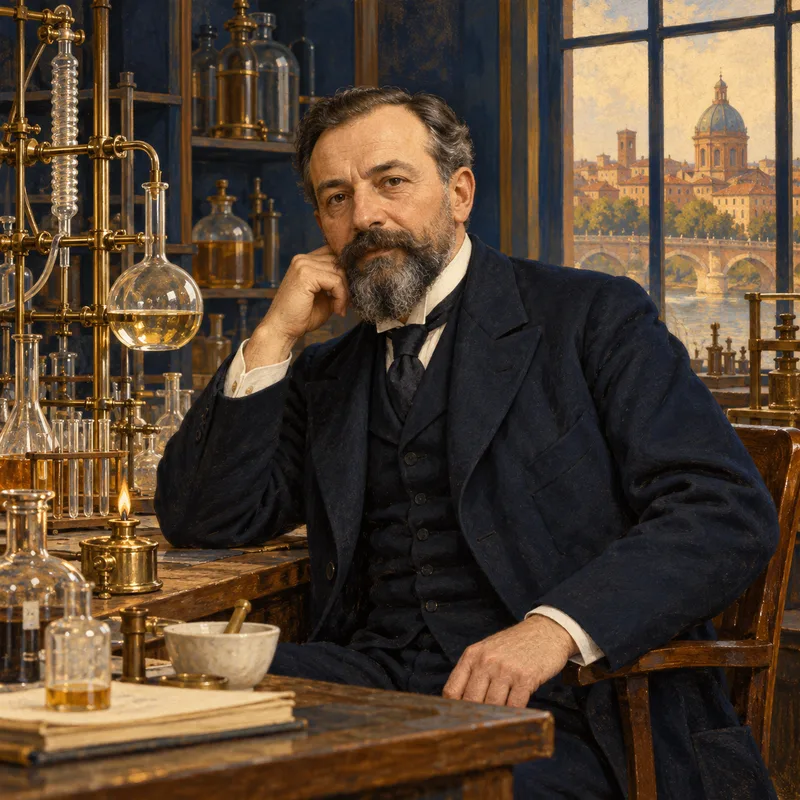
Paul Sabatier
1854-1941 · France · Nobel Chemistry 1912
Catalytic hydrogenation; Sabatier reaction