Biography · Chemist no. 295 of 350
Percy Lavon Julian (1899-1975): The Chemist Who Turned Soybeans into Medicine
Introduction
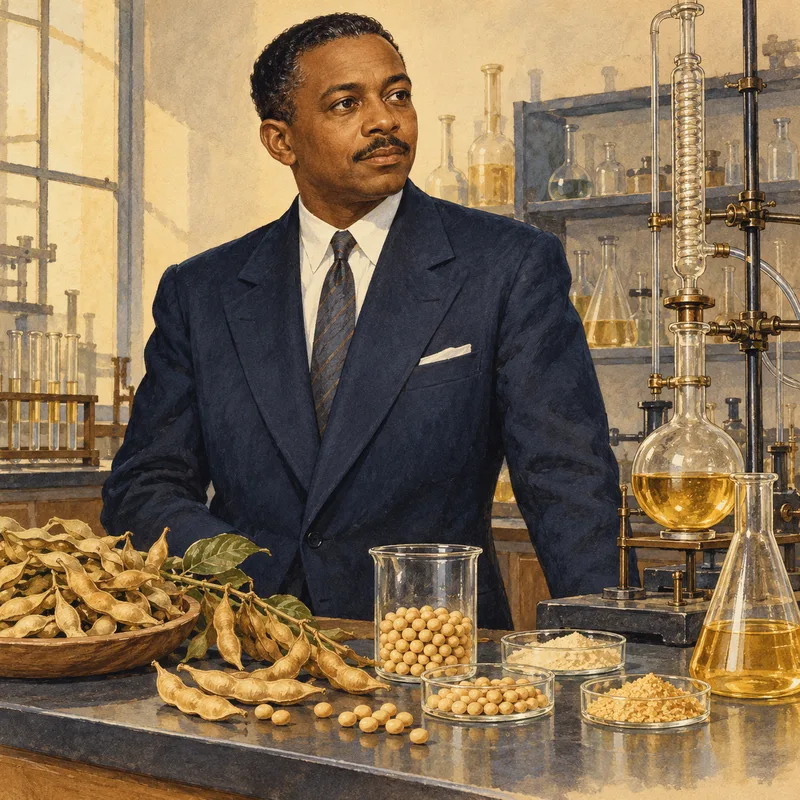
Percy Lavon Julian was an American research chemist who became one of the most successful scientists in the history of industrial pharmaceutical chemistry. He synthesised the alkaloid physostigmine, and he found efficient ways to make progesterone, testosterone and cortisone precursors from soybean sterols. He accomplished all this while facing racial prejudice that shut many doors to him. His legacy in one line: brilliant chemistry, achieved through persistence, that lowered the price of life-saving drugs.
Early Life and Family
Julian was born on 11 April 1899 in Montgomery, Alabama, the eldest of six children. His grandparents had been enslaved, and his father worked as a railway mail clerk while his mother was a schoolteacher. In the segregated South at that time, Black children in Montgomery could only attend school up to a limited grade, and there was no public high school for Black students. His family nevertheless valued education very strongly, and the children grew up reading and studying at home.
Education and Mentors
Julian was admitted to DePauw University in Greencastle, Indiana, in 1916, but was first placed in a sub-freshman preparatory program because his earlier schooling was considered inadequate. He worked while studying, including waiting tables and doing odd jobs, and he graduated in 1920 as class valedictorian with a degree in chemistry. As a Black graduate, he found few opportunities in American universities for doctoral work. He taught for a time at Fisk University and then, with a fellowship, completed a master's degree at Harvard University in 1923.
Still unable to obtain a research position at Harvard, he taught at several institutions and then travelled to Austria, where he studied at the University of Vienna under the eminent natural-product chemist Ernst Späth. He received his PhD in 1931. Späth's mentorship in alkaloid chemistry directly prepared him for the physostigmine problem.
Career Timeline
| Year | Event |
|---|---|
| 1899 | Born in Montgomery, Alabama |
| 1920 | Graduates from DePauw University as valedictorian |
| 1923 | Master's degree, Harvard University |
| 1931 | PhD, University of Vienna, under Ernst Späth |
| 1932 | Joins Howard University as professor of chemistry |
| 1935 | With Josef Pikl at DePauw, completes the synthesis of physostigmine |
| 1936 | Joins the Glidden Company, Chicago, as director of research for soya products |
| 1940s | Develops soy-protein products, including a fire-fighting foam, and soy-based steroid routes |
| 1953 | Founds Julian Laboratories, Inc., in Franklin Park, Illinois |
| 1961 | Sells his company and sets up the Julian Research Institute |
| 1975 | Dies at the age of 76 |
Major Scientific Contributions
1. Physostigmine synthesis
This was the first laboratory synthesis of an alkaloid used for glaucoma, and it was carried out in 1935. It showed that a complex tricyclic natural product could be built from simple starting materials. See our companion discovery article.
2. Steroids from soy
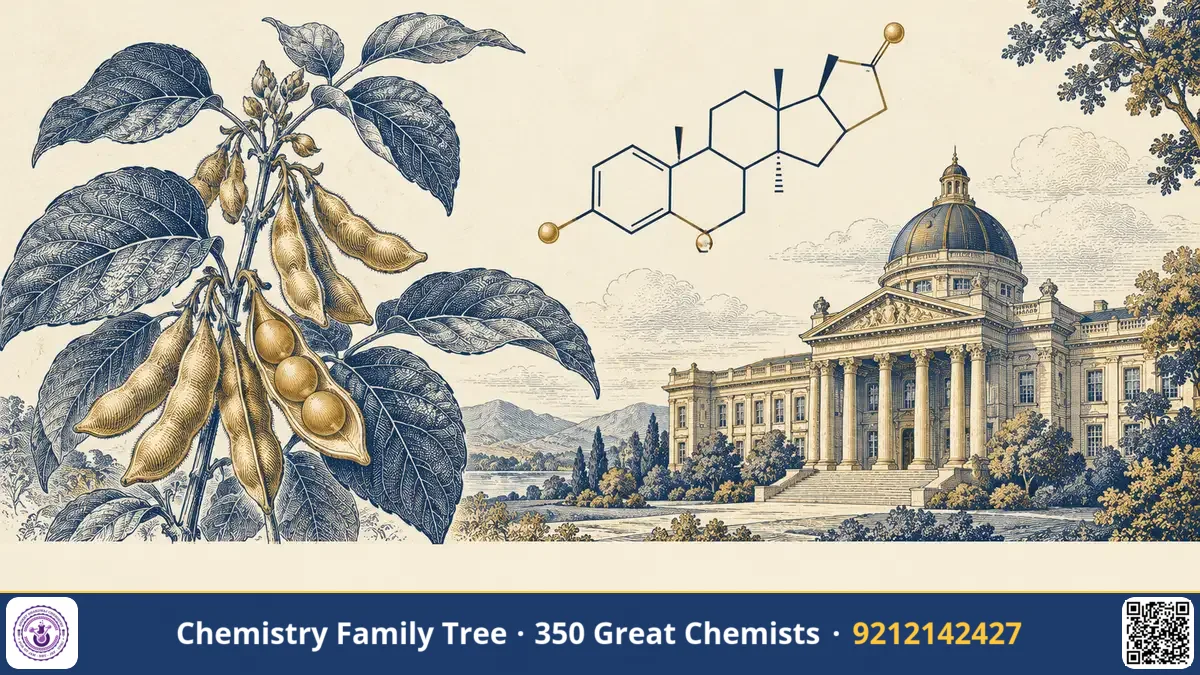
Julian learned how to convert stigmasterol, abundant in soybean oil, into progesterone and testosterone, using Oppenauer oxidation, ozonolysis and further steps. He also contributed to the production of compound S, a precursor of cortisone-type drugs. Large-scale supply from a cheap crop reduced prices dramatically.
3. Soy proteins and industrial chemistry
At Glidden he pioneered applications of soy protein, including coatings, paper sizing and a fire-extinguishing foam used on ships and by the US Navy during the Second World War.
Awards, Honours and Nobel Prize
Julian did not win a Nobel Prize. He was awarded the Spingarn Medal by the NAACP in 1947, and in 1973 he became one of the first African American scientists elected to the United States National Academy of Sciences. He was inducted into the National Inventors Hall of Fame in 1990, and he held about 130 chemical patents. A US postage stamp honouring him was issued in 1993, and he was the subject of a PBS documentary, Forgotten Genius.
Personality, Struggles and Lesser-Known Facts
- A hard road to the doctorate. Despite graduating first in his class, he had to go to Europe for his PhD because American doors were closed to him.
- Passed over at DePauw. In 1932 he was reportedly considered for a chair at DePauw but denied the position because of his race.
- Threats against his family. After he bought a home in Oak Park, Illinois, in the 1950s, the house was attacked with a dynamite device, and he faced threats. The community and many neighbours later came out in support of his family, and the family stayed.
- Industry leader. At Glidden he became one of the first Black scientists to lead a major industrial research laboratory in the United States.
- Entrepreneur. His own company, Julian Laboratories, was sold in 1961 for a large sum, and he later gave much of his time to philanthropy and civil rights causes.
Legacy and Influence on Modern Chemistry
The idea of using plant sterols as the feedstock for steroid drugs has become the basis of a global industry. Hormonal therapy, anti-inflammatory steroids and contraceptives all rely on this strategy. Julian is also a model for diversity in science: chemistry societies and universities now run awards and scholarships in his name. His career shows how important it is for talent to be allowed to flourish regardless of background.
Lessons for Students
- Do not let barriers define you. Julian persevered and, in time, changed the system.
- Master the basics, such as mechanisms and functional-group chemistry, because they are the tools of invention.
- Apply chemistry to real social needs: affordable medicine matters.
- Seek mentors in distant places, as he did with Späth in Vienna.
- Combine research with entrepreneurship when the opportunity exists.
Quick Facts Box
- Born: 11 April 1899, Montgomery, Alabama, USA
- Died: 19 April 1975, aged 76
- Nationality: American
- Field: Natural product synthesis, steroid chemistry
- Famous for: Synthesis of physostigmine; steroids from soybean sterols
- Nobel Prize: None; Spingarn Medal 1947, National Academy of Sciences 1973
FAQ
Where did Percy Julian earn his PhD?
He earned his PhD in 1931 at the University of Vienna, Austria, under Ernst Späth.
What was Percy Julian's most famous synthesis?
His 1935 synthesis of physostigmine is the best-known laboratory achievement, and his soy-based routes to steroid hormones are the best-known industrial achievement.
Did he win a Nobel Prize?
No, but he was elected to the National Academy of Sciences in 1973 and inducted into the National Inventors Hall of Fame in 1990.
Why is Percy Julian relevant to exam syllabi?
His work illustrates alkaloid synthesis, Oppenauer oxidation, ozonolysis and steroid chemistry, which feature in organic chemistry papers for IIT-JAM, CSIR-NET and GATE.
Published by ABC Chemistry — IIT-JAM | CSIR-NET | GATE Chemistry Coaching. Visit abcchemistry.com
About the chemist
Percy Julian
1899-1975 · United States
Synthesis of cortisone precursors; physostigmine