The discovery, explained · Chemist no. 295 of 350
Percy Julian's Chemistry: From Calabar Bean to Soybean Steroids
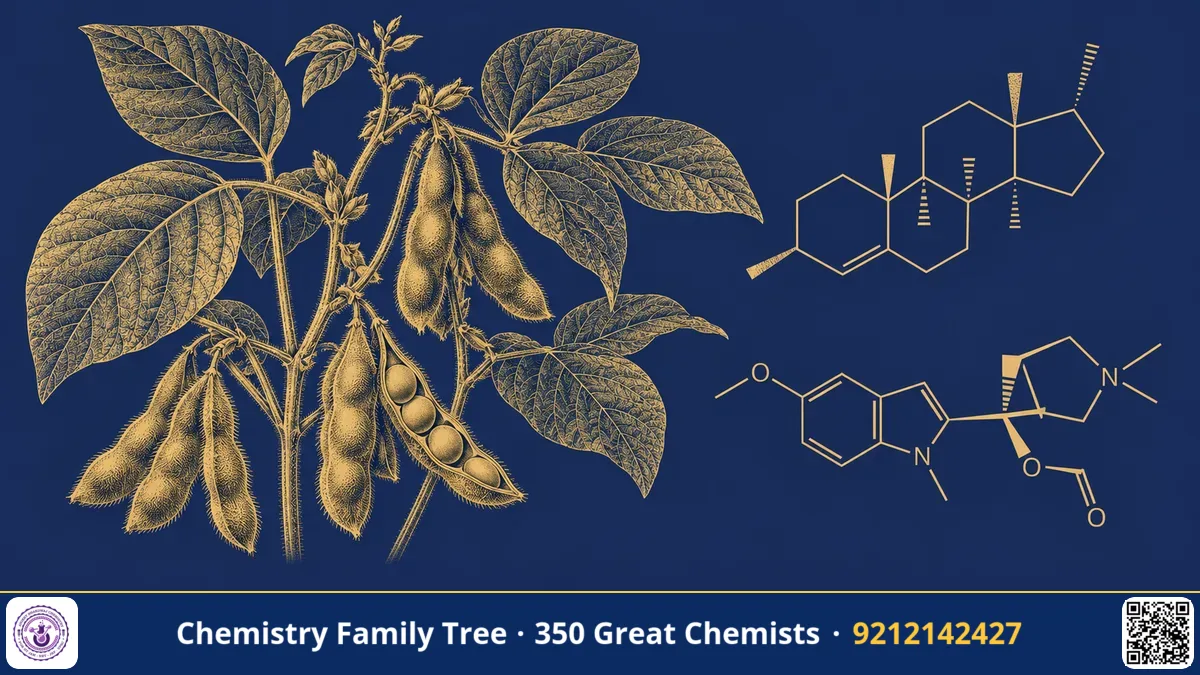
Percy Lavon Julian (1899-1975) was an American research chemist who solved two famous problems in natural product chemistry. In 1935 he completed the first laboratory synthesis of physostigmine, an alkaloid used to treat glaucoma. Later, working in industry, he showed how to make the human hormones progesterone and testosterone, and a precursor of cortisone, from sterols found in soybean oil. This made life-saving steroid drugs far cheaper and more widely available. His story is also a lesson in determination, since he worked in an era of strong racial discrimination in the United States.
The Scientific Problem Before the Discovery
Physostigmine (eserine) is an alkaloid from the Calabar bean (Physostigma venenosum) of West Africa. It inhibits the enzyme acetylcholinesterase, so acetylcholine stays longer at the synapse. Doctors used it to reduce the pressure in the eye in glaucoma. Its structure had been worked out, but no one had synthesised it, and the natural source was limited and expensive.
Steroid hormones also faced a supply problem. In the 1930s and 1940s progesterone, testosterone and corticosteroids were in demand for medicine, but were obtained in tiny amounts from animal organs, or by long and costly semi-synthesis. The cheap, abundant plant sterols in soybean oil, such as stigmasterol, had the right carbon skeleton but a wrong side chain and the wrong functional groups.
The Discovery: Step-by-Step
Part 1: Physostigmine (1935)
With his collaborator Josef Pikl at DePauw University, Julian built physostigmine in the laboratory. The core of the molecule is a tricyclic pyrroloindoline (a fused indoline and pyrrolidine) with a quaternary carbon bearing a methyl group, plus a methylcarbamate on the aromatic ring. The key stages were:
- Preparation of a suitably substituted oxindole carrying an aryl group with an oxygen function.
- Building the quaternary carbon and the side chain bearing an aminoethyl unit.
- Ring closure to form the fused pyrrolidine ring (the "eseroline" skeleton).
- Conversion of the phenol (eseroline) into the methylcarbamate with methyl isocyanate: eseroline-OH + CH₃N=C=O → physostigmine (a carbamate ester).
The synthesis was widely celebrated as a masterpiece of alkaloid chemistry and made his international reputation.
Part 2: Soy sterols to hormones
At the Glidden Company in Chicago, Julian worked on soybean products. He found that stigmasterol could be separated from soy oil residues in large quantity, and that it could be converted to progesterone by a sequence like this:
Stigmasterol (Δ⁵, Δ²² side chain, 3β-OH)
  → Oppenauer oxidation → stigmasta-4,22-dien-3-one
  → ozonolysis of the Δ²² side chain → 3-keto-bisnorcholenic aldehyde
  → further steps to the pregnane side chain → progesterone
The Oppenauer oxidation uses aluminium isopropoxide and a ketone (such as acetone) to convert the 3β-hydroxy-Δ⁵ steroid into the conjugated Δ⁴-3-ketone with the double bond moving into conjugation. Ozonolysis then cleaves the side-chain double bond and leaves the aldehyde, which is elaborated to the two-carbon acetyl side chain of progesterone. Testosterone and other hormones could be prepared from the same intermediates. Julian also made a cortisone precursor (Reichstein's compound S, 11-deoxycortisol) from soy sterols, which was important in the early drug production of cortisone, a medicine for rheumatoid arthritis.
The Chemistry Behind It
Alkaloid carbamates. Physostigmine contains an N-methylcarbamate ester, -O-C(=O)-NHCH₃. The carbamate transfers its carbamoyl group to the serine hydroxyl in the active site of acetylcholinesterase, forming a carbamoylated enzyme that hydrolyses very slowly. This reversible inhibition raises acetylcholine levels. Rivastigmine, a modern Alzheimer's drug, works by a related mechanism.
Steroid numbering. The four rings are A, B, C, D. Cholesterol and the plant sterols have a C-17 side chain, while progesterone has a two-carbon COCH₃ side chain, so the side chain must be shortened. Stigmasterol has a trans double bond at C-22, which makes ozonolysis a convenient way to remove the side chain.
Oppenauer oxidation is the reverse of the Meerwein-Ponndorf-Verley reduction. It uses a ketone as the hydride acceptor and is selective for secondary alcohols.
| Starting sterol | Source | Product class |
|---|---|---|
| Stigmasterol | Soybean oil | Progesterone, testosterone, corticoid intermediates |
| Diosgenin | Mexican yam (Marker degradation) | Progesterone and other steroid drugs |
| Cholesterol | Animal sources | Vitamin D and steroid intermediates |
Applications Today
- Ophthalmology and neurology: Physostigmine and its analogues are used to treat glaucoma and as an antidote to anticholinergic poisoning.
- Steroid drugs: Hormone therapy, anti-inflammatory corticosteroids and contraceptives rely on large-scale plant-sterol semi-synthesis.
- Food and materials: Julian's work on soy protein also produced products used in coatings, paper and a fire-fighting foam known as Aero-Foam during the Second World War.
- Indian pharmaceutical industry: India is a major producer of steroid active ingredients, often starting with plant sterols, a route popularised by Julian-style chemistry.
- Teaching: The Oppenauer oxidation, ozonolysis and carbamate formation are examination staples.
Exam Corner
- Physostigmine is an alkaloid from Calabar bean; it is a reversible acetylcholinesterase inhibitor and contains a methylcarbamate.
- Oppenauer oxidation: Al(OiPr)₃ with acetone oxidises secondary alcohols to ketones; the Δ⁵-3β-ol shifts to Δ⁴-3-one.
- Ozonolysis of stigmasterol cleaves the Δ²² bond and gives an aldehyde used to build the progesterone side chain.
- Stigmasterol (soy) and diosgenin (yam) are the two classic starting materials for steroid drugs.
- Steroid skeleton: three six-membered rings and one five-membered ring, 17 carbons.
Common Misconceptions
- "Julian discovered cortisone." No. Cortisone was isolated and then studied by Kendall, Reichstein and Hench, who shared the 1950 Nobel Prize. Julian developed cheaper routes to its precursors.
- "Soybeans contain progesterone." They contain sterols such as stigmasterol that can be chemically converted.
- "Physostigmine acts irreversibly." The carbamoylated enzyme hydrolyses slowly but does recover, so the inhibition is described as reversible or pseudo-irreversible.
Quick Revision Box
- 1935: total synthesis of physostigmine (with Josef Pikl).
- Physostigmine: carbamate alkaloid; treats glaucoma; inhibits acetylcholinesterase.
- Stigmasterol from soybean oil is converted to progesterone through Oppenauer oxidation and ozonolysis.
- Julian also made a cortisone precursor (compound S) from soy sterols.
- Aero-Foam: soy-protein fire-fighting foam used in World War II.
- Julian founded his own company to make steroids and sold it in 1961.
FAQ
What did Percy Julian synthesise?
He synthesised the alkaloid physostigmine in 1935, and later developed commercial routes from soybean sterols to progesterone, testosterone and a cortisone precursor.
Why was soybean useful for steroid drugs?
Soybean oil is abundant and contains stigmasterol, a sterol with a skeleton similar to human steroid hormones. It is much cheaper than animal sources.
What is the role of ozonolysis in the process?
Ozonolysis cleaves the C22 double bond of stigmasterol to shorten the side chain and generate an aldehyde, which is converted to the pregnane side chain of progesterone.
How does physostigmine work?
It carbamoylates the active-site serine of acetylcholinesterase, slowing the breakdown of acetylcholine and prolonging its effect.
Published by ABC Chemistry — IIT-JAM | CSIR-NET | GATE Chemistry Coaching. Visit abcchemistry.com
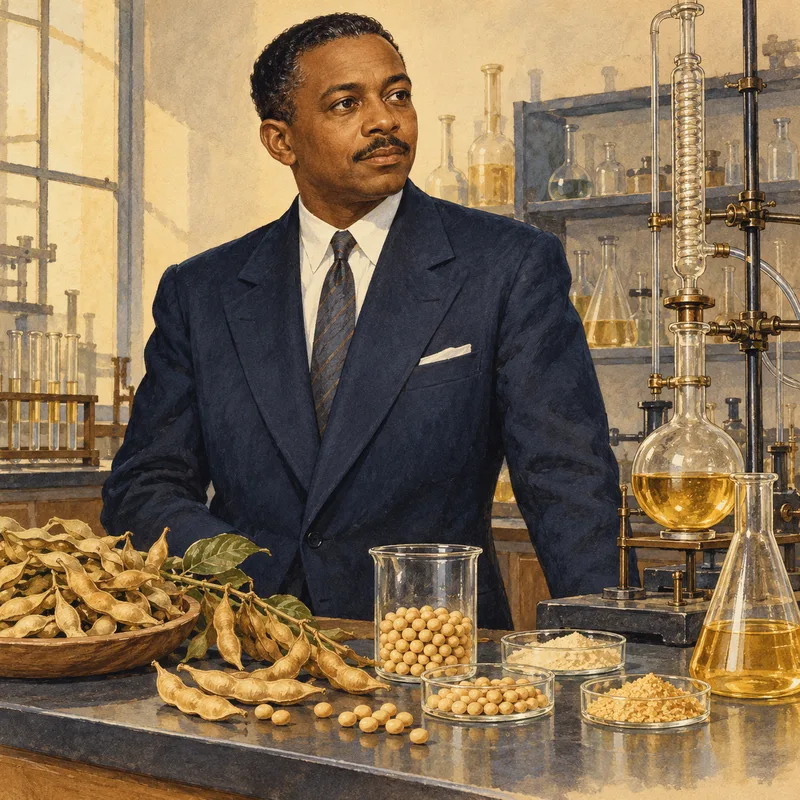
About the chemist
Percy Julian
1899-1975 · United States
Synthesis of cortisone precursors; physostigmine