The discovery, explained · Chemist no. 257 of 350
Perkin's Mauve: How a Failed Experiment Created the First Synthetic Dye
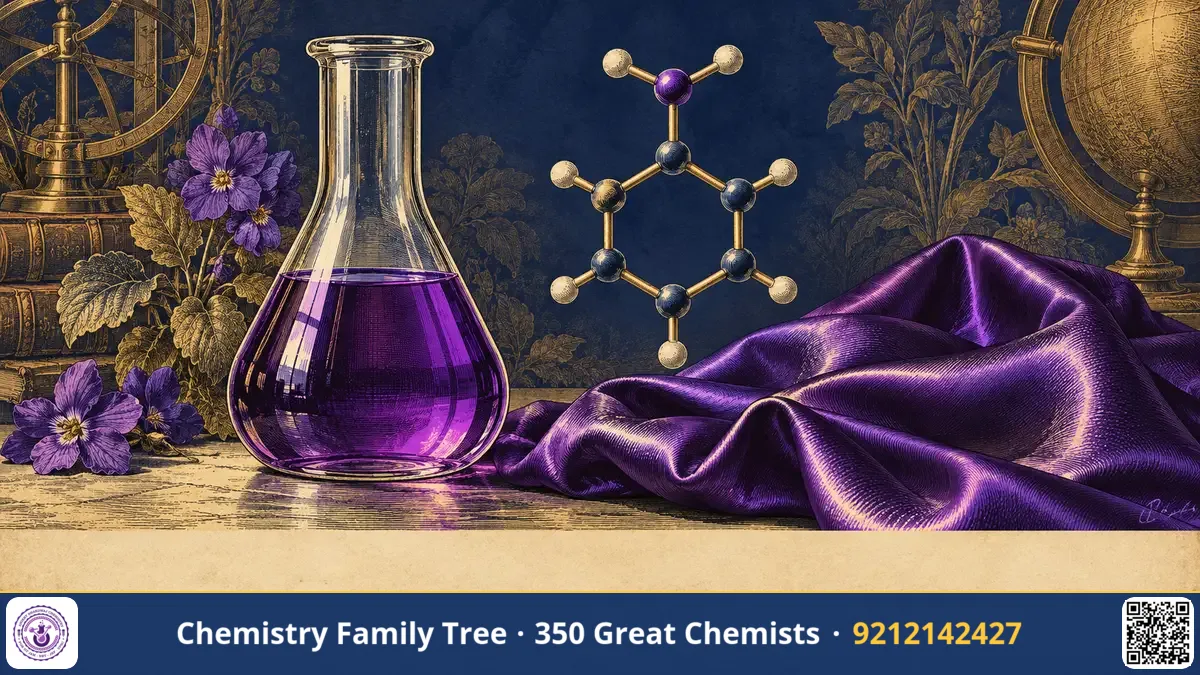
In the Easter holidays of 1856, an 18-year-old student named William Henry Perkin tried to make the anti-malarial drug quinine in a small laboratory at his home in London. He failed. But the dirty black residue in his flask, when he washed it with alcohol, gave a beautiful purple solution that dyed silk. That colour became known as mauveine or Perkin's mauve, the first commercially successful synthetic organic dye. The accident created the synthetic dye industry, led to the modern chemical industry in Germany, Britain and beyond, and gave birth to pharmaceuticals and many other fields. This blog explains what Perkin did and the chemistry behind it.
The Scientific Problem Before the Discovery
Before 1856, all dyes came from plants, insects or shellfish. Indigo came from plants (India was a major supplier), madder gave red, and Tyrian purple was made from sea snails and was so costly that it was associated with royalty. Natural dyes were expensive, variable and often faded.
Meanwhile, Britain's demand for quinine was great, as malaria affected the colonies, including India. Quinine was extracted from cinchona bark in South America and was costly. Chemists dreamed of making it in a laboratory. August Wilhelm von Hofmann, Perkin's teacher at the Royal College of Chemistry, had suggested that quinine might one day be made artificially. At that time, structural theory was unknown, so chemists tried to build molecules by reasoning from simple formulae. The idea was far too simple, as we know today.
The Discovery: Step by Step
Perkin started from allyltoluidine, a compound from coal-tar chemistry. Looking at molecular formulae, he thought that quinine (C₂₀H₂₄N₂O₂) could be obtained by adding oxygen to two molecules of allyltoluidine (C₁₀H₁₃N), since 2 C₁₀H₁₃N + 3 O = C₂₀H₂₄N₂O₂ + H₂O on paper.
2 C10H13N + 3 [O] → C20H24N2O2 + H2O (Perkin's hope)
The experiment gave only a reddish-brown sludge. Not discouraged, Perkin repeated the experiment with a simpler base, aniline, and oxidised it with potassium dichromate (K₂Cr₂O₇). This gave a black precipitate. When he tried to clean the flask with alcohol, he got a purple solution. The steps were:
- Aniline sulfate was treated with potassium dichromate solution.
- A black solid formed.
- The solid was filtered and dried, and the tarry material was removed.
- Extraction with alcohol (ethanol) dissolved a purple compound.
- Silk dipped in the solution turned a bright purple that did not fade easily in light or on washing.
The aniline used was impure, containing toluidines (o- and p-toluidine). This was the reason for success: pure aniline alone does not give mauveine. The mixed amines combine under oxidation to make the dye. Modern analysis shows mauveine is a mixture of related compounds, chiefly mauveine A and B, which are phenazinium (aromatic polycyclic nitrogen) salts.
Perkin patented the process in August 1856, and with his father and brother built a factory at Greenford Green near London. He was 18 and the patent was a bold step. At first dyers were doubtful. French dyers took it up first, and the colour became a fashion sensation, when Empress Eugénie of France and Queen Victoria wore mauve. The 1850s and 1860s are sometimes called the "mauve decade".
The Chemistry Behind It
The key reaction is oxidative coupling of aromatic amines. Aniline (C₆H₅NH₂) is easily oxidised. Under dichromate oxidation, amine molecules couple through their nitrogen atoms and ring carbons, forming larger conjugated systems.
- Chromophore: Mauveine has an extended system of conjugated double bonds in the phenazine ring. The more extended the conjugation, the smaller the HOMO-LUMO gap, so the molecule absorbs visible light (green-yellow) and appears purple.
- Auxochrome: The amino groups (–NH₂ or –NHR) deepen the colour and help the dye bind to fibres such as silk and wool through ionic interactions.
- Basic dye: Mauveine is a cationic (basic) dye and sticks to protein fibres which carry negative charges. Cotton needed a mordant such as tannin.
The full structure of mauveine was not established until 1994, when Meth-Cohn and Smith identified it as a mixture, showing the dye is a good lesson in how chemistry can be useful long before the structure is known.
Perkin's name also appears in the Perkin reaction, which he discovered in 1868, where an aromatic aldehyde condenses with an acid anhydride in the presence of the sodium or potassium salt of the acid, to give an α,β-unsaturated acid. Example: benzaldehyde + acetic anhydride → cinnamic acid.
C6H5CHO + (CH3CO)2O --(CH3COONa, heat)--> C6H5CH=CHCOOH + CH3COOH
Applications Today
- Dye and textile industry: Synthetic dyes, now in tens of thousands of colours, are used in textiles in cities like Tiruppur and Surat. India is one of the major dye producers in the world.
- Pharmaceuticals: The dye industry led to the creation of drug chemistry. Methylene blue, a related dye, is an antimalarial lead and a biological stain.
- Biological stains: Many stains used in microscopy, such as those for Gram staining, descend from this tradition.
- Perfumery: Perkin reaction products such as coumarin (from salicylaldehyde) and cinnamic acid derivatives are used in fragrances. Perkin synthesised coumarin in 1868, the first synthetic perfume ingredient.
- Quinine: It was synthesised much later, in 1944 by Woodward and Doering, and today other antimalarials like chloroquine and artemisinin derivatives are used.
Exam Corner
- Perkin discovered mauveine in 1856 by oxidising impure aniline with K₂Cr₂O₇.
- Perkin reaction: ArCHO + (RCH₂CO)₂O → ArCH=CRCOOH; base is the sodium salt of the acid. Aldehyde must have no α-hydrogen.
- Cinnamic acid is made by benzaldehyde + acetic anhydride + CH₃COONa.
- Chromophore and auxochrome concept in dyes (Witt's theory, 1876).
- Mauveine is a basic dye that is a phenazinium compound.
Common Misconceptions
- "Perkin was trying to make a dye." No, he was trying to synthesise quinine.
- "Pure aniline gives mauveine." No, the toluidine impurities were essential.
- "Mauveine is a single compound." It is a mixture of related compounds.
Quick Revision Box
- Year: 1856; age 18; London.
- Starting material: impure aniline; oxidant: K₂Cr₂O₇.
- Product: mauveine, first synthetic dye, phenazinium-based.
- Factory at Greenford Green.
- Perkin reaction (1868): benzaldehyde + acetic anhydride gives cinnamic acid.
- Perkin also synthesised coumarin.
FAQ
Why is mauveine important?
It was the first synthetic organic dye made commercially, and it started the synthetic dye and organic chemical industry.
What was Perkin trying to make?
He wanted to synthesise quinine, the anti-malarial drug, from coal-tar derivatives.
What is the Perkin reaction?
It is the condensation of an aromatic aldehyde with an acid anhydride in the presence of the salt of the acid, giving an α,β-unsaturated carboxylic acid.
Why does mauveine appear purple?
Its extended conjugated system absorbs light in the yellow-green region, so the complementary colour, purple, is seen.
Published by ABC Chemistry — IIT-JAM | CSIR-NET | GATE Chemistry Coaching. Visit abcchemistry.com
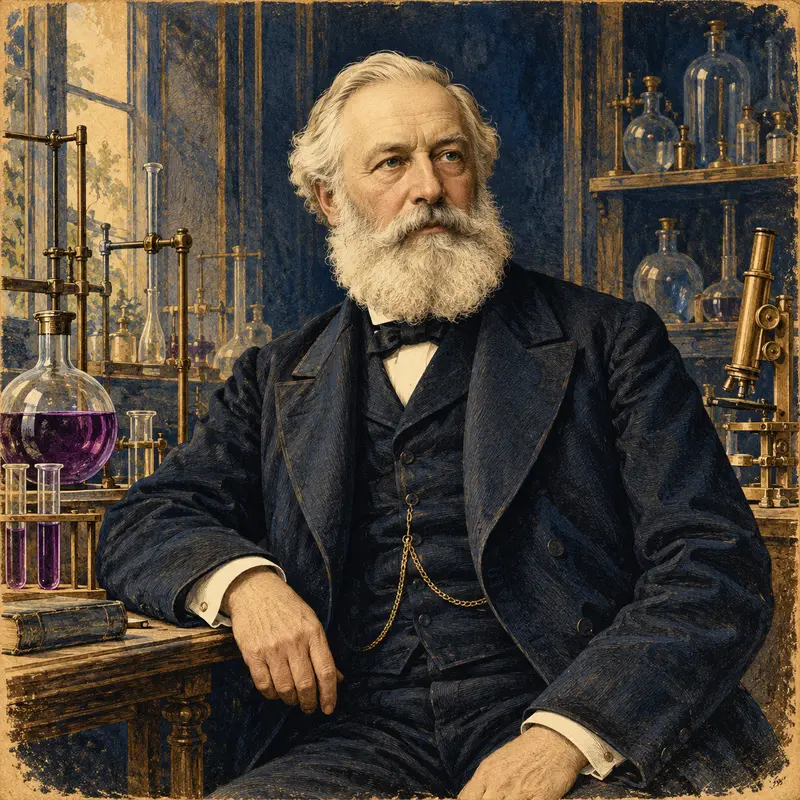
About the chemist
William Henry Perkin
1838-1907 · United Kingdom
Synthesized mauveine, first synthetic dye