Biography · Chemist no. 257 of 350
Sir William Henry Perkin (1838-1907): The Teenager Who Coloured the World
Introduction
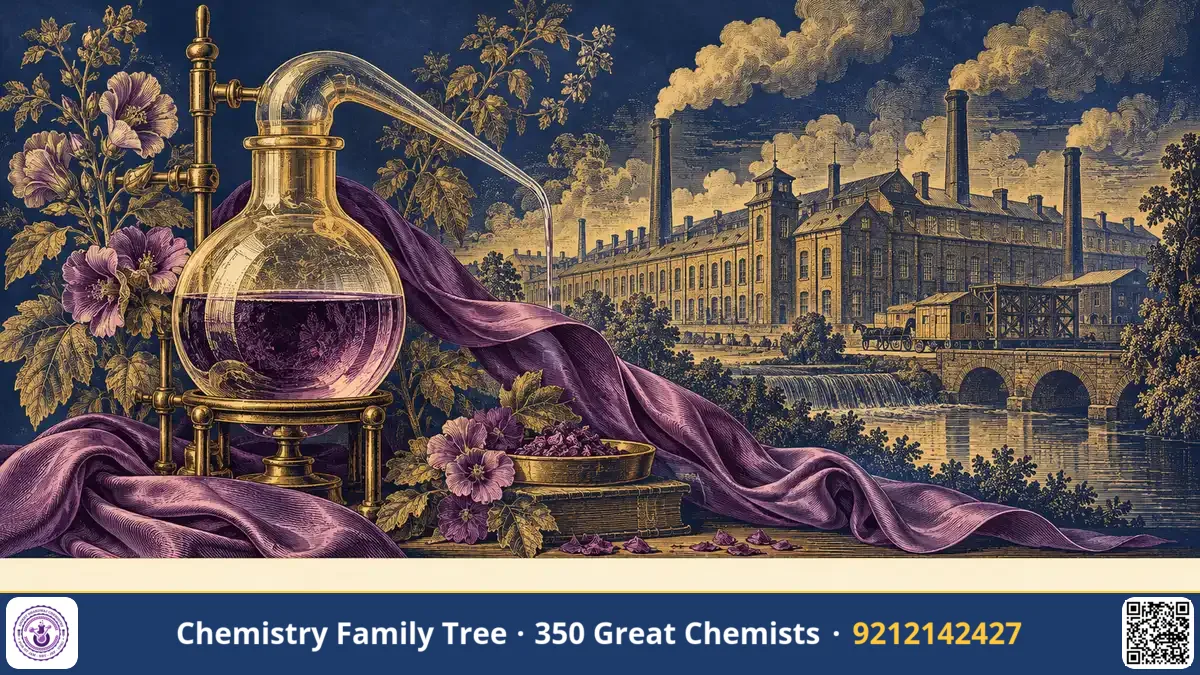
Sir William Henry Perkin was an English chemist who, at the age of 18, discovered the first synthetic organic dye, mauveine, and built a factory to make it. He later became a leading figure in organic chemistry through the Perkin reaction. His legacy in one line: he turned coal-tar chemistry into an industry and showed that a young scientist could build a business from a laboratory result.
Early Life and Family
Perkin was born on 12 March 1838 in the East End of London. He was the youngest of the sons of George Perkin, a successful builder and carpenter. The family was prosperous, and his father hoped William would become an architect. But William loved chemistry, which had been awakened by a demonstration he saw as a boy, and by a teacher at school who showed the class a chemical experiment. His family finally supported his choice and later gave financial and practical backing to his factory.
Education and Mentors
He attended the City of London School, where a teacher named Thomas Hall encouraged his chemical interest. At 15, in 1853, Perkin entered the Royal College of Chemistry in London, where August Wilhelm von Hofmann, a German chemist invited by Prince Albert, was the director. Perkin became Hofmann's assistant at age 17. It was Hofmann's suggestion that quinine could be synthesised which led Perkin to the experiment that gave mauveine. Perkin set up a home laboratory in his family house in Shadwell for experiments during the holidays.
Career Timeline
| Year | Event |
|---|---|
| 1838 | Born in London, 12 March |
| 1853 | Entered the Royal College of Chemistry |
| 1856 | Discovered mauveine; patent filed in August |
| 1857 | Factory built at Greenford Green |
| 1858 | Mauve became a fashion; production grew |
| 1866 | Elected Fellow of the Royal Society |
| 1868 | Synthesised coumarin; described the Perkin reaction |
| 1869 | Patented a practical alizarin process |
| 1874 | Sold the business and retired from industry at age 36 |
| 1879 | Royal Medal; later research on magnetic rotation |
| 1906 | Knighted; jubilee of mauve celebrated |
| 1907 | Died on 14 July in Sudbury, Middlesex |
Major Scientific Contributions
- Mauveine (1856): The first commercially successful synthetic dye, made by oxidising impure aniline. See our discovery blog for the chemistry.
- Alizarin synthesis (1869): Perkin developed a practical method to make alizarin, the red dye of the madder plant, in England at about the same time as Graebe and Liebermann in Germany. The German process won the early lead in the market.
- Perkin reaction (1868): The condensation of aromatic aldehydes with acid anhydrides to give α,β-unsaturated acids, such as cinnamic acid. He also made coumarin in this way, the first synthetic perfume compound.
- Magnetic rotation: In his later life, he worked in his private laboratory on the magnetic rotation of the plane of polarised light (the Faraday effect) in organic compounds, a topic that was linked with molecular structure.
- Industrial chemistry: He taught the world the process of scaling up a reaction from flask to factory, including making aniline cheaply from nitrobenzene by the Béchamp method of reduction with iron.
Awards, Honours and Nobel Prize
- Fellow of the Royal Society (1866).
- Royal Medal (1879) and Davy Medal (1889) of the Royal Society.
- Knighted in 1906 during the jubilee celebrations of mauve.
- Perkin Medal, awarded by the American section of the Society of Chemical Industry, was established in his honour in 1906 and is still given for work in applied chemistry.
- He did not receive a Nobel Prize.
Personality, Struggles and Lesser-Known Facts
- He made the discovery during the Easter holidays of 1856 in a home laboratory, at an age when most students are in school.
- He left the Royal College of Chemistry and a promising academic path to start a factory at 18, a risky choice that his family backed.
- He wrote to Pullars of Perth, a firm of dyers in Scotland, which tested his dye on silk and replied favourably. This is a well-known part of the story.
- Eugénie, wife of Napoleon III, popularised the colour, and mauve spread in Paris and London. A craze for the colour was satirised in Punch.
- He retired from business at age 36 to devote his time to pure research, which is unusual for a successful industrialist.
- His sons, William Henry Perkin Jr. and Arthur George Perkin, both became noted chemists. W. H. Perkin Jr. became a famous organic chemist, who worked on terpenes and natural products.
Legacy and Influence on Modern Chemistry
Perkin's mauve began a movement. German firms such as BASF, Bayer and Hoechst developed from dye production and gave rise to organic chemicals, pharmaceuticals, plastics and photographic chemicals. The synthetic indigo that eventually replaced natural indigo ended the indigo plantations of India, a significant episode in India's economic history. Today the Indian dye industry in Gujarat and Maharashtra is a major export sector. The basic skills of an industrial chemist, scale-up, patents and quality control, were shown early by Perkin. His reaction and his idea of using coal-tar byproducts still appear in organic chemistry courses.
Lessons for Students
- Observe the unexpected. The purple colour was a failed experiment that most people would have washed down the drain.
- Back your idea. Perkin took a chance when elders advised caution.
- Combine science and practical skill. He made the process work in a factory, not just in a flask.
- Keep learning. After leaving business he continued serious research.
- Family and mentors matter. His father and brother helped him build the factory.
Quick Facts Box
- Born: 12 March 1838, London
- Died: 14 July 1907, Sudbury, Middlesex
- Nationality: British
- Field: Organic and industrial chemistry
- Famous for: Mauveine; Perkin reaction
- Nobel Prize: None (knighted 1906)
FAQ
How old was Perkin when he discovered mauve?
He was 18 years old, in 1856.
Who funded his factory?
His father George Perkin and his brother Thomas Dix Perkin provided the money and help to build the factory at Greenford Green.
Did Perkin get a Nobel Prize?
No. He was knighted in 1906 and received medals from the Royal Society and other bodies.
What is the Perkin Medal?
It is an American award in applied chemistry named in his honour and first presented in 1906.
Published by ABC Chemistry — IIT-JAM | CSIR-NET | GATE Chemistry Coaching. Visit abcchemistry.com
About the chemist
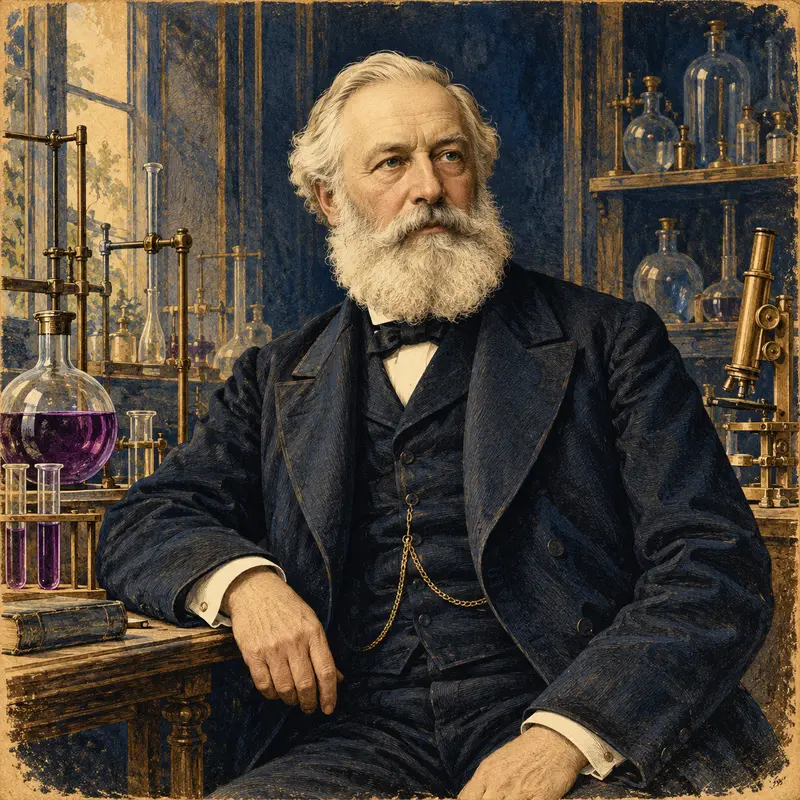
William Henry Perkin
1838-1907 · United Kingdom
Synthesized mauveine, first synthetic dye