The discovery, explained · Chemist no. 181 of 350
Peter Agre and Aquaporins: How Cells Let Water Through
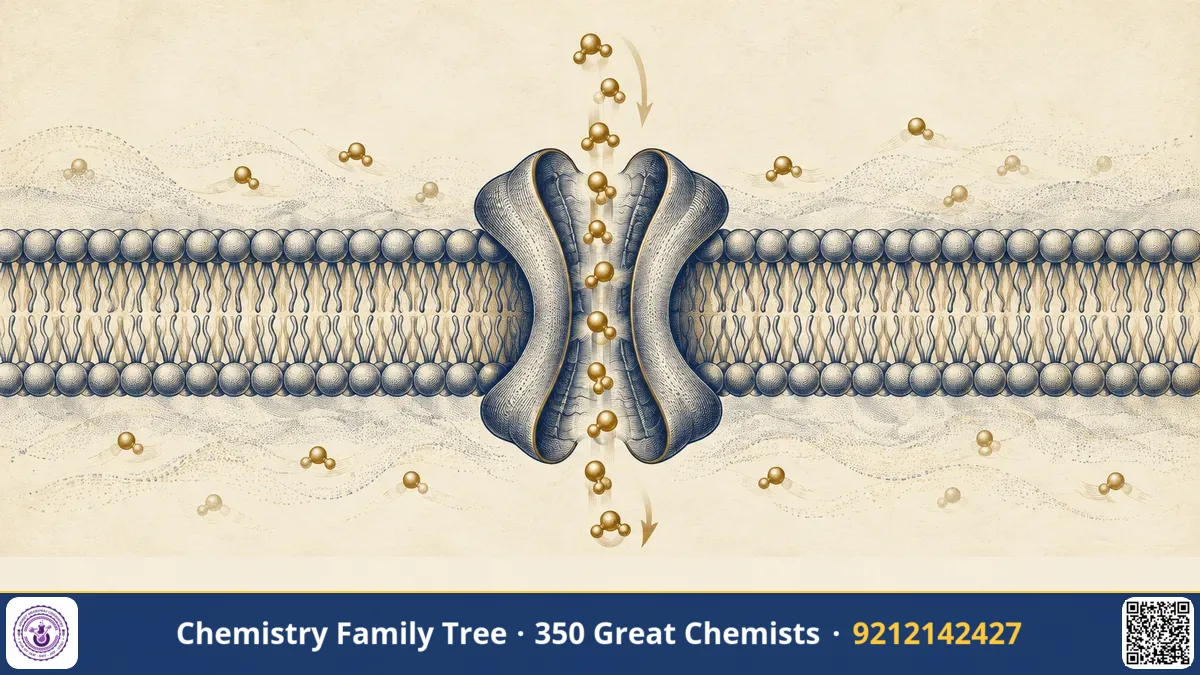
Every cell in your body moves water across its membrane. Your kidneys reabsorb about 180 litres of water a day from the filtrate, red blood cells swell and shrink, and plant roots pull water from soil. For more than a century scientists believed water simply seeped through the lipid bilayer. In 1988–1992, physician-scientist Peter Agre at Johns Hopkins University found that cells have dedicated protein pores for water, which he named aquaporins.
For this discovery Agre shared the 2003 Nobel Prize in Chemistry with Roderick MacKinnon, who received the other half for his work on ion channels. Notably, Agre is a medical doctor, but the prize was in Chemistry, because it recognised the molecular structure and function of a membrane protein. Let us walk through the problem, the experiments and the chemistry.
The Scientific Problem Before the Discovery
A phospholipid bilayer has a hydrophobic core of fatty-acid chains. Water is polar, so it should cross that core only slowly. Yet physiologists knew that some cells, such as red blood cells and kidney collecting-duct cells, are far more permeable to water than a pure lipid bilayer would explain. Also, in some tissues the permeability was blocked by mercury salts such as HgCl₂, which suggested a protein was involved.
Biophysicists argued for decades: was it simple diffusion through the lipid, or a specific channel? Nobody had isolated a "water channel protein", and the idea was unpopular because no candidate existed.
The Discovery: Step by Step
The story began by accident. Agre was studying the Rh blood-group antigens in red cell membranes. During the purification of the Rh protein he kept finding a second, smaller contaminant protein of about 28 kDa which was abundant in the red cell membrane and in kidney tubules. He first thought it was a breakdown product. Instead of discarding it he investigated it, which was the key decision.
- Isolation and cloning (1988–1991): His group purified the 28-kDa protein, named it CHIP28 (channel-forming integral protein of 28 kDa), and cloned its gene together with colleagues. The amino-acid sequence suggested six membrane-spanning helices, with a repeated motif in the two halves.
- The oocyte test (1992): Agre and colleagues injected mRNA for CHIP28 into Xenopus laevis (African clawed frog) eggs, which normally have very low water permeability. Control eggs were injected with water only.
- When both eggs were placed in dilute (hypotonic) buffer, the control oocytes barely changed, but the CHIP28 oocytes swelled rapidly and burst within minutes.
- Mercury inhibition: Adding HgCl₂ blocked the swelling, and the block could be reversed with the reducing agent β-mercaptoethanol. This matched the long-known mercury sensitivity of water permeability.
- The protein was renamed Aquaporin-1 (AQP1); many aquaporins were soon found in animals, plants and microbes.
The Chemistry Behind It
Water crosses the membrane by osmosis, driven by differences in solute concentration. The osmotic pressure of a solution is:
π = i C R T
When an oocyte with AQP1 is placed in a solution of lower osmolarity, water flows in, volume increases, and the membrane ruptures. The experiment is a direct application of colligative properties.
The structure of aquaporin (determined later by electron crystallography and X-ray crystallography) is an elegant example of chemical design:
- Each monomer has six transmembrane α-helices and two short half-helices, forming an hourglass shape; four monomers form a tetramer, and each monomer has its own pore.
- The narrowest part of the pore is only about 3 Å wide, so water molecules pass in single file, around 10⁹ molecules per second per channel.
- Two conserved asparagine–proline–alanine (NPA) motifs meet at the centre of the pore. The asparagine side chains form hydrogen bonds with the passing water, orienting each molecule, which breaks the chain of hydrogen bonds along the file.
- That breaking of the chain stops proton hopping (the Grotthuss mechanism): H₃O⁺ cannot be conducted through the channel. This is vital; otherwise the cell would lose its proton gradient.
- An arginine residue and the electrostatic field at the narrow "selectivity filter" repel positively charged ions.
Mercury binds a cysteine residue near the pore entrance, which explains the inhibition by Hg²⁺ and the reversal by thiol reagents.
Applications Today
- Kidney physiology: AQP2 in collecting-duct cells is controlled by the antidiuretic hormone vasopressin, and mutations cause nephrogenic diabetes insipidus.
- Eye and brain: AQP0 in the lens, and AQP4 in brain astrocytes, are linked to cataract and brain oedema; AQP4 antibodies are also a diagnostic marker in neuromyelitis optica.
- Plants: Aquaporins help crops deal with drought and salt stress, relevant to Indian agriculture.
- Water purification: Researchers are building biomimetic membranes using aquaporins for desalination.
- Malaria research: Agre later turned to malaria at Johns Hopkins, and aquaporins in Plasmodium and mosquitoes became part of that research.
Exam Corner
- Agre shared the 2003 Nobel Prize in Chemistry (with MacKinnon) for the discovery of water channels.
- First aquaporin: AQP1 (originally CHIP28), 28 kDa, found in red cells and kidney.
- Xenopus oocyte swelling in hypotonic medium proves water permeability; HgCl₂ inhibits.
- NPA motifs and a narrow pore allow single-file water movement and exclude H₃O⁺.
- Osmosis follows π = iCRT; water moves from low solute to high solute concentration.
Common Misconceptions
- "Water never crosses lipid bilayers without a channel." It does cross slowly by simple diffusion; aquaporins make it much faster and regulated.
- "Aquaporins let protons through, since water does." The opposite is true: the structure prevents proton conduction.
- "Agre won the Medicine Nobel because he was a doctor." His prize was in Chemistry.
Quick Revision Box
- Peter Agre, Johns Hopkins; Nobel Prize in Chemistry 2003 (half).
- Protein: CHIP28 = Aquaporin-1, found while studying Rh antigens.
- Test: Xenopus oocytes swell in hypotonic solution; blocked by Hg²⁺.
- Structure: hourglass, 6 helices, NPA motifs, single-file water.
- Excludes H₃O⁺ by breaking the hydrogen-bond chain.
- Disease link: nephrogenic diabetes insipidus (AQP2).
FAQ
Why did it take so long to find water channels?
Water permeates membranes slowly even without channels, so the evidence was ambiguous, and no one had isolated a candidate protein until the Rh-protein purification gave Agre a lucky clue.
How fast do aquaporins move water?
Roughly a billion water molecules per second per channel, in single file.
Why does mercury inhibit aquaporin?
Hg²⁺ binds a cysteine thiol near the pore, blocking water flow; thiol-containing reagents reverse the effect.
Are aquaporins found in plants?
Yes. Plants have many aquaporin types, which regulate water uptake in roots and movement between cells.
Published by ABC Chemistry — IIT-JAM | CSIR-NET | GATE Chemistry Coaching. Visit abcchemistry.com

About the chemist
Peter Agre
1949- · United States · Nobel Chemistry 2003
Discovery of aquaporin water channels