Biography · Chemist no. 181 of 350
Peter Agre: The Physician Who Found the Doors for Water
Peter Agre (born 30 January 1949) is an American physician and molecular biologist who discovered aquaporins, the protein channels that let water cross cell membranes. He shared the 2003 Nobel Prize in Chemistry with Roderick MacKinnon. Agre's life shows how an unexpected side-result, a contaminant in a purification, can open a new field of science.
Early Life and Family
Agre was born in Northfield, Minnesota, in the United States, into a family of Norwegian-American heritage. His father, Courtland Agre, was a chemistry professor at Augsburg College in Minneapolis, so Peter grew up around laboratories and science talk at the dinner table. Minnesota winters, the lakes and an outdoor-oriented family life also shaped his character. He has often described his family as an important source of encouragement.
Education and Mentors
Agre studied chemistry at Augsburg College, where his father taught, graduating in 1970. He then went to the Johns Hopkins University School of Medicine in Baltimore and received his MD in 1974. He trained in internal medicine in Cleveland, then did fellowship training at the University of North Carolina at Chapel Hill, where the red cell membrane researcher John Parker was an important mentor, before joining the faculty at Johns Hopkins. His early research concerned the red blood cell membrane, an interest that led him to the Rh blood-group proteins.
Career Timeline
| Year | Event |
|---|---|
| 1949 | Born in Northfield, Minnesota |
| 1970 | BA in chemistry, Augsburg College |
| 1974 | MD, Johns Hopkins University School of Medicine |
| 1980s | Faculty at Johns Hopkins; studied the Rh protein in red blood cells |
| 1988 | Isolated a 28-kDa membrane protein (CHIP28) |
| 1992 | Showed CHIP28 is a water channel with the frog oocyte experiment; renamed aquaporin-1 |
| 2003 | Nobel Prize in Chemistry (half share) |
| 2005 | Became vice chancellor for science and technology at Duke University |
| 2008 | Returned to Johns Hopkins as director of the Johns Hopkins Malaria Research Institute, Bloomberg School of Public Health |
Major Scientific Contributions
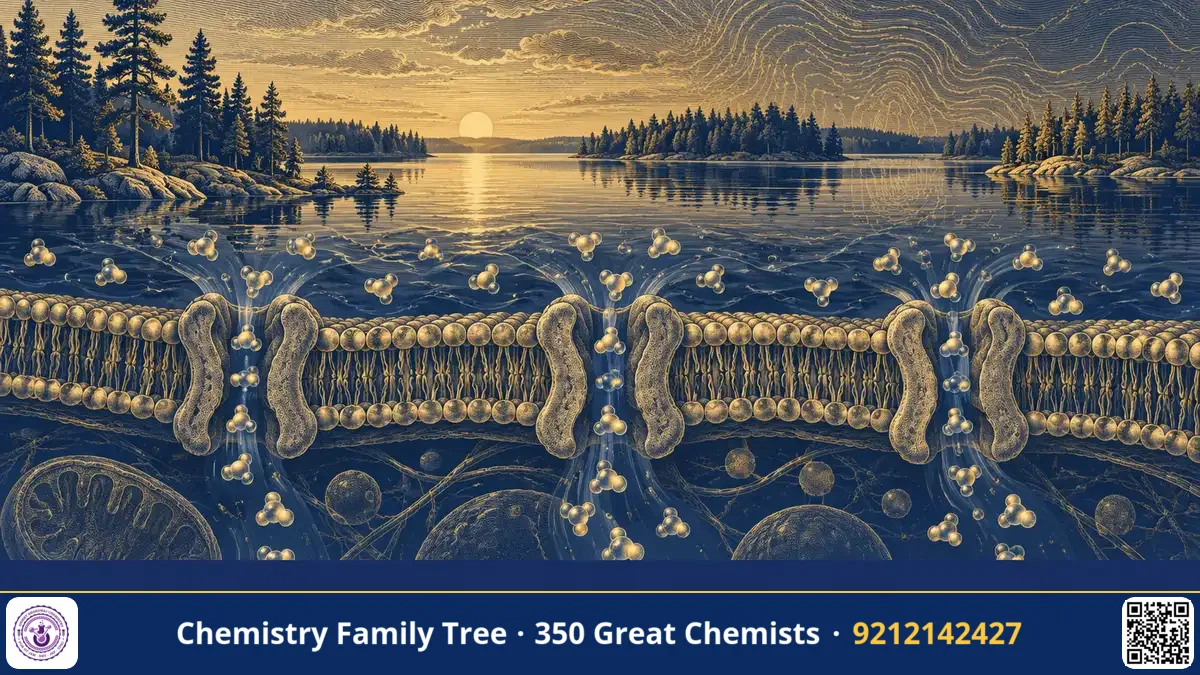
Agre's great contribution is aquaporin-1, the first known water channel. When mRNA for CHIP28 was injected into Xenopus oocytes, the eggs swelled and burst in dilute medium, while control eggs did not. Mercury chloride blocked the effect. The structure revealed an hourglass-shaped tetramer with NPA motifs, and a narrow pore where water moves single file but protons are excluded. The full chemistry is in our discovery article. This single protein explained a century of physiology on how kidneys concentrate urine, how tears and saliva form, and how red cells respond to osmotic stress.
Later, Agre studied aquaporins in disease, and his group investigated malaria, an infection of great importance in tropical countries including India. He worked on how the malaria parasite and mosquito use aquaporins and how new interventions might be designed.
Awards, Honours and Nobel Prize
- Nobel Prize in Chemistry 2003: shared with Roderick MacKinnon, "for discoveries concerning channels in cell membranes". Agre received the half "for the discovery of water channels" and MacKinnon the other half "for structural and mechanistic studies of ion channels". The prize was in Chemistry, not Medicine.
- Member of the US National Academy of Sciences and other academies.
- He later served as president of the American Association for the Advancement of Science (AAAS), the publisher of the journal Science.
- Many honorary degrees.
Personality, Struggles and Lesser-Known Facts
- The contaminant: The water channel was first noticed as a stubborn contaminant in the preparation of the Rh antigen. He chose to investigate rather than ignore it.
- Collaboration: The key oocyte experiment was done together with a colleague in Baltimore, with physiologists who knew the frog egg system, showing the value of teamwork between a haematologist and a membrane physiologist.
- Doctor, not chemist by title: He is a physician, so his Chemistry prize shows how biological questions need chemical answers.
- Science diplomacy: He has travelled to many countries as a science ambassador, including trips to Cuba and other nations, to support scientific exchange.
- Persistence: Early grant reviewers were sceptical that a water channel existed. He kept going.
Legacy and Influence on Modern Chemistry
Thirteen human aquaporins are known, and they are medically important in kidney, eye, brain and secretory glands. Mutations in AQP2 cause nephrogenic diabetes insipidus, where the kidneys cannot concentrate urine. Plant aquaporins are used to study drought tolerance, and aquaporin-based filter membranes are being studied for water purification. His work gave a molecular explanation for osmosis in living cells, a topic that every student meets in school biology and physical chemistry.
Lessons for Students
- Do not discard odd results; investigate them.
- Cross-disciplinary training (medicine plus chemistry) helps you see new questions.
- Use simple, clever experiments: a swelling egg proved a big idea.
- Persist when reviewers doubt your hypothesis, but stay open to evidence.
- Science can serve public health; use your knowledge for others.
Quick Facts Box
- Born: 30 January 1949, Northfield, Minnesota, USA
- Died: Living
- Nationality: American
- Field: Biochemistry, membrane biology, medicine
- Famous for: Discovery of aquaporin water channels
- Nobel: Chemistry 2003 (half, shared with Roderick MacKinnon)
FAQ
Is Peter Agre a chemist or a doctor?
He is a physician-scientist trained in medicine with a chemistry degree. His Nobel Prize was in Chemistry.
Who shared the 2003 Nobel Prize with him?
Roderick MacKinnon, who solved the structure of potassium ion channels.
What was the original name of aquaporin-1?
CHIP28, the channel-forming integral protein of 28 kilodaltons.
What does he work on now?
At Johns Hopkins his group has focused on malaria research and on the role of aquaporins in disease.
Published by ABC Chemistry — IIT-JAM | CSIR-NET | GATE Chemistry Coaching. Visit abcchemistry.com
About the chemist
Peter Agre
1949- · United States · Nobel Chemistry 2003
Discovery of aquaporin water channels