Biography · Chemist no. 312 of 350
Phoebus Levene (1869–1940): The Chemist Who Defined the Nucleotide

Phoebus Aaron Theodore Levene was a Russian-born American physician and biochemist who spent most of his career at the Rockefeller Institute for Medical Research in New York. For about four decades he was the leading authority on the chemistry of nucleic acids. He identified the two sugars of RNA and DNA, introduced the concept of the nucleotide and worked on many other biomolecules. He also proposed a wrong theory, the tetranucleotide hypothesis, which influenced the field for years. His legacy in one line: he laid the chemical groundwork that made the discovery of the DNA double helix possible.
Early Life and Family
Levene was born on 25 February 1869 in the village of Sagor (Žagarė) in the Russian Empire, in what is now Lithuania. His birth name was Fishel Levin, and his family was Jewish. When he was a child, the family moved to St Petersburg, where he attended school and where his name was changed to Feodor (later he used Phoebus). Jewish families in the Russian Empire faced restrictions and, increasingly, violence, and in 1893, the family left Russia for the United States and settled in New York City.
Education and Mentors
Levene studied medicine at the Imperial Military Medical Academy in St Petersburg and received his medical degree in 1891. After emigrating to the United States, he practised medicine for a time in New York while also turning to chemistry. He turned to chemistry and worked in several laboratories in the United States and abroad. He spent periods of study in Europe with leading figures of the time, including Albrecht Kossel in Marburg, who was already famous for his work on nucleic acid bases, and Emil Fischer in Berlin, the master of carbohydrate and protein chemistry. These two mentors determined his future: the study of nucleic acids with the tools of sugar chemistry.
Career Timeline
| Year | Event |
|---|---|
| 1869 | Born in Sagor, Russian Empire (now Lithuania) |
| 1891 | Medical degree, St Petersburg |
| 1893 | Emigrates to the United States |
| 1890s–1900s | Works in laboratories in the United States and studies in Europe |
| 1905 | Joins the Rockefeller Institute for Medical Research as head of a chemistry laboratory |
| 1909 | With Walter Jacobs, identifies D-ribose in nucleic acids |
| 1929 | Identifies 2-deoxy-D-ribose in thymus nucleic acid |
| 1931 | Publishes the book "Nucleic Acids" with Lawrence Bass |
| 1940 | Dies in New York City on 6 September |
Major Scientific Contributions
1. Ribose and deoxyribose. Levene found that RNA and DNA differ in their sugars. Ribose (C₅H₁₀O₅) is in RNA, and deoxyribose (C₅H₁₀O₄) in DNA. This resolved a long-standing question and explained why the two nucleic acids have different chemical properties.
2. The nucleotide. He recognised that the basic unit of a nucleic acid consists of a phosphate, a sugar and a base joined together, and he introduced the term nucleotide. The detailed chemistry is in our companion discovery article.
3. The tetranucleotide hypothesis. He proposed that nucleic acids are small molecules made up of equal amounts of four nucleotides. This view later proved wrong, and it was overturned by Chargaff and others.
4. Other biomolecules. Levene published extensively on carbohydrates, such as hexosamines and the sugars in cartilage and mucins, on the chemistry of proteins and amino acids, on optical activity, and on the relationship between configuration and rotation. He published several hundred papers, and a book "Nucleic Acids" (1931) with Lawrence Bass.
Awards, Honours and Nobel Prize
Levene never won a Nobel Prize, even though he was one of the best-known biochemists in the world in his time. He held high standing in the scientific community, but the detailed list of his honours is not given here, since it cannot be verified with certainty. The most important honour is that every textbook uses the words nucleotide, ribose and deoxyribose in the sense he established.
Personality, Struggles and Lesser-Known Facts
- Immigrant scientist. He left Russia as a young man, partly because of the discrimination that Jews faced, and built his scientific career in a new country and language.
- Tireless worker. Colleagues remembered him for his long hours in the laboratory and for the large number of papers he produced.
- Authority and its cost. Because he was so respected, his tetranucleotide idea was widely accepted for decades. Many historians believe it slowed the acceptance of DNA as genetic material, although other factors also played a role.
- Correct chemistry, wrong biology. His chemical identifications were right, even though his conclusion about molecular size was wrong. It is an important lesson on the difference between data and interpretation.
- Younger scientists. Erwin Chargaff and others later corrected his picture of nucleic acids, and Chargaff paid tribute to the quality of the earlier chemistry.
Legacy and Influence on Modern Chemistry
When Watson and Crick proposed the double helix in 1953, they built it from components that Levene had identified: deoxyribose, phosphate and four bases. The chemistry of nucleotides is now central to biotechnology, medicine and drug design, including antiviral drugs and mRNA vaccines. Levene's work on carbohydrate stereochemistry also contributed to the understanding of glycosides and of the relationship between structure and optical rotation. The Rockefeller Institute, now Rockefeller University, went on to host Oswald Avery's experiments on DNA as the transforming principle, an experiment that finally started to overturn Levene's idea.
Lessons for Students
- Be bold but humble. Even the greatest authorities can be wrong, and good scientists revise their ideas.
- Distinguish data from interpretation. Check whether the method really supports the conclusion.
- Use classical tools well. Levene identified the sugars of nucleic acids with organic chemistry of the time.
- Remember the nucleotide formula. It is a favourite topic in NCERT, JAM and NET.
Quick Facts Box
- Born: 25 February 1869, Sagor (Žagarė), Russian Empire (now Lithuania)
- Died: 6 September 1940, New York City, USA
- Nationality: Russian-born American
- Field: Biochemistry, nucleic acid chemistry
- Famous for: Identifying ribose and deoxyribose, the nucleotide concept, the tetranucleotide hypothesis
- Nobel: None
FAQ
Where did Levene work for most of his career?
At the Rockefeller Institute for Medical Research in New York, which he joined in 1905.
Was Levene a doctor or a chemist?
He was trained as a physician but became a chemist and biochemist.
What was his big mistake?
The tetranucleotide hypothesis, which wrongly suggested that nucleic acids were simple repeating units too uniform to carry genetic information.
Who proved him wrong?
Erwin Chargaff showed that base composition varies between species and that A equals T and G equals C, and Avery's group showed that DNA can transform bacteria.
Published by ABC Chemistry — IIT-JAM | CSIR-NET | GATE Chemistry Coaching. Visit abcchemistry.com
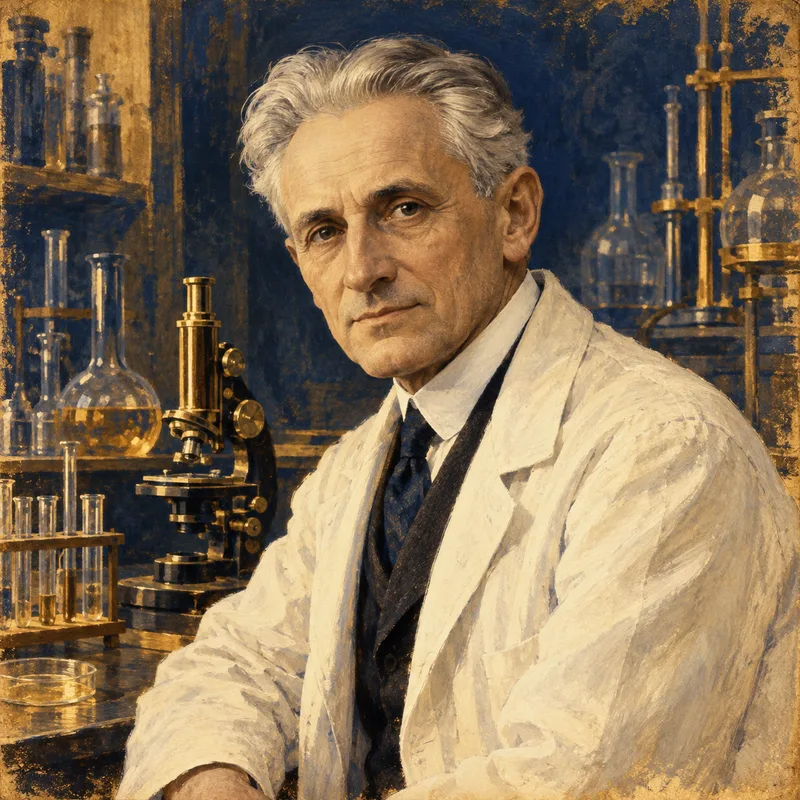
About the chemist
Phoebus Levene
1869-1940 · United States
Nucleic acid composition; ribose, deoxyribose