The discovery, explained · Chemist no. 312 of 350
Phoebus Levene and the Nucleotide: The Sugar-Phosphate Backbone of Heredity
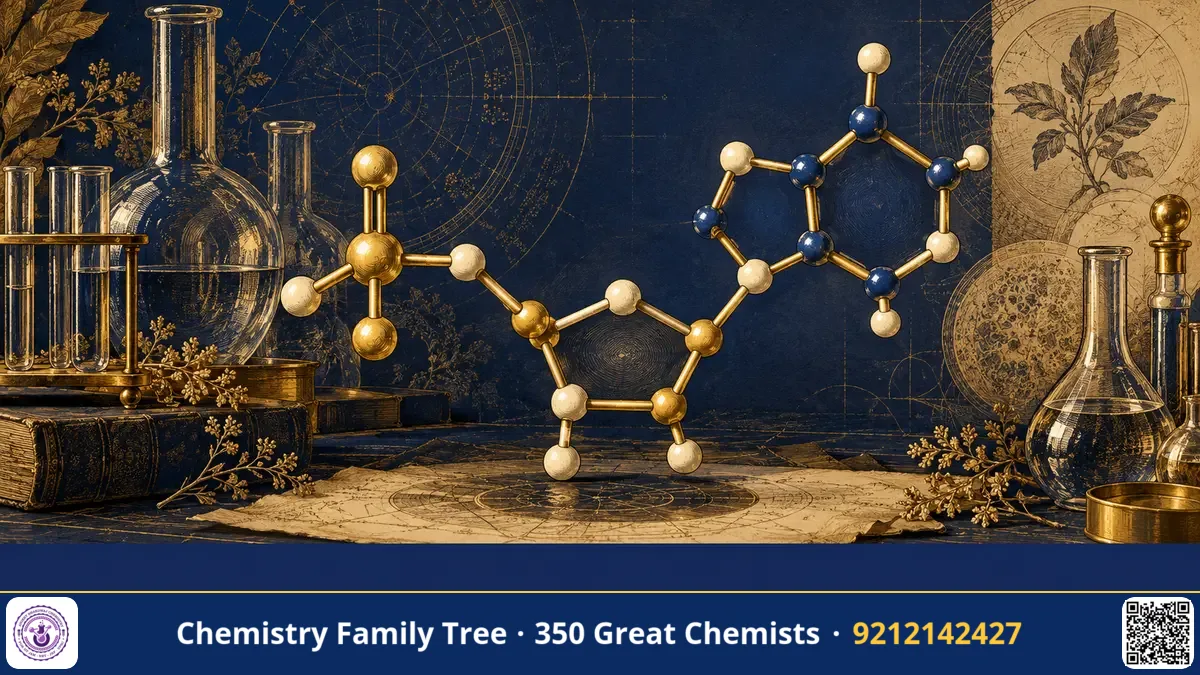
If you open any biochemistry textbook, you will find that DNA and RNA are chains of nucleotides, each made of a base, a five-carbon sugar and a phosphate group. We take this for granted, but at the start of the twentieth century nobody knew it. The person who worked out the nature of the sugars and the way the pieces are connected was Phoebus Aaron Theodore Levene, a Russian-born American biochemist at the Rockefeller Institute. In 1909 he identified D-ribose as the sugar of yeast nucleic acid, in 1929 he identified 2-deoxy-D-ribose as the sugar of thymus nucleic acid, and he introduced the concept of the nucleotide as the basic unit. He also proposed the "tetranucleotide hypothesis", which turned out to be wrong and which delayed the idea that DNA carries genetic information. Studying both his successes and his error is useful for any student of chemistry.
The Scientific Problem Before the Discovery
By 1900, thanks to Miescher and Kossel, it was known that nucleic acids contain phosphoric acid, nitrogenous bases (adenine, guanine, cytosine and thymine or uracil) and a carbohydrate. But three questions remained:
- What exactly is the sugar? Was it a hexose (six carbons), like glucose, or a pentose (five carbons)?
- Is the sugar the same in all nucleic acids?
- In what order and in what way are base, sugar and phosphate connected, and how big are the molecules?
Early workers had found that the nucleic acid from the thymus gland ("thymonucleic acid") and that from yeast ("yeast nucleic acid") differed in properties. In particular, the yeast acid gave a sugar that responded to tests for pentoses, while the thymus acid did not give those tests in the same way. The sugars were present only in small amounts and were unstable, and there were no modern chromatographic or spectroscopic tools. The organic chemistry of carbohydrates, developed by Emil Fischer, was the key to solving the problem.
The Discovery: Step by Step
Step 1: Ribose from yeast nucleic acid (1909)
Working with Walter Jacobs at the Rockefeller Institute, Levene studied the products obtained from yeast nucleic acid and isolated its sugar. By using classical carbohydrate chemistry, they characterised it as a new pentose, D-ribose, C₅H₁₀O₅, an aldopentose, using methods such as oxidation and derivatives of the kind developed by Emil Fischer. Later, ribose was also found in the nucleosides of adenosine, cytidine and uridine.
Step 2: Deoxyribose from thymus nucleic acid (1929)
Levene and his co-workers then showed that the sugar of thymus nucleic acid is not ribose, but a sugar with one oxygen less, 2-deoxy-D-ribose, C₅H₁₀O₄. It lacks the hydroxyl group on carbon 2 of the ring:
D-Ribose:           HOCH₂–CH(OH)–CH(OH)–CH(OH)–CHO       C₅H₁₀O₅
2-Deoxy-D-ribose:   HOCH₂–CH(OH)–CH(OH)–CH₂–CHO          C₅H₁₀O₄
In the nucleic acids, the sugars exist as five-membered ring (furanose) forms, linked to the base through a β-N-glycosidic bond at C-1′.
Step 3: The nucleotide concept (1909–1919)
Levene studied the products obtained by gentle hydrolysis and concluded that the basic unit consists of a base linked to a sugar, with the sugar carrying a phosphate group. He called this unit a nucleotide, and the base-sugar part a nucleoside:
Base + Sugar → Nucleoside     (e.g., adenine + ribose → adenosine)
Nucleoside + H₃PO₄ → Nucleotide     (e.g., adenosine 5′-monophosphate, AMP)
Nucleotides --(3′–5′ phosphodiester bonds)--> Polynucleotide
He proposed that the nucleotides are linked through phosphate groups, which is the sugar-phosphate backbone that we know today, although the exact linkage (3′–5′) was established later by Alexander Todd's group in the 1940s and 1950s, which led to Todd's Nobel Prize in Chemistry in 1957.
Step 4: The tetranucleotide hypothesis (1910s–1930s) — a mistake
Levene's analysis suggested that the four bases occur in equal amounts, so he proposed that a nucleic acid is a short molecule made of just four nucleotides, one for each base, repeated in a fixed order. This is the tetranucleotide hypothesis. If correct, DNA would be too simple and monotonous to carry genetic information, and many scientists therefore thought that proteins, with 20 amino acids, were the likely genetic material. The hypothesis was disproved when Erwin Chargaff used paper chromatography in the late 1940s to show that base composition differs between species, and when Avery, MacLeod and McCarty (1944) showed that DNA transforms bacteria. The errors in Levene's data came from the harsh methods that degraded the samples and gave incomplete recovery of bases, and from the fact that he worked with fragmented DNA.
The Chemistry Behind It
| Feature | RNA | DNA |
|---|---|---|
| Sugar | D-Ribose | 2-Deoxy-D-ribose |
| Bases | A, G, C, U | A, G, C, T |
| Strands | Usually single | Usually double helix |
| Stability | Less stable (2′–OH makes alkaline hydrolysis easy) | More stable |
| Linkage | 3′–5′ phosphodiester bonds | |
The 2′-hydroxyl group of ribose explains why RNA is easily hydrolysed under alkaline conditions: the 2′-OH attacks the neighbouring phosphorus to form a cyclic 2′,3′-phosphate. DNA lacks this group, so it is chemically more stable, an advantage for long-term storage of genetic information.
Applications Today
- Genetics and biotechnology: Understanding nucleotide structure is the basis of PCR, DNA sequencing and cloning.
- Antiviral and cancer drugs: Many drugs are nucleoside analogues that change the sugar: acyclovir, zidovudine (AZT, a 3′-azido-dideoxy nucleoside), sofosbuvir and gemcitabine.
- Energy currency: ATP is a ribonucleotide; understanding of nucleotides explains metabolism, signalling (cAMP) and coenzymes such as NAD⁺ and FAD.
- mRNA vaccines: Chemically modified ribonucleotides are used in the vaccines developed against COVID-19.
- Sanger sequencing: It uses dideoxynucleotides that lack the 3′-OH, a direct application of nucleotide chemistry.
Exam Corner: 5 Likely Points
- Nucleoside = base + sugar; nucleotide = base + sugar + phosphate.
- Ribose is C₅H₁₀O₅ (RNA), deoxyribose is C₅H₁₀O₄ (DNA); deoxyribose lacks the 2′–OH.
- Base attaches to C-1′ of sugar (β-N-glycosidic bond); phosphate esterifies C-5′; the backbone bond is 3′–5′ phosphodiester.
- RNA is hydrolysed in alkali because of its 2′–OH; DNA is not.
- Tetranucleotide hypothesis (Levene) was refuted by Chargaff's rules (A = T, G = C, and base composition varies between species).
Common Misconceptions
- "Levene discovered the structure of DNA." He identified its components and the nucleotide unit, but not the double helix.
- "Deoxyribose has no oxygen." It has one oxygen fewer than ribose (no 2′–OH), but still has the ring oxygen and the other hydroxyl groups.
- "A wrong hypothesis makes a scientist unimportant." Levene's chemistry of nucleotides was correct and essential, only his idea about the size of the nucleic acid was wrong.
Quick Revision Box
- Levene identified ribose (1909) and deoxyribose (1929) as the sugars of RNA and DNA.
- Defined the nucleotide: phosphate + sugar + base.
- Tetranucleotide hypothesis was wrong; Chargaff's work corrected it.
- Ribose has 2′–OH; deoxyribose has 2′–H.
- Backbone: 3′–5′ phosphodiester linkage (established later by Todd).
- He worked at the Rockefeller Institute; no Nobel Prize.
FAQ
Why is it called deoxyribose?
"Deoxy" means without oxygen: the sugar has lost the oxygen of the 2′ hydroxyl group relative to ribose.
Why did the tetranucleotide idea last so long?
Levene was the most respected nucleic acid chemist of his time, and the analytical methods of the period seemed to confirm equal amounts of bases. Better methods were needed to show the truth.
What is the difference between a nucleoside and nucleotide?
A nucleoside has a base and sugar only. A nucleotide has in addition one or more phosphate groups.
Is Levene's work part of the Class 12 syllabus?
Yes. NCERT Class 12 Biomolecules covers nucleotides, the sugars of DNA and RNA and the types of bases.
Published by ABC Chemistry — IIT-JAM | CSIR-NET | GATE Chemistry Coaching. Visit abcchemistry.com
About the chemist
Phoebus Levene
1869-1940 · United States
Nucleic acid composition; ribose, deoxyribose