Biography · Chemist no. 270 of 350
Pierre Curie (1859–1906): A Quiet Genius of Physics and Radioactivity
Pierre Curie was a French physicist who discovered piezoelectricity, established important laws of magnetism, and, with Marie Curie, helped to discover polonium and radium. He shared the 1903 Nobel Prize in Physics. His life ended suddenly in a road accident at the age of 46, but his ideas and the scientific partnership he formed with Marie shaped the study of radioactivity and chemistry.
Early Life and Family
Pierre was born in Paris on 15 May 1859. His father, Eugène Curie, was a doctor, and his mother, Sophie-Claire Depouilly, came from a family of manufacturers. The family was Protestant in outlook, with a free-thinking atmosphere. Pierre was a dreamy, independent child who did not do well in conventional school. His parents therefore educated him at home, with help from private teachers and his father, who encouraged his interest in nature and science. His elder brother Jacques became his first research partner.
Education and Mentors
Pierre showed great mathematical ability and finished his baccalaureate at 16. He received a degree (licence) in physical sciences from the Sorbonne at 18. He then worked as a laboratory assistant. Paul Desains, a physicist at the Sorbonne, was among his early teachers. In 1882 he was appointed supervisor of laboratory work at the new École municipale de physique et de chimie industrielles (ESPCI) in Paris, where he stayed for 22 years, working in poor conditions. He completed his doctorate in 1895 with a thesis on the magnetic properties of bodies at different temperatures.
Career Timeline
| Year | Event |
|---|---|
| 1859 | Born in Paris (15 May). |
| 1880 | With his brother Jacques, discovers piezoelectricity. |
| 1882 | Appointed head of laboratory work at the Paris School of Physics and Chemistry (ESPCI). |
| 1895 | Doctorate on magnetism; formulates Curie's law and the idea of the Curie point; marries Marie Skłodowska (26 July). |
| 1897 | Daughter Irène born (later a Nobel laureate in Chemistry, 1935). |
| 1898 | Joins Marie's work on radioactivity; polonium and radium announced. |
| 1903 | Shares the Nobel Prize in Physics with Marie Curie and Henri Becquerel. |
| 1904 | Appointed professor at the Sorbonne; daughter Ève born. |
| 1905 | Elected to the Académie des sciences. |
| 1906 | Killed in a street accident in Paris (19 April). |
Major Scientific Contributions
Piezoelectricity. The Curie brothers showed that crystals such as quartz produce charge under stress. This led to the electrometer used to measure tiny currents in radioactivity research, and eventually to quartz clocks.
Magnetism. Pierre divided materials into diamagnetic, paramagnetic and ferromagnetic types and found that diamagnetism is almost independent of temperature, while paramagnetism follows Curie's law (χ = C/T). He discovered that ferromagnets lose their magnetism at a specific temperature, now called the Curie point.
Symmetry principle. He argued that the symmetry elements of the cause must be found in the effect, an idea still used in crystallography and spectroscopy.
Radioactivity. From 1898, he abandoned crystal research to work on radioactive elements. He measured the heat released by radium, studied how the rays are bent by magnets (showing there are positively charged, negatively charged and neutral rays), and investigated the biological effects of radium. In a famous experiment in 1901, he deliberately strapped radium to his arm for hours to study the burn it caused, which led to medical use of radium against tumours.
²²⁶Ra → ²²²Rn + α      (radium decay)
χ = C / T               (Curie's law)
Awards, Honours and Nobel Prize
The 1903 Nobel Prize in Physics was divided: one half to Henri Becquerel for the discovery of spontaneous radioactivity, and the other half jointly to Pierre Curie and Marie Curie for their research on radiation phenomena discovered by Becquerel. The original nomination did not include Marie, and Pierre is recorded as having pressed that her part in the work be acknowledged; the prize was finally awarded to both. The Curies also received the Davy Medal of the Royal Society in 1903. Pierre did not live to see Marie's second Nobel Prize, in Chemistry in 1911.
Personality, Struggles and Lesser-Known Facts
- Simple tastes. Pierre was modest and uninterested in fame and medals. He was reluctant to accept honours, and he found the attention after the Nobel Prize a distraction from work.
- Poor laboratory. The Curies did their major work in a converted shed with a leaky roof, which Marie later described as hard but happy.
- Health problems. In his later years he suffered pain in his limbs and fatigue. This was possibly connected with radiation exposure, although the cause was never established with certainty.
- Refused the Legion of Honour. He declined the cross of the Légion d'honneur in 1903, saying he had no need of decoration but a laboratory.
- A sudden death. On 19 April 1906, on a rainy day on the rue Dauphine in Paris, he slipped while crossing the street and was struck by a horse-drawn wagon. He died instantly.
- The family continued. Marie took his teaching post at the Sorbonne, becoming the first woman to teach there. Their daughter Irène and her husband Frédéric Joliot-Curie won the 1935 Nobel Prize in Chemistry.
Legacy and Influence on Modern Chemistry
Piezoelectric devices are in nearly every electronic gadget. The Curie point is crucial in materials science. The curie, a unit of radioactivity, honours the family, and the element curium (Z = 96) was named for Pierre and Marie. The radiochemical methods the Curies used, fractional crystallisation guided by activity measurement, were forerunners of modern radiochemistry and led to nuclear medicine. Institutions in France such as the Institut Curie continue research into cancer treatment.
Lessons for Students
- Follow curiosity across fields. Pierre moved from crystals to magnetism to radioactivity.
- Good measurement tools can create a new science, as his electrometer did.
- A strong partnership multiplies results. The Curies worked as equals.
- Safety matters. Early workers handled radium with bare hands, and we now use shielding and monitoring.
Quick Facts
- Born: 15 May 1859, Paris, France.
- Died: 19 April 1906, Paris, France.
- Nationality: French.
- Field: Physics, crystallography, magnetism, radioactivity.
- Famous for: Piezoelectricity, Curie's law, Curie point, polonium and radium.
- Nobel: Physics, 1903 (shared with Marie Curie and Henri Becquerel).
FAQ
Was Pierre Curie a chemist?
He was mainly a physicist, but his work on radium and polonium overlaps strongly with chemistry, and he is in every chemistry history.
How did Pierre Curie die?
He was killed by a horse-drawn wagon in Paris on 19 April 1906.
Which element is named after the Curies?
Curium (Cm, Z = 96), named after Pierre and Marie Curie.
Who were his famous children?
Irène Joliot-Curie, Nobel laureate in Chemistry (1935), and Ève Curie, a writer and the biographer of her mother.
Published by ABC Chemistry — IIT-JAM | CSIR-NET | GATE Chemistry Coaching. Visit abcchemistry.com
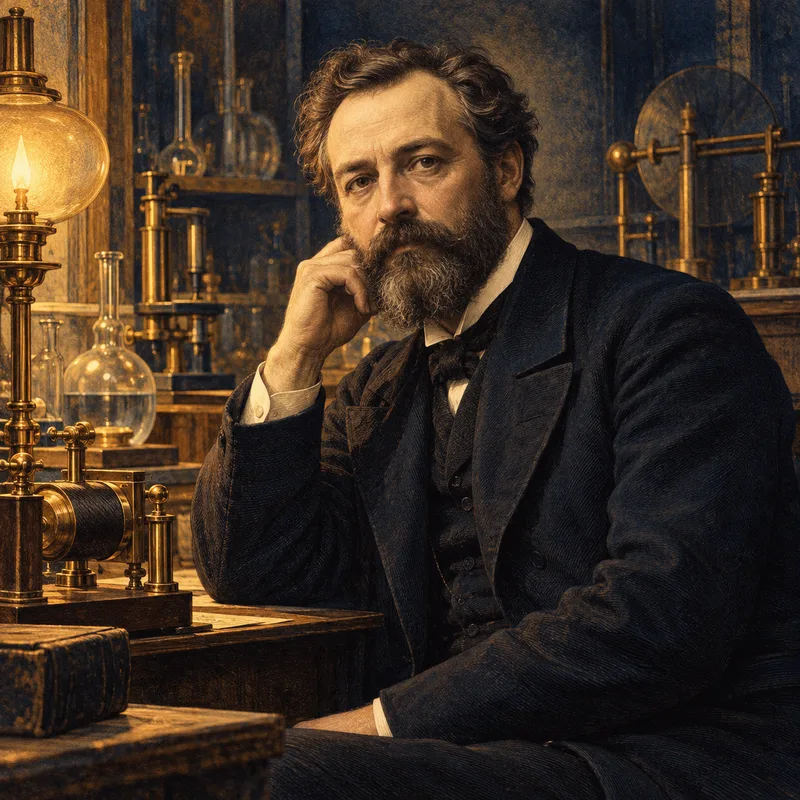
About the chemist
Pierre Curie
1859-1906 · France · Nobel Physics 1903
Radioactivity research; piezoelectricity