The discovery, explained · Chemist no. 270 of 350
Pierre Curie: Crystals, Magnets and the Discovery of Radium and Polonium
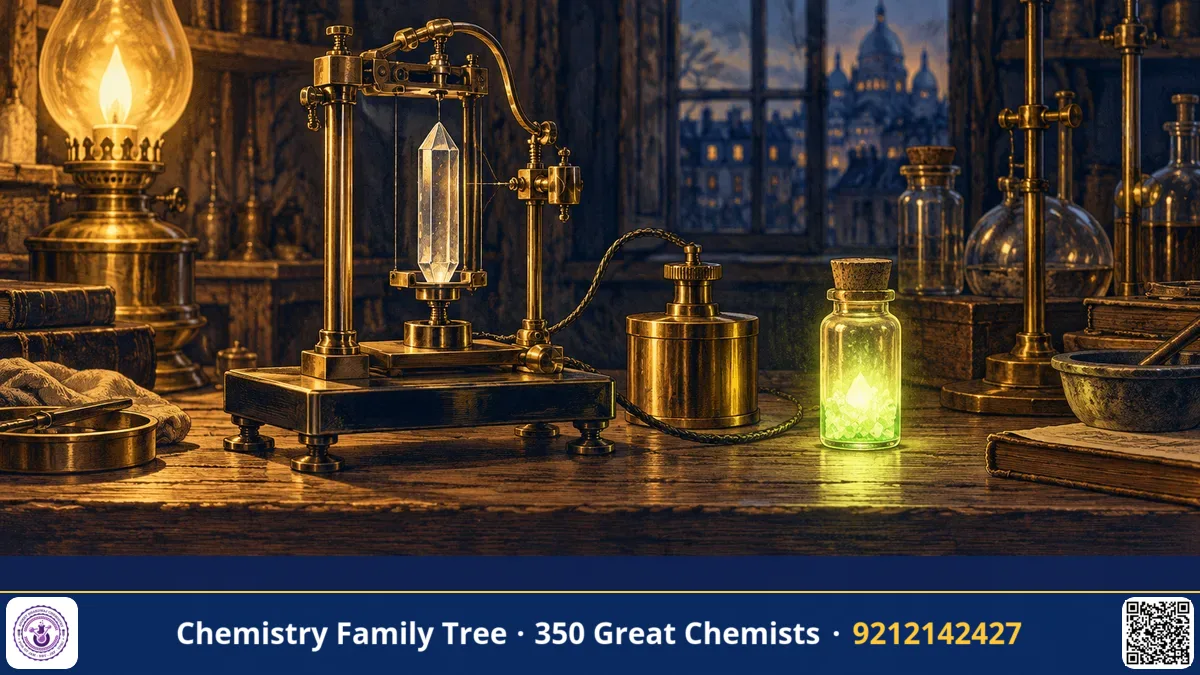
Pierre Curie was a French physicist whose work sits at the border of physics and chemistry. With his brother Jacques, he discovered piezoelectricity in 1880. He then studied magnetism and found that the magnetic behaviour of materials changes with temperature in a simple way (Curie's law) and that ferromagnets lose their magnetism above a certain temperature (the Curie point). Finally, with his wife Marie, he took part in the discovery of two new radioactive elements, polonium and radium. For this he shared the 1903 Nobel Prize in Physics (not Chemistry) with Marie Curie and Henri Becquerel. Marie later won the 1911 Nobel Prize in Chemistry.
The Scientific Problem Before the Discovery
In 1896, Henri Becquerel found that uranium salts emit penetrating rays without any external energy source. Marie Curie then began a systematic study for her doctoral research. She measured the "activity" of uranium compounds using the ionisation of air, which was detected with an electrometer built by Pierre and Jacques Curie using a piezoelectric quartz crystal. She found that pitchblende (a uranium ore, mainly U₃O₈) was much more active than the uranium it contained. This meant that some unknown, much more active substance was present in small amounts.
The Discovery: Step by Step
Piezoelectricity (1880). Pierre and Jacques Curie found that when certain crystals such as quartz, tourmaline and Rochelle salt are squeezed along particular axes, electric charges appear on their faces. The reverse effect (applying a voltage causes the crystal to deform) was predicted by Lippmann and confirmed by the Curie brothers. The effect appears only in crystals that lack a centre of symmetry.
Polonium and radium (1898). Pierre was so interested in Marie's results that he put aside his crystal research and joined her. Their method combined chemistry with the electrometer:
- Dissolve pitchblende in acids and separate it into chemical groups.
- Measure the radioactivity of each fraction with the electrometer.
- Keep only the fractions that were strongly active and repeat.
In July 1898, they reported a bismuth-like active fraction and named the new element polonium after Marie's native Poland. In December 1898, together with Gustave Bémont, they announced a second element in the barium fraction, radium (Latin radius, ray). Radium behaves like barium, so it was separated from barium by fractional crystallisation of the chlorides, as RaCl₂ is slightly less soluble than BaCl₂.
Pitchblende → acid leach → Bi fraction (Po) + Ba fraction (Ra)
RaCl₂ / BaCl₂ → repeated fractional crystallisation → pure RaCl₂
Working in a leaky shed at the École de Physique et Chimie in Paris, they processed tonnes of pitchblende residues. In 1902, Marie succeeded in obtaining about 0.1 g of pure radium chloride and in determining its atomic mass as about 225. Pierre also reported that radium salts continuously give off heat (with Albert Laborde, 1903), which was a puzzle at the time because it seemed to break the conservation of energy. We now know it comes from nuclear decay.
The Chemistry Behind It
Radium (Ra, Z = 88) is an alkaline earth metal in Group 2, below barium, with an [Rn] 7s² configuration. Its chemistry is like barium: Ra²⁺ forms insoluble sulfate RaSO₄ and a soluble chloride. Its most common isotope, ²²⁶Ra, has a half-life of about 1600 years and decays by alpha emission:
²²⁶₈₈Ra → ²²²₈₆Rn + ⁴₂He
Polonium (Po, Z = 84) is a Group 16 element, chemically similar to tellurium and bismuth. ²¹⁰Po has a half-life of about 138 days and is an alpha emitter.
Curie's law for paramagnetic substances says that the magnetic susceptibility is inversely proportional to the absolute temperature:
χ = C / T
where C is the Curie constant. Heat disturbs the alignment of magnetic moments, so the paramagnetism falls as T rises. Above the Curie temperature a ferromagnet becomes paramagnetic (for iron it is about 770 °C, or 1043 K), and the Curie–Weiss law then applies: χ = C/(T − θ).
Pierre also established the Curie principle of symmetry: the symmetry of the causes must appear in the effects. This helped explain why piezoelectricity needs non-centrosymmetric crystals. The unit curie (Ci) for radioactivity, 3.7 × 10¹⁰ disintegrations per second, honours the family; today the SI unit is the becquerel.
Applications Today
- Quartz oscillators: Piezoelectric quartz sets the timing in watches, computers, mobile phones and radios.
- Sensors and ultrasound: Piezoelectric ceramics produce and detect ultrasound for medical scans and sonar. Gas lighters and fuel injectors also use the effect.
- Cancer treatment: Radium was used in early radiotherapy, called Curietherapy or brachytherapy in France. Modern brachytherapy uses other isotopes such as iridium-192 and caesium-137.
- Magnetic materials: The Curie point is important in designing magnetic storage, transformers and thermal switches.
- Research: Radium and polonium started nuclear chemistry and led to nuclear medicine and radiocarbon-type dating techniques.
Exam Corner
- Piezoelectric effect (1880, Pierre and Jacques Curie): mechanical stress creates electric polarisation in non-centrosymmetric crystals.
- Curie's law: χ = C/T for paramagnets; Curie–Weiss law: χ = C/(T − θ).
- Above the Curie temperature, ferromagnetic materials become paramagnetic.
- Polonium (1898) and radium (1898) were discovered from pitchblende; ²²⁶Ra decays to ²²²Rn by alpha emission.
- 1903 Nobel Prize in Physics: Becquerel (half) and Pierre and Marie Curie (half, shared).
Common Misconceptions
- "Pierre Curie won a Chemistry Nobel." No. His Nobel was in Physics (1903). Marie Curie later won the Chemistry Nobel in 1911.
- "Radium was isolated in 1898." It was announced in 1898, but pure radium salts were obtained in 1902 and the metal in 1910 by Marie Curie and André Debierne.
- "Curie's law applies to ferromagnets at all temperatures." It applies to paramagnets, and ferromagnets follow Curie–Weiss only above the Curie point.
Quick Revision Box
- Piezoelectricity discovered 1880 by Pierre and Jacques Curie in quartz, tourmaline, Rochelle salt.
- Polonium (Z = 84) and radium (Z = 88) announced in 1898 from pitchblende.
- Radium is a Group 2 element, similar to barium; separated as chloride.
- Curie's law: χ = C/T.
- Curie point: ferromagnet to paramagnet transition (Fe about 770 °C).
- Nobel Prize in Physics 1903 (shared).
FAQ
Which Nobel Prize did Pierre Curie win?
The 1903 Nobel Prize in Physics, shared with Marie Curie and Henri Becquerel.
What is piezoelectricity in simple words?
It is the creation of an electric voltage when a suitable crystal is squeezed, and also the change in shape when a voltage is applied.
Why is polonium named so?
Marie Curie named it after Poland, her native country, which then had no independent state.
What is the Curie temperature?
It is the temperature above which a ferromagnetic material loses its permanent magnetism and becomes paramagnetic.
Published by ABC Chemistry — IIT-JAM | CSIR-NET | GATE Chemistry Coaching. Visit abcchemistry.com
About the chemist
Pierre Curie
1859-1906 · France · Nobel Physics 1903
Radioactivity research; piezoelectricity