Biography · Chemist no. 327 of 350
Acharya Prafulla Chandra Ray: The Father of Indian Chemistry
Introduction
Prafulla Chandra Ray (1861–1944) was an experimental chemist, a teacher, an industrialist and a social reformer. He is widely called the father of modern Indian chemistry, and Indians remember him as "Acharya" (teacher). He proved that Indians could do original research in chemistry, he trained the generation that built Indian science, and he started one of the first chemical and pharmaceutical companies run by Indians. His life is a reminder that science and nation-building can go together.
Early Life and Family
Ray was born on 2 August 1861 in the village of Raruli-Katipara in the Khulna district of Bengal, then part of British India (now in Bangladesh). His father, Harish Chandra Ray, was a landowner who valued education and kept a good library. As a boy Prafulla was taught at the village school, and the family later moved to Calcutta. A long illness in his teens interrupted his schooling, but it also gave him time to read widely, including biographies of scientists and statesmen such as Benjamin Franklin. This habit of wide reading stayed with him all his life.
Education and Mentors
Ray studied at the Metropolitan Institution in Calcutta, where he attended chemistry lectures at Presidency College as well. He was deeply influenced by the teaching of Alexander Pedler, who made experiments the centre of the lesson. In 1882 he went to the University of Edinburgh on a Gilchrist scholarship. There he studied chemistry under Alexander Crum Brown, took a BSc in 1885 and a DSc in 1887 for work on the copulated sulphates of the copper-magnesium group. He won the Hope Prize and stayed on a little longer to do additional research. While in Edinburgh he also wrote an essay on India before and after the Mutiny, which showed his concern for his country.
Career Timeline
| Year | Event |
|---|---|
| 1861 | Born in Raruli-Katipara, Bengal |
| 1882 | Goes to Edinburgh for higher studies |
| 1887 | Receives DSc from Edinburgh |
| 1889 | Joins Presidency College, Calcutta, as assistant professor |
| 1896 | Reports stable mercurous nitrite |
| 1901 | Founds Bengal Chemical and Pharmaceutical Works |
| 1902 and 1909 | Publishes two volumes of A History of Hindu Chemistry |
| 1912 | Honoured as Companion of the Order of the Indian Empire (CIE) |
| 1916 | Retires from Presidency College; joins University College of Science, Calcutta |
| 1919 | Receives knighthood |
| 1924 | Becomes first president of the Indian Chemical Society |
| 1932 and 1935 | Publishes his autobiography, Life and Experiences of a Bengali Chemist |
| 1944 | Dies in Calcutta on 16 June |
Major Scientific Contributions
Nitrite chemistry. His best-known research is the preparation of stable mercurous nitrite in 1896, followed by studies of nitrites of other metals and of ammonium and alkylammonium nitrites. Read more in our companion post on the discovery. The compounds illustrate oxidation states, the Hg₂²⁺ ion and ambidentate ligands.
Organic sulphur and mercury compounds. He and his students prepared many organic derivatives of mercury and sulphur, and studied their reactions.
History of Hindu Chemistry. This two-volume work collected evidence on chemistry, metallurgy and medicine from ancient and medieval Indian texts. It made Indians aware of their scientific heritage and drew international attention, though modern historians note that some of its interpretations need to be read with care.
Chemical industry. He started a small business from his own rented rooms with very little money. It grew into Bengal Chemical and Pharmaceutical Works, which produced medicines and chemicals and became a model of swadeshi enterprise.
Awards, Honours and Nobel Prize
Ray received a CIE in 1912 and a knighthood in 1919. Several universities honoured him with doctorates, and he was president of the Indian Science Congress and of the Indian Chemical Society. He did not win a Nobel Prize. His great honour was a different one: the title "Acharya" and the respect of students who became leaders in science.
Personality, Struggles and Lesser-Known Facts
- A simple life. He remained a bachelor and lived in a small room in the college laboratory building, wearing plain Indian clothes. He gave a major part of his salary to students and to charity.
- Famine and flood relief. He organised relief work during Bengal floods and famine, and he supported khadi and village industries. He met Mahatma Gandhi and supported the national movement while remaining an academic.
- A teacher who made scientists. Among those who studied or worked with him were Meghnad Saha, Shanti Swarup Bhatnagar, Jnan Chandra Ghosh, Nilratan Dhar, Rasik Lal Datta and Priyadaranjan Ray. Many of them became leaders of Indian science.
- Struggle for a business. Starting an Indian pharmaceutical company in the early 1900s meant facing capital shortage, little demand for Indian-made goods and strong foreign competition.
- Social reformer. He spoke against caste discrimination and untouchability and argued for science education for everyone.
Legacy and Influence on Modern Chemistry
Ray's legacy is human as much as chemical. The Calcutta school he created fed the Indian Association for the Cultivation of Science, the University College of Science and later national laboratories. His student Shanti Swarup Bhatnagar became the founder-director of the Council of Scientific and Industrial Research. Bengal Chemicals later became a public sector enterprise and shows the link between education and industry. Today, the Indian Chemical Society and many university chemistry departments carry the tradition he began. His birth anniversary is remembered each year in India, and Indian students still read his autobiography.
Lessons for Students
- Do original work with whatever equipment you have. Ray's results came from modest apparatus and careful thinking.
- Combine research with service. He wanted chemistry to help farmers, patients and industry.
- Read widely. Biography, history and literature gave him a mission.
- Teach generously. His greatest "product" was his students.
- Live simply and give. Wealth was not the aim of his life.
Quick Facts Box
- Born: 2 August 1861, Raruli-Katipara, Bengal (now Bangladesh)
- Died: 16 June 1944, Calcutta
- Nationality: Indian (British India)
- Field: Inorganic and organic chemistry, history of chemistry
- Famous for: Mercurous nitrite (1896), Bengal Chemicals, A History of Hindu Chemistry
- Nobel: None
FAQ
Why is P. C. Ray called the father of Indian chemistry?
He was the first Indian to build a research school in chemistry, published original discoveries that were noticed abroad, trained many leading scientists and started an Indian chemical industry.
What is Bengal Chemicals?
It is the company Ray founded in 1901 as Bengal Chemical and Pharmaceutical Works. It manufactured medicines and chemicals in India at a time when most were imported.
Did P. C. Ray win a Nobel Prize?
No. But his students and the institutions he built made a large contribution to Indian science.
Which book should I read to learn more?
His autobiography, Life and Experiences of a Bengali Chemist, and A History of Hindu Chemistry are the two best-known works.
Published by ABC Chemistry — IIT-JAM | CSIR-NET | GATE Chemistry Coaching. Visit abcchemistry.com
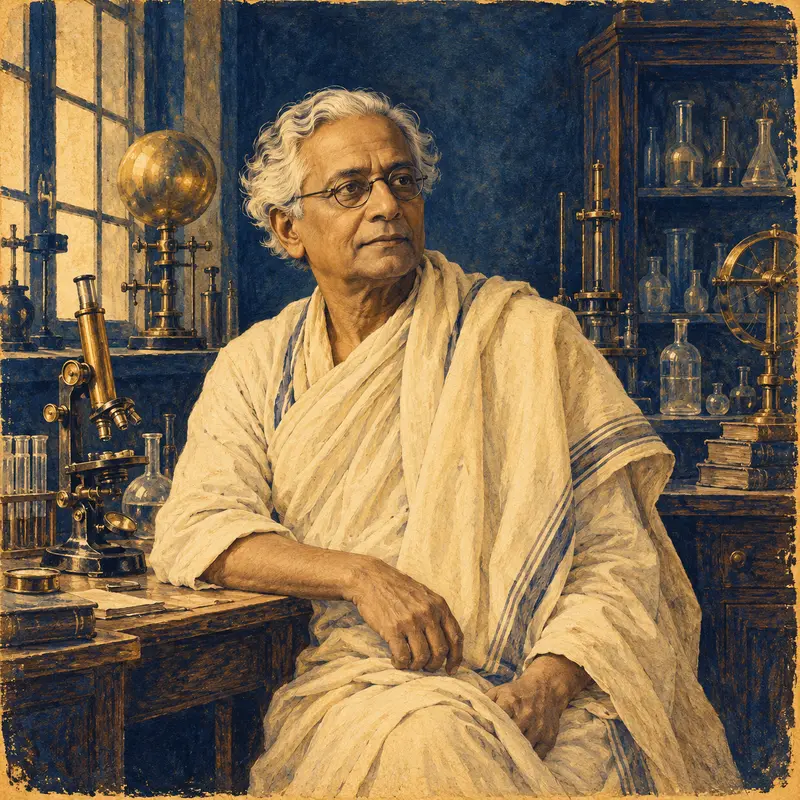
About the chemist
Prafulla Chandra Ray
1861-1944 · India
Mercurous nitrite; founded Indian chemical industry