The discovery, explained · Chemist no. 327 of 350
P. C. Ray and Mercurous Nitrite: The Discovery That Announced Indian Chemistry to the World
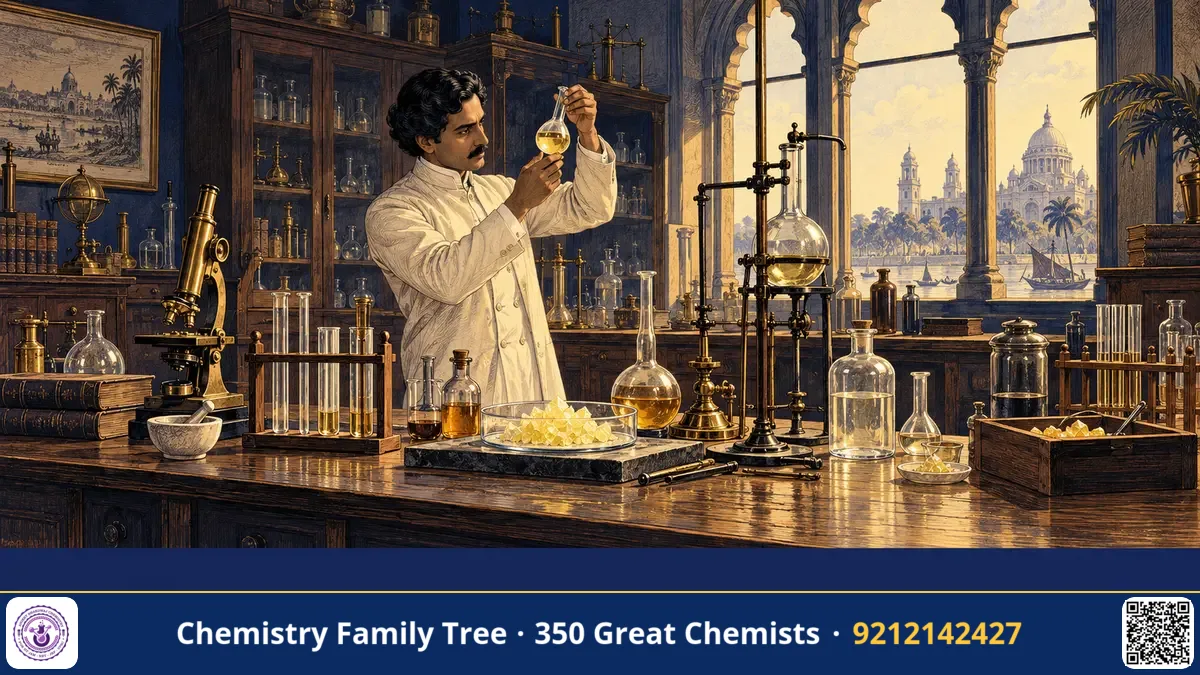
In 1896, in a modest laboratory of Presidency College, Calcutta, a Bengali chemist reported something that European textbooks had said was nearly impossible: a stable, isolable nitrite of mercury. Prafulla Chandra Ray, then in his mid-thirties, had prepared mercurous nitrite, Hg₂(NO₂)₂, and published the work in the Journal of the Asiatic Society of Bengal. The compound itself is not a household chemical. Its importance is different. It opened a long programme of research on metal nitrites and alkylammonium nitrites, it gave modern India its first internationally noticed research school in chemistry, and it showed a generation of Indian students that world-class science could be done at home with simple equipment.
The Scientific Problem Before the Discovery
By the 1890s chemists knew a great many nitrates (salts of HNO₃) but far fewer nitrites (salts of HNO₂). Nitrous acid itself is unstable and decomposes in solution: 3HNO₂ → HNO₃ + 2NO + H₂O. Many heavy-metal nitrites were believed to be too unstable, too easily oxidised, or too easily converted into basic salts to be obtained pure. Mercury was a particularly difficult case, because mercury forms two series of compounds: mercurous (Hg₂²⁺, with a Hg–Hg bond) and mercuric (Hg²⁺). A nitrite ion is a reducing agent as well as a ligand, and mercurous ions disproportionate easily, so a clean mercurous nitrite seemed unlikely.
Ray's problem was therefore practical and conceptual at the same time. Could he control the oxidation state of mercury and the acidity of the solution well enough to obtain a pure, crystalline, reproducible compound?
The Discovery: Step by Step
Ray worked with very limited funds and mostly with locally made apparatus. His route, in outline, followed the logic of careful low-acidity chemistry.
- Step 1: Make mercurous nitrate. Metallic mercury is treated with cold, dilute nitric acid, with mercury kept in excess so that oxidation stops at the mercurous stage.
- Step 2: Introduce nitrite. The mercurous nitrate solution is treated with a nitrite of an alkali metal under controlled conditions, so that double decomposition gives the poorly soluble mercurous nitrite.
- Step 3: Isolate and wash. The pale yellow solid is filtered, washed, and dried away from heat and strong light.
6Hg + 8HNO₃ → 3Hg₂(NO₃)₂ + 2NO + 4H₂O   (excess Hg, cold, dilute acid)
Hg₂(NO₃)₂ + 2NaNO₂ → Hg₂(NO₂)₂ ↓ + 2NaNO₃
He then analysed the product for mercury and nitrite and studied its behaviour on warming, showing that it is a true compound and not a basic salt mixture. On heating, it decomposes with the formation of mercury or mercury oxide and oxides of nitrogen. Ray later extended the work to nitrites of other metals and, around 1911–1912, to ammonium and alkylammonium nitrites. Ethylammonium nitrite, a salt that is liquid near room temperature, is often cited today as an early example of what we now call an ionic liquid, although the term did not exist then.
The Chemistry Behind It
Mercurous ion. The mercurous ion is a dimer, ⁺Hg–Hg⁺, with oxidation state +1 for each mercury atom. The Hg–Hg bond is the reason why it is written Hg₂²⁺ and never Hg⁺. This is a favourite exam point.
Disproportionation. Hg₂²⁺ ⇌ Hg + Hg²⁺. Anything that removes Hg²⁺ (by forming a very insoluble or very stable mercuric compound, for example with OH⁻, S²⁻ or CN⁻) pushes the equilibrium to the right. In Ray's preparation the key was to avoid such conditions and to keep mercury in contact with the solution.
Nitrite as a ligand. The nitrite ion NO₂⁻ is ambidentate. It can bind through nitrogen (nitro, M–NO₂) or through oxygen (nitrito, M–ONO). This is the classic example of linkage isomerism in coordination chemistry, and nitrite chemistry such as Ray's laid the ground for it.
| Species | Oxidation state of N | Shape |
|---|---|---|
| NO₂⁻ (nitrite) | +3 | Bent, sp² N |
| NO₃⁻ (nitrate) | +5 | Trigonal planar |
| Hg₂²⁺ | Hg is +1 | Linear Hg–Hg unit |
Applications and Indian Context
Mercurous nitrite is a laboratory compound and mercury compounds are toxic, so there is no industrial use to describe. The real applications of Ray's discovery lie elsewhere.
- Nitrite chemistry today. Sodium nitrite is used in diazotisation (ArNH₂ + NaNO₂ + 2HCl → ArN₂⁺Cl⁻ + NaCl + 2H₂O) for azo dyes, and as a food preservative for cured meat. Nitrite ligands remain textbook examples of linkage isomerism.
- Ionic liquids. Low-melting alkylammonium nitrites, first reported in Ray's laboratory, are part of the early history of a field now used in green chemistry, electrochemistry and catalysis.
- The Indian research school. Ray taught and guided students including Meghnad Saha, Shanti Swarup Bhatnagar, Jnan Chandra Ghosh and Nilratan Dhar. His research group is regarded as the first real school of chemistry in India.
- Industry. In 1901 he founded Bengal Chemical and Pharmaceutical Works, using chemistry for making medicines and chemicals in India. He wished science to serve the nation and not only publish papers.
Exam Corner
- Mercurous ion is Hg₂²⁺ with an Hg–Hg bond; diamagnetic, so no unpaired electrons.
- Mercurous nitrite is Hg₂(NO₂)₂, first prepared pure by P. C. Ray in 1896.
- NO₂⁻ shows linkage isomerism: nitro (N-bonded) versus nitrito (O-bonded). A standard example is [Co(NH₃)₅(NO₂)]²⁺ (yellow) and [Co(NH₃)₅(ONO)]²⁺ (red).
- Disproportionation of Hg₂²⁺ is favoured by OH⁻, S²⁻, CN⁻ and NH₃, giving Hg and a mercuric compound.
- Acidified nitrite gives nitrous acid, which on standing gives NO and HNO₃ (3HNO₂ → HNO₃ + 2NO + H₂O).
Common Misconceptions
- "Mercurous means Hg⁺." Wrong. The correct ion is the dimer Hg₂²⁺.
- "Nitrite and nitrate are interchangeable." They differ in oxidation state (+3 versus +5), shape and chemistry. Nitrite is both a reducing agent and an oxidising agent; nitrate is mainly oxidising.
- "Ray was only a historian of chemistry." He wrote A History of Hindu Chemistry, but he was first an experimental chemist who published original research on nitrites, mercury compounds and organosulphur chemistry.
Quick Revision Box
- Compound: mercurous nitrite, Hg₂(NO₂)₂, reported in 1896.
- Place: Presidency College, Calcutta.
- Key idea: control acidity and oxidation state of mercury.
- Later work: ammonium and alkylammonium nitrites (about 1911–1912).
- Nitrite is an ambidentate ligand (N or O donor).
- Founded Bengal Chemical and Pharmaceutical Works in 1901.
FAQ
What exactly did P. C. Ray discover?
He prepared and characterised mercurous nitrite, a stable compound that had been thought difficult or impossible to isolate, and published it in 1896. It is generally treated as the first major original discovery in chemistry from a modern Indian laboratory.
Why is mercurous nitrite not used in industry?
It is toxic, sensitive to heat and light, and has no special advantage over other reagents. Its significance is historical and scientific.
Is mercurous nitrite asked in competitive exams?
The compound itself rarely appears. What is asked is the chemistry around it: the Hg₂²⁺ ion, disproportionation, nitrite linkage isomerism and oxidation states of nitrogen.
How should I study this topic?
Learn the formula Hg₂²⁺, write the disproportionation equation, memorise the nitro and nitrito isomers, and connect the story with the name of the scientist and the year 1896.
Published by ABC Chemistry — IIT-JAM | CSIR-NET | GATE Chemistry Coaching. Visit abcchemistry.com
About the chemist
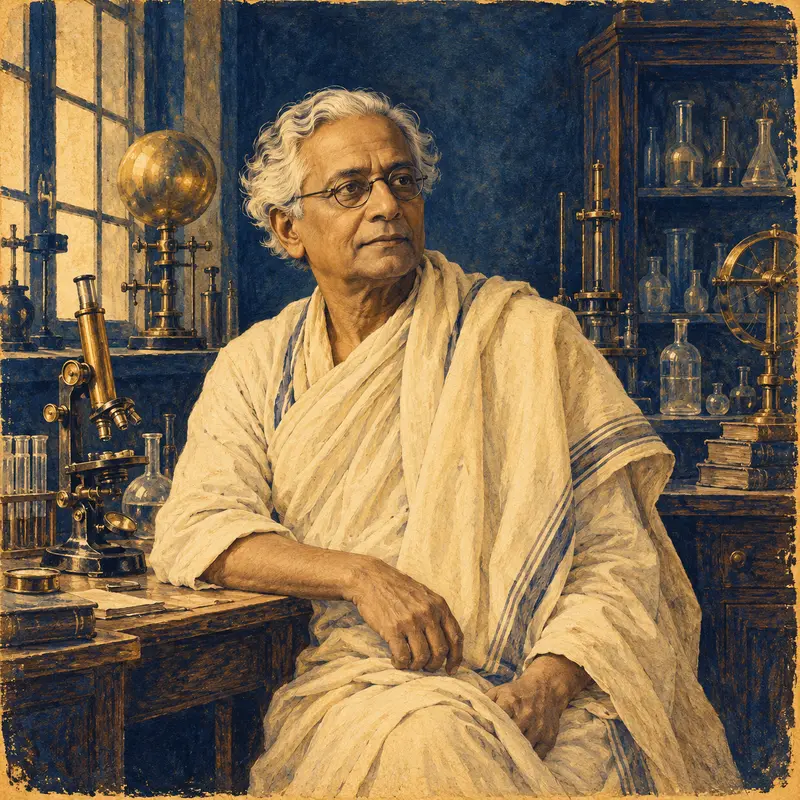
Prafulla Chandra Ray
1861-1944 · India
Mercurous nitrite; founded Indian chemical industry