Biography · Chemist no. 306 of 350
Ralph G. Pearson (1919–2022): A Century of Chemistry and the Idea of Hardness
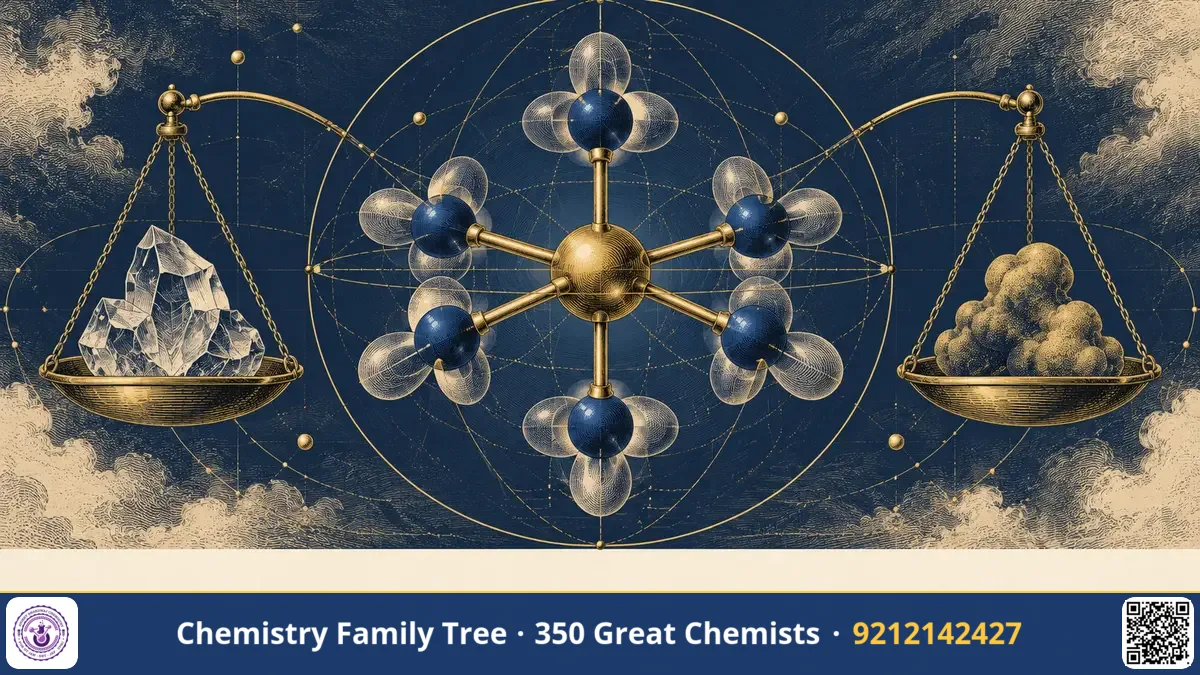
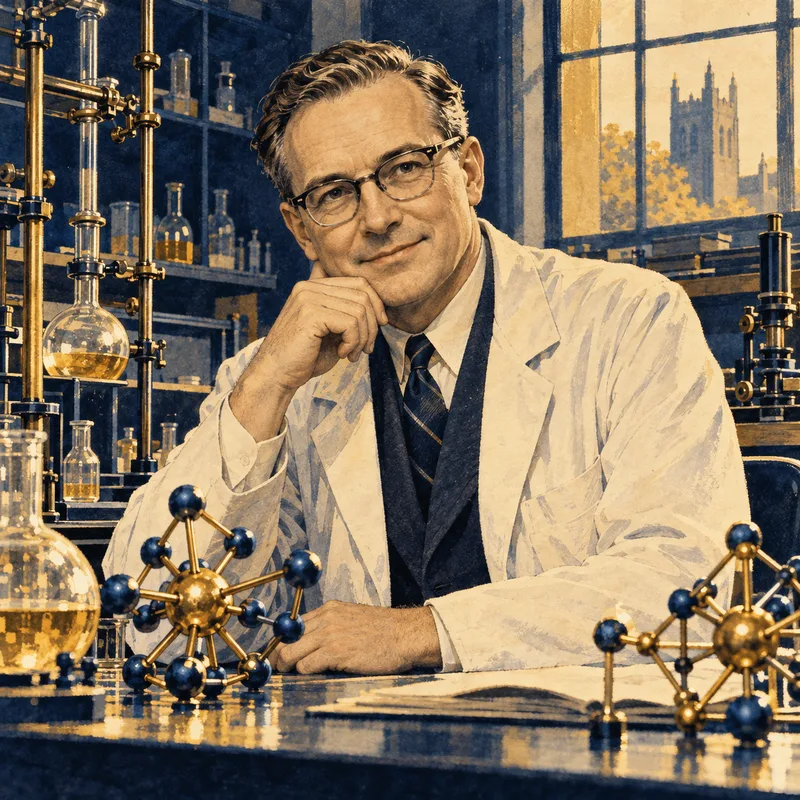
Ralph Gottfrid Pearson was an American chemist whose long life stretched across a hundred years of change in chemistry. He is best known for the HSAB principle (hard and soft acids and bases), which he proposed in 1963, but he was also a founder of the modern study of mechanisms of inorganic reactions, especially substitution in metal complexes. He lived past the age of 100 and remained interested in science late in life. His legacy in one line: he gave chemists a simple, memorable rule for predicting which species will bind to which.
Early Life and Family
Pearson was born on 12 July 1919 in Chicago, Illinois, in the United States. He grew up in the Chicago area during the interwar years and developed an interest in chemistry during his school years. Details of his parents' lives are not widely documented, so they are not repeated here.
Education and Mentors
Pearson studied chemistry at the University of Chicago, where he took his bachelor's degree, and went on to earn his PhD at Northwestern University in 1943. He worked at Northwestern for most of the following decades. At Northwestern he became a colleague and collaborator of Fred Basolo, with whom he wrote the influential book "Mechanisms of Inorganic Reactions" (1958; a second edition followed in 1967), which defined the field.
Career Timeline
| Year | Event |
|---|---|
| 1919 | Born in Chicago, Illinois |
| 1943 | PhD, Northwestern University |
| 1946 | Joins the Northwestern chemistry faculty |
| 1958 | Publishes "Mechanisms of Inorganic Reactions" with Fred Basolo |
| 1963 | Proposes the HSAB principle |
| 1976 | Moves to the University of California, Santa Barbara |
| 1983 | With Robert Parr, defines absolute hardness within density functional theory |
| 1990s–2000s | Continues research on hardness, symmetry rules and reaction mechanisms as an emeritus |
| 2022 | Dies, having lived past 100 |
Major Scientific Contributions
1. Mechanisms of inorganic reactions. With Basolo and others, Pearson studied how ligands are replaced in octahedral and square planar complexes. They examined dissociative (D), associative (A) and interchange (I) pathways, the effect of leaving group and entering group, and the trans effect in platinum(II) complexes. This work answered questions such as why cisplatin is made by one route and transplatin by another. It also included the study of base hydrolysis in cobalt(III) ammine complexes, the conjugate base (SN1CB) mechanism.
2. HSAB principle (1963). Pearson classified Lewis acids and bases as hard or soft and proposed that hard prefers hard and soft prefers soft. This broadened the earlier class (a)/class (b) idea of Ahrland, Chatt and Davies. See our discovery article for the full classification and examples.
3. Absolute hardness and DFT (1983). With Robert Parr, he showed that hardness has a precise definition, η = (I − A)/2, which comes from the curvature of the energy as a function of electron number. This put the chemical intuition on a firm mathematical footing.
4. Symmetry rules for reactions. In the 1970s, he used orbital symmetry arguments to explain why some inorganic reactions are forbidden or slow, in a way parallel to the Woodward–Hoffmann rules in organic chemistry.
Awards, Honours and Nobel Prize
Pearson did not win a Nobel Prize. He received recognition in inorganic and physical organic chemistry during his career. The exact list of awards is not given here, since the names and years cannot be confirmed with certainty. His books and the HSAB principle are his best-known honours in practice, since they appear in textbooks worldwide.
Personality, Struggles and Lesser-Known Facts
- Active into old age. He continued to publish and discuss chemistry as an emeritus professor well into his nineties, and he lived to be over 100.
- A simple idea that took time. The words "hard" and "soft" were criticised at first as vague. Pearson answered by providing data and, later, quantitative definitions.
- Co-author friendships. His long partnership with Fred Basolo is an example of a productive scientific friendship; their book trained many students in inorganic mechanisms.
- A move to the Pacific coast. He moved from Northwestern to the University of California, Santa Barbara in the 1970s, a big change late in his career.
- Wide-ranging interests. He published on organic reactions, catalysis and theoretical concepts such as the "maximum hardness principle".
Legacy and Influence on Modern Chemistry
The HSAB principle is taught in nearly every undergraduate and postgraduate inorganic chemistry course. It explains mineral occurrence, toxicity, catalysis, drug action and selectivity in organic reactions. Chemical hardness and softness indices are now reported in computational chemistry and used in studies of reactivity, including the "conceptual DFT" field. The study of mechanism in coordination compounds, which he helped found, remains essential for designing metal-based drugs such as cisplatin and catalysts for industry. Indian students meet Pearson's name in questions on ligand substitution, the trans effect and acid-base theory.
Lessons for Students
- Look for patterns. HSAB came from arranging large amounts of data into a simple rule.
- Sharpen your ideas with numbers. Pearson later gave "hardness" a formula so that it could be calculated.
- Long careers need curiosity. He kept learning for decades.
- Memorise key classifications. Knowing which ions are hard or soft is a quick source of marks in NET and GATE.
Quick Facts Box
- Born: 12 July 1919, Chicago, Illinois, USA
- Died: 2022, aged over 100
- Nationality: American
- Field: Inorganic and physical chemistry
- Famous for: HSAB principle (1963), inorganic reaction mechanisms, chemical hardness (η)
- Nobel: None
FAQ
Who proposed the HSAB principle?
Ralph G. Pearson proposed it in 1963, building on the earlier class (a) and class (b) metal ion classification.
What book is Pearson famous for?
"Mechanisms of Inorganic Reactions", written with Fred Basolo, is a classic text on ligand substitution in complexes.
How did Pearson and Parr work together?
In 1983 they linked chemical hardness to density functional theory, defining it as half the difference between ionisation energy and electron affinity.
Is HSAB useful in exams?
Yes. Questions on the stability of complexes, solubility of salts, ambidentate ligands and organic reaction selectivity often use HSAB logic.
Published by ABC Chemistry — IIT-JAM | CSIR-NET | GATE Chemistry Coaching. Visit abcchemistry.com
About the chemist
Ralph Pearson
1919-2022 · United States
Hard and soft acids and bases