The discovery, explained · Chemist no. 306 of 350
Ralph Pearson and the HSAB Principle: "Hard Likes Hard, Soft Likes Soft"
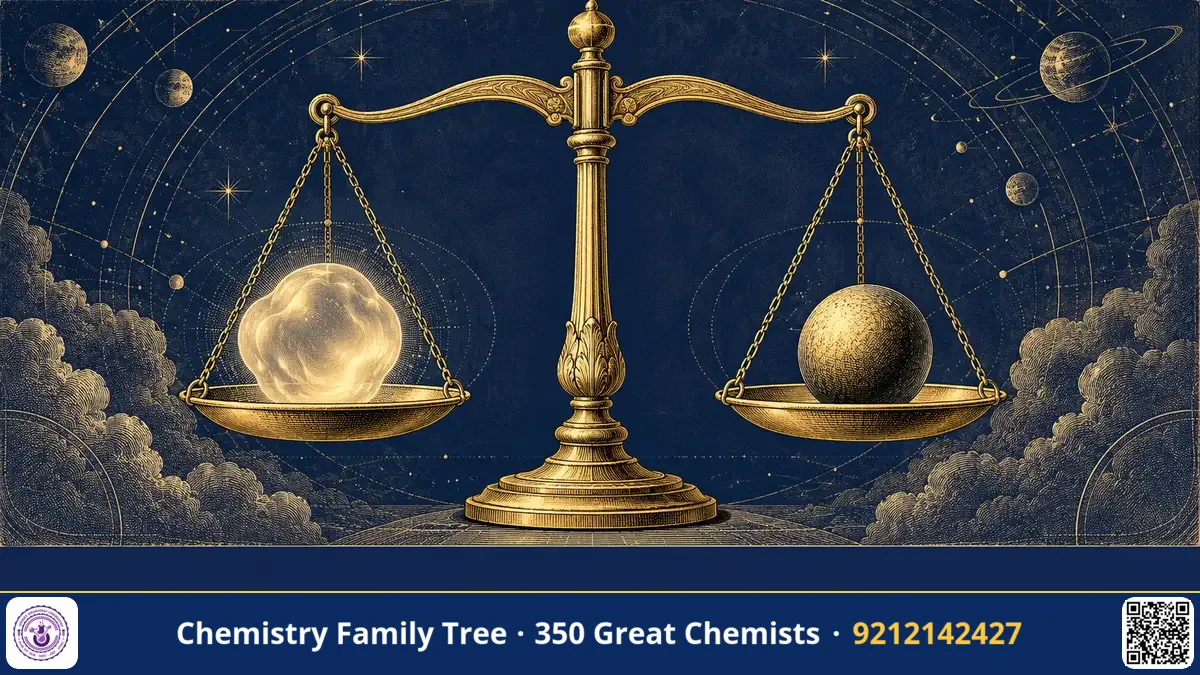
Why does silver occur in nature as the sulphide Ag₂S, while calcium and aluminium occur as oxides, carbonates and silicates? Why is the Hg²⁺ ion so toxic to proteins with –SH groups? Why does Fe³⁺ bind strongly to fluoride but Hg²⁺ prefers iodide? In 1963, the American chemist Ralph G. Pearson gave a unifying answer called the Hard and Soft Acids and Bases (HSAB) principle. Its core statement is easy to remember: hard acids prefer to bind to hard bases, and soft acids prefer to bind to soft bases. HSAB is one of the most useful qualitative tools in inorganic chemistry, and it appears often in IIT-JAM, CSIR-NET and GATE.
The Scientific Problem Before the Discovery
By the 1960s, chemists already had several acid–base definitions: Arrhenius (H⁺/OH⁻), Brønsted–Lowry (proton donor/acceptor) and Lewis (electron-pair acceptor/donor). Lewis theory was general, but it said little about strength or preference. Why do some Lewis acids favour certain bases over others?
Earlier, Ahrland, Chatt and Davies (1958) had divided metal ions into class (a) and class (b) acceptors. Class (a) metals, like Na⁺, Mg²⁺, Al³⁺ and Fe³⁺, form their most stable complexes with the first element of each group of ligands (F⁻, O, N). Class (b) metals, like Ag⁺, Hg²⁺, Pt²⁺ and Au⁺, prefer the heavier donors (I⁻, S, P). This classification fitted the facts, but it was empirical and applied only to metal complexes. Pearson generalised the idea to all Lewis acids and bases, including organic species.
The Discovery: Step by Step
- Collect data. Pearson examined stability constants of complexes and equilibrium constants of acid–base reactions across inorganic and organic chemistry.
- Introduce the terms "hard" and "soft". He borrowed these words to describe how tightly the valence electrons are held.
- Classify species. He placed acids and bases into hard, soft and borderline classes.
- State the principle. The most stable combinations are hard–hard and soft–soft. Hard–soft combinations are comparatively weaker.
What does hard and soft mean?
Hard acids are small, highly charged, weakly polarisable cations with a high-energy LUMO, such as H⁺, Li⁺, Na⁺, Mg²⁺, Al³⁺, Cr³⁺, Fe³⁺ and BF₃. Hard bases have small, highly electronegative donor atoms that hold their electrons tightly and have a low-energy HOMO: F⁻, OH⁻, H₂O, NH₃, O²⁻, CO₃²⁻, SO₄²⁻, Cl⁻ (borderline-hard) and ROH.
Soft acids are large, low-charged, highly polarisable cations with a low-lying LUMO, like Cu⁺, Ag⁺, Au⁺, Hg²⁺, Pd²⁺, Pt²⁺ and also neutral molecules like I₂ and metal atoms in zero oxidation state. Soft bases have large, polarisable donor atoms with a high-energy HOMO: I⁻, S²⁻, SCN⁻, R₂S, RSH, R₃P, CO, CN⁻ and C₂H₄.
| Type | Acids | Bases |
|---|---|---|
| Hard | H⁺, Na⁺, Mg²⁺, Ca²⁺, Al³⁺, Fe³⁺, Ti⁴⁺ | F⁻, OH⁻, H₂O, NH₃, O²⁻, RO⁻ |
| Borderline | Fe²⁺, Co²⁺, Ni²⁺, Cu²⁺, Zn²⁺, Pb²⁺ | Br⁻, N₃⁻, C₆H₅NH₂, pyridine |
| Soft | Cu⁺, Ag⁺, Au⁺, Hg²⁺, Cd²⁺, Pd²⁺, Pt²⁺ | I⁻, S²⁻, CN⁻, R₃P, CO, SCN⁻ (S-bound) |
The Chemistry Behind It
Why does the rule work? Two main reasons.
- Hard–hard interactions are mainly ionic. Small, highly charged ions have strong electrostatic attraction. This is why Al³⁺ binds F⁻ and O²⁻ so strongly.
- Soft–soft interactions are mainly covalent. Large polarisable species have orbitals of similar energy and good overlap. Back-donation (for example, in metal carbonyls) adds to the stability.
Pearson and Robert Parr later gave HSAB a quantitative basis through density functional theory. They defined absolute hardness η as the second derivative of energy with respect to the number of electrons, which can be approximated using ionisation energy (I) and electron affinity (A):
η = (I − A) / 2          (absolute hardness)
χ = (I + A) / 2          (Mulliken electronegativity)
S = 1 / (2η)             (softness)
A large HOMO–LUMO gap gives a hard species, and a small gap a soft species. Another useful principle is the maximum hardness principle: at constant external conditions, a system tends to arrange itself to be as hard as possible.
Examples explained by HSAB
Reaction:  LiI + CsF → LiF + CsI      (hard Li⁺ with hard F⁻; soft Cs⁺ with soft I⁻)
           AgF is very soluble, AgI is very insoluble (soft–soft is favoured)
           SCN⁻ binds to hard Fe³⁺ through N, but to soft Pd²⁺ through S (ambidentate)
           CO is a soft base: Ni + 4CO → Ni(CO)₄ (zero-valent soft metal)
HSAB also predicts the course of organic reactions. In the reaction of an ambident nucleophile such as the enolate, the hard oxygen end reacts with hard electrophiles (like chlorotrimethylsilane), while the soft carbon end reacts with soft electrophiles (like alkyl iodides). Likewise, hard nucleophiles tend to attack the carbonyl carbon (1,2-addition), whereas soft nucleophiles, such as cuprates, do Michael (1,4) addition to α,β-unsaturated ketones.
Applications Today
- Metallurgy and geochemistry: The Goldschmidt classification into lithophile (hard, oxides/silicates) and chalcophile (soft, sulphides) elements fits HSAB. Indian ores of zinc, lead and copper are mainly sulphides.
- Toxicology and medicine: Soft metals Hg²⁺, Cd²⁺ and Pb²⁺ bind to cysteine thiols. Chelation therapy uses soft sulphur donors such as British Anti-Lewisite (dimercaprol) and DMSA for mercury and arsenic poisoning.
- Catalysis and organic synthesis: Selecting nucleophiles, protecting groups and catalysts.
- Analytical chemistry: Choosing masking agents and ligands for titrations, for example, EDTA with hard metals.
- Environmental chemistry: Removing heavy metals from water using sulphide or thiol-functionalised adsorbents.
Exam Corner: 5 Likely Points
- Classify given ions (Fe³⁺, Hg²⁺, Cu⁺, Zn²⁺, CN⁻, F⁻ and so on) as hard, soft or borderline.
- Predict the direction of exchange reactions such as HgF₂ + BeI₂ → BeF₂ + HgI₂ (hard-hard and soft-soft combine).
- Explain why thiocyanate is N-bonded to hard metals and S-bonded to soft metals.
- Know the formulas η = (I − A)/2 and χ = (I + A)/2 and that hardness correlates with large HOMO–LUMO gap.
- HSAB is a rule about preference, not a strict measure of strength; it is independent of Brønsted strength.
Common Misconceptions
- "Hard means strong acid." No. Hardness is about polarisability, not acid strength.
- "Hard acids only bind hard bases." They prefer them, but mixed combinations are possible, just less stable.
- "Oxidation state alone decides hardness." For a given metal, higher oxidation state usually means harder (Fe³⁺ harder than Fe²⁺), but size and electronic structure also matter.
Quick Revision Box
- HSAB (Pearson, 1963): hard prefers hard, soft prefers soft.
- Hard: small, highly charged, low polarisability. Soft: large, low charge, high polarisability.
- Hardness η = (I − A)/2; softness S = 1/(2η).
- Hard–hard is ionic; soft–soft is covalent.
- Ambidentate SCN⁻: N-bonded to hard, S-bonded to soft acids.
- Earlier class (a)/(b) metals were proposed by Ahrland, Chatt and Davies.
FAQ
Is H⁺ a hard or a soft acid?
H⁺ is the hardest acid: it has no electrons, is extremely small and is not polarisable.
Why is mercury toxic according to HSAB?
Hg²⁺ is a soft acid and binds strongly to soft sulphur donors, such as the thiol groups in enzymes, blocking their action.
What is the link between HSAB and Fajans' rules?
Both involve polarisation. Small, highly charged cations (hard) polarise large anions, giving covalent character; HSAB generalises this to explain the stability trends of complexes.
Can hardness be measured?
Yes. Using the approximation η = (I − A)/2 from the ionisation energy and electron affinity, or from HOMO and LUMO energies in calculations.
Published by ABC Chemistry — IIT-JAM | CSIR-NET | GATE Chemistry Coaching. Visit abcchemistry.com
About the chemist
Ralph Pearson
1919-2022 · United States
Hard and soft acids and bases