Biography · Chemist no. 162 of 350
Richard R. Ernst: Complete Life and Legacy of the Master of NMR
Richard Robert Ernst (1933–2021) was a Swiss physical chemist who transformed nuclear magnetic resonance from a slow, specialised technique into the central tool of structural chemistry. He introduced Fourier transform NMR and, with his group at ETH Zurich, two-dimensional NMR. For this work he received the 1991 Nobel Prize in Chemistry on his own. Outside the laboratory he was a passionate collector of Tibetan art and a musician. His legacy: every time a chemist records a ¹H or ¹³C spectrum or a patient lies in an MRI scanner, Ernst's ideas are at work.
Early Life and Family
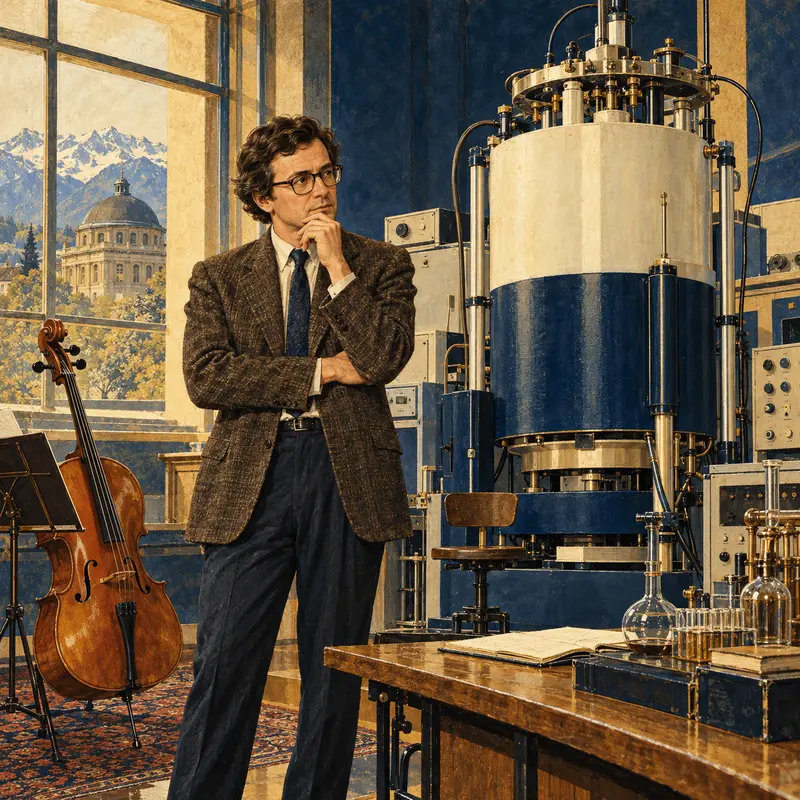
Richard Ernst was born on 14 August 1933 in Winterthur, Switzerland. His father, Robert Ernst, was an architect, and the family lived in a cultured household. As a young boy he found chemistry materials in the attic of the family home and began experimenting with them. This childhood interest in chemistry is often mentioned in accounts of his life. He also loved music and played the cello, and he developed a strong sense of art and beauty, which later extended to his interest in Tibetan painting and culture.
Education and Mentors
Ernst studied chemistry at the Swiss Federal Institute of Technology (ETH) Zurich, where he received his diploma in 1957. He stayed at ETH for his doctoral work, which he completed in 1962 under Hans Primas, a theoretical physical chemist who guided him in magnetic resonance and in the mathematical treatment of spin systems. After the doctorate, he went to the United States to work in industry.
Career Timeline
| Year | Event |
|---|---|
| 1933 | Born in Winterthur, Switzerland |
| 1957 | Diploma in chemistry, ETH Zurich |
| 1962 | PhD, ETH Zurich, under Hans Primas |
| 1963–1968 | Scientist at Varian Associates, Palo Alto, California |
| 1965–1966 | With Weston Anderson, introduced Fourier transform NMR |
| 1968 | Returned to ETH Zurich |
| 1971 onwards | Development of two-dimensional NMR |
| 1976 | Became professor at ETH Zurich |
| 1991 | Awarded the Nobel Prize in Chemistry |
| 2021 | Died on 4 June in Winterthur |
Major Scientific Contributions
Ernst's work on Fourier transform NMR, started at Varian, replaced the slow sweeping of frequencies with a short radiofrequency pulse followed by a mathematical transformation of the free induction decay. This improved sensitivity by a large factor and made ¹³C NMR and other methods practical. At ETH, he developed two-dimensional NMR spectroscopy, building on a suggestion by Jean Jeener. The 2D methods, such as COSY, separate overlapping signals and reveal connections between nuclei.
Further contributions:
- Magnetic resonance imaging: Ernst and co-workers showed in 1975 how to use Fourier methods with field gradients to build up images, which became the basis of modern MRI.
- Protein NMR: His 2D techniques were taken up by Kurt Wüthrich, who used them to determine the structures of proteins in solution.
- Theory: A book, Principles of Nuclear Magnetic Resonance in One and Two Dimensions, written with Geoffrey Bodenhausen and Alexander Wokaun, is a standard reference for the field.
- Solid-state and other methods: Methods for studying solids, dynamics and exchange processes.
Awards, Honours and Nobel Prize
The Nobel Prize in Chemistry 1991 was awarded to Richard R. Ernst "for his contributions to the development of the methodology of high resolution nuclear magnetic resonance (NMR) spectroscopy." This was a Chemistry prize awarded to him alone. He also received other awards, including the Wolf Prize in Chemistry (1991), and he was a member of national academies in several countries.
Personality, Struggles and Lesser-Known Facts
- The attic chemicals: His first chemistry experiments came from materials found in the attic of his family home.
- Cello player: Music was an important part of his life, and he often mentioned how his interest in music and in science supported each other.
- Collector of Tibetan art: He assembled a notable collection of Tibetan paintings (thangkas), and wrote and spoke about this art. He became a scholar of its iconography as well.
- Modest about applications: He was glad that his methods were used in medicine through MRI but credited others for the development of imaging machines.
- Concern for science and society: He spoke in later life about responsible science, and emphasised that research should serve society and not only produce publications.
Legacy and Influence on Modern Chemistry
NMR is today a routine method: nearly every synthetic chemistry paper contains NMR spectra. High-field instruments record multi-dimensional spectra of proteins with hundreds of residues. In medicine, MRI gives images of the brain and organs without ionising radiation. The mathematical thinking behind pulse sequences, in which the spin system is controlled by a series of pulses and delays, has inspired many later techniques, including those used in quantum information. In India, NMR facilities at IITs, IISc, IISERs and CSIR laboratories use FT-NMR as an everyday instrument, and students are trained on its interpretation for the JAM, NET and GATE spectroscopy papers.
Lessons for Students
- Combine mathematics and chemistry. Fourier analysis turned a slow method into a fast one.
- Listen to ideas from others. The 2D experiment began from a suggestion by Jean Jeener.
- Have interests outside science. Music and art kept his thinking creative.
- Think of application. Methods developed for chemistry can transform medicine.
Quick Facts Box
- Born: 14 August 1933, Winterthur, Switzerland
- Died: 4 June 2021, Winterthur, Switzerland
- Nationality: Swiss
- Field: Physical chemistry, NMR spectroscopy
- Famous for: Fourier transform NMR and two-dimensional NMR
- Nobel: 1991, Chemistry (awarded alone)
FAQ
Who was Richard Ernst's doctoral supervisor?
Hans Primas at ETH Zurich.
Did Ernst invent MRI?
No. He contributed key Fourier imaging ideas; the 2003 Nobel Prize in Physiology or Medicine for MRI was awarded to Paul Lauterbur and Peter Mansfield.
What is Ernst famous for in chemistry?
For Fourier transform NMR and two-dimensional NMR spectroscopy.
Which other hobby is he known for?
Collecting and studying Tibetan art, besides playing the cello.
Published by ABC Chemistry — IIT-JAM | CSIR-NET | GATE Chemistry Coaching. Visit abcchemistry.com
About the chemist
Richard R. Ernst
1933-2021 · Switzerland · Nobel Chemistry 1991
Fourier transform NMR spectroscopy