The discovery, explained · Chemist no. 162 of 350
Richard Ernst and Fourier Transform NMR: Making Spectroscopy Fast and Two-Dimensional
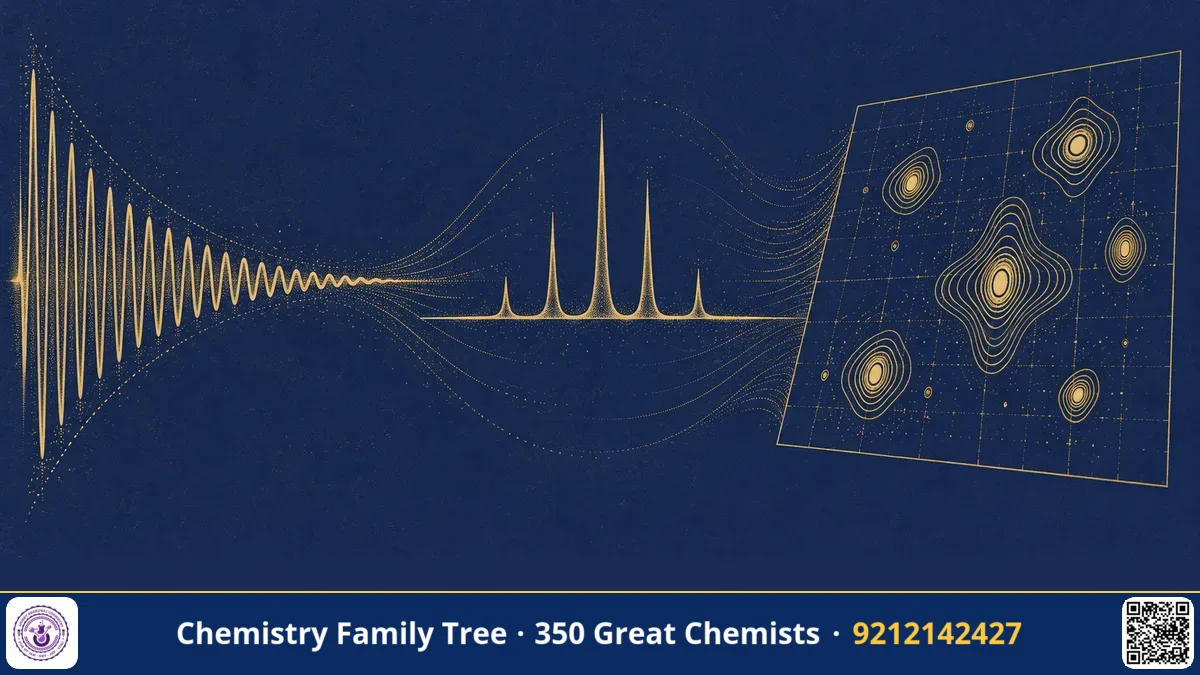
Nuclear magnetic resonance (NMR) is the most important tool an organic chemist has for deciding the structure of a molecule. But in its early form it was slow and insensitive. Richard R. Ernst, a Swiss physical chemist, changed that in two steps. First, in the 1960s, he and Weston Anderson showed that exciting all nuclei with a short radiofrequency pulse and applying a Fourier transform to the response gives a spectrum in a fraction of the time, with much better sensitivity. Second, in the 1970s, his group developed two-dimensional NMR, which spreads the information across two frequency axes and allows the structure of complex molecules, including proteins, to be solved. For this he alone received the 1991 Nobel Prize in Chemistry. Ernst's methods also underlie magnetic resonance imaging (MRI) used in hospitals.
The Scientific Problem Before the Discovery
In the early NMR instruments, called continuous-wave (CW) spectrometers, the magnetic field or radiofrequency was slowly swept across the range, and each resonance was recorded one after another. A typical scan took minutes, and the signal for dilute samples was often too weak to see. Averaging many scans improved the signal-to-noise ratio only in proportion to the square root of the number of scans, so it was very slow.
This was a serious limit for nuclei of low natural abundance and low sensitivity, such as ¹³C (1.1% abundance). Another problem was that the spectra of large molecules are crowded. In a protein ¹H spectrum, hundreds of lines overlap, and chemists could not tell which belong to which atoms.
The Discovery: Pulses, Fourier Transform and a Second Dimension
Ernst worked at Varian Associates in Palo Alto, California, from 1963 to 1968, and then at ETH Zurich. The main steps in his contribution are as follows.
- Pulse excitation. A short, strong radiofrequency pulse excites all nuclei at once, tipping the bulk magnetisation away from the field direction.
- Free induction decay (FID). After the pulse, the magnetisation precesses and decays, producing a signal in the detection coil that contains all frequencies together, in the time domain.
- Fourier transform. A computer converts the time-domain FID into the frequency-domain spectrum: S(ω) = ∫ f(t) e−iωt dt.
- Signal averaging. Because a whole spectrum is obtained in about a second, many FIDs can be added quickly, giving a large gain in sensitivity compared with CW scanning (Ernst and Anderson, 1965–66).
The advantage is often described as the multiplex (Fellgett) advantage: all frequencies are measured at the same time. This made ¹³C NMR a routine method in chemistry laboratories.
The next idea was dimensional. Inspired by a suggestion from Jean Jeener at a conference in 1971 for a two-pulse experiment, Ernst's group at ETH worked out the theory and practice of two-dimensional spectroscopy. In a typical 2D experiment there are four parts: preparation (a pulse), evolution (a time t1 that is increased step by step), mixing (a second pulse) and detection (time t2). A double Fourier transform over t1 and t2 gives a spectrum with two frequency axes, F1 and F2. The group published the basic 2D experiments around 1975–1976, with Aue, Bartholdi and Ernst describing the method.
The Chemistry Behind It
An atomic nucleus with spin I = ½, such as ¹H or ¹³C, has two energy states in a magnetic field B₀. The resonance (Larmor) frequency is:
ν = γB₀ / 2π
where γ is the magnetogyric ratio. Chemical shift (δ), spin–spin coupling (J) and integration all appear in a spectrum. In 2D NMR the extra axis shows relationships between nuclei:
| Experiment | Information |
|---|---|
| COSY | Correlation between nuclei coupled through bonds (J-coupling), shown as cross peaks |
| NOESY | Through-space proximity (nuclear Overhauser effect), useful for 3D structure |
| HSQC / HMQC | Correlation between a proton and the heteronucleus (¹³C or ¹⁵N) directly bonded to it |
| TOCSY | Correlation within a whole coupled spin system |
Cross peaks off the diagonal tell which protons are coupled or close together. Kurt Wüthrich used these 2D methods to determine the three-dimensional structures of proteins in solution, and received the 2002 Nobel Prize in Chemistry.
Applications Today
- Structure determination: Routine characterisation of newly synthesised organic compounds in universities and in pharmaceutical companies in India and abroad.
- Protein NMR: Solution structures and dynamics of proteins, nucleic acids and their complexes.
- MRI: Ernst and co-workers proposed the use of Fourier methods for imaging. Modern MRI scanners use pulses, field gradients and Fourier transformation to produce images of soft tissue.
- Metabolomics and drug discovery: NMR finds the binding of small molecules to proteins.
- Materials science: Solid-state NMR studies polymers, catalysts and battery materials.
Exam Corner
- Richard R. Ernst received the 1991 Nobel Prize in Chemistry (unshared) for methodology of high-resolution NMR spectroscopy.
- FT-NMR: pulse excitation, FID in time domain, Fourier transform to frequency domain.
- Larmor frequency: ν = γB₀/2π; chemical shift δ (ppm) = (ν − νref)/νspectrometer × 10⁶.
- 2D NMR: preparation, evolution (t1), mixing, detection (t2).
- COSY shows J-coupling; NOESY shows through-space proximity.
Common Misconceptions
- "MRI was invented by Ernst." He contributed the Fourier imaging approach; the Nobel Prize in Physiology or Medicine for MRI (2003) went to Paul Lauterbur and Peter Mansfield.
- "Fourier transform adds new information." It only converts the same information from the time domain to the frequency domain; the gain comes from measuring all frequencies at once.
- "2D NMR means two-dimensional molecules." It means two frequency axes in the spectrum.
Quick Revision Box
- CW NMR was slow; pulse FT-NMR measures all nuclei at once.
- FID (time) → Fourier transform → spectrum (frequency).
- 2D NMR sequence: preparation, evolution, mixing, detection.
- COSY (through-bond), NOESY (through-space), HSQC (¹H–¹³C).
- Ernst: 1991 Nobel Prize in Chemistry, alone.
- Methods underlie protein NMR and MRI.
FAQ
Why is FT-NMR more sensitive?
Because all resonances are detected together in a short time, so many scans can be added quickly and the signal-to-noise ratio improves faster.
What is a free induction decay?
The decaying time-domain signal emitted by nuclei after a radiofrequency pulse; its Fourier transform is the NMR spectrum.
Did Ernst win alone?
Yes. The 1991 Nobel Prize in Chemistry went to Richard R. Ernst alone.
How does it connect to JAM and NET?
NMR spectroscopy, chemical shift, coupling and 2D techniques such as COSY are standard topics in the spectroscopy sections.
Published by ABC Chemistry — IIT-JAM | CSIR-NET | GATE Chemistry Coaching. Visit abcchemistry.com
About the chemist
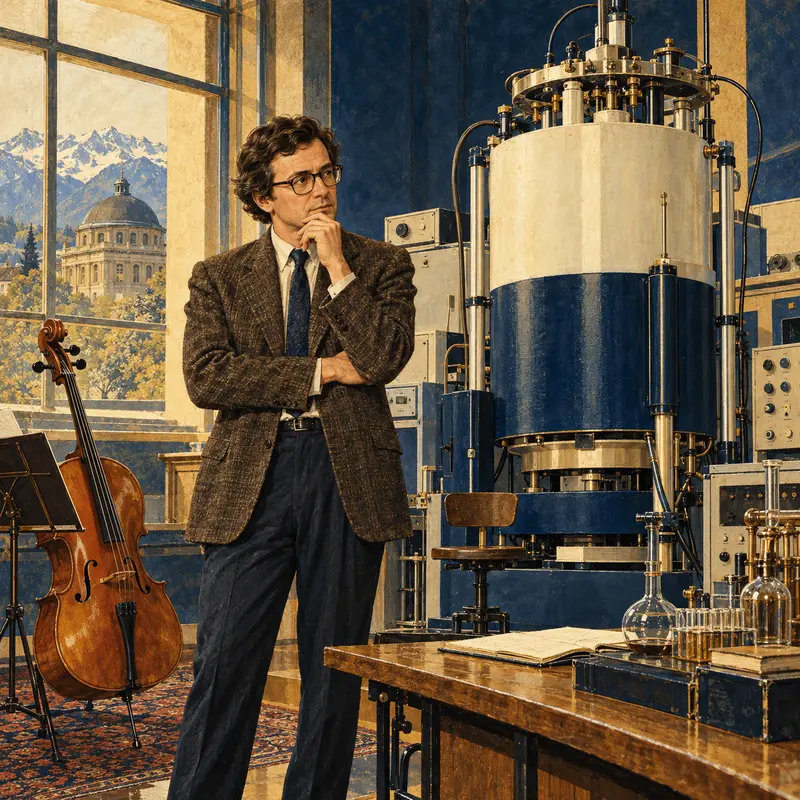
Richard R. Ernst
1933-2021 · Switzerland · Nobel Chemistry 1991
Fourier transform NMR spectroscopy