Biography · Chemist no. 97 of 350
Richard F. Heck: From Industrial Laboratory to the Nobel Prize in Chemistry
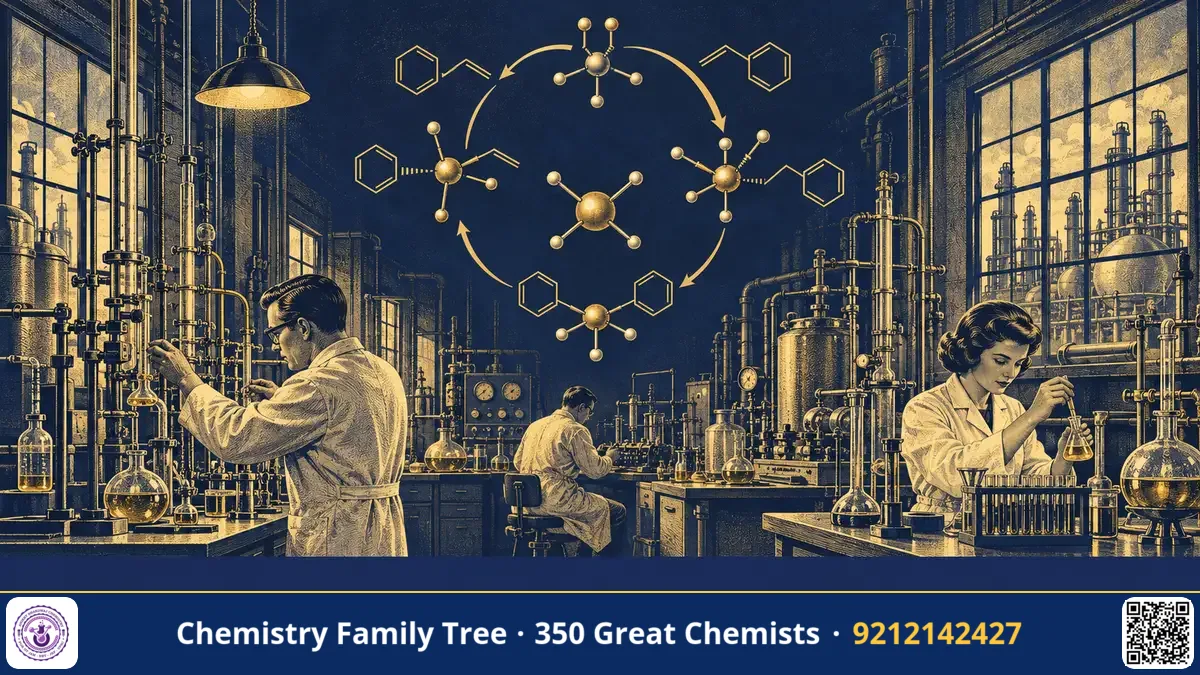
Richard Fred Heck (1931-2015) was an American organic chemist who developed the palladium-catalysed reaction between aryl halides and alkenes, now known as the Heck reaction or the Mizoroki-Heck reaction. He made the key discoveries while working in an industrial laboratory, and he later became a professor at the University of Delaware. In 2010 he shared the Nobel Prize in Chemistry with Ei-ichi Negishi and Akira Suzuki. His legacy in one line: he opened the door to palladium-catalysed carbon-carbon bond formation, a technology that changed pharmaceutical and materials chemistry.
Early Life and Family
Heck was born on 15 August 1931 in Springfield, Massachusetts, in the United States. His childhood coincided with the Great Depression, and his family later moved to Southern California, where he grew up and went to school. He came from a family with no background in science, and his path into chemistry was shaped by his own interests and by the opportunities offered by public education in California. Like many American chemists of his generation, his training and his later career were helped by the post-war growth of chemical industry and university research in the United States.
Education and Mentors
Heck studied chemistry at the University of California, Los Angeles (UCLA). He completed his PhD there in 1954 under Saul Winstein, one of the leading physical organic chemists of the century, known for work on carbocations, neighbouring group participation and solvolysis mechanisms. Winstein's emphasis on mechanism, on asking exactly how electrons and atoms move in a reaction, shaped Heck's approach throughout his life. After the PhD, Heck spent time in postdoctoral research before moving into industry. In 1957 he joined Hercules Powder Company in Wilmington, Delaware, where he worked in a research department that gave him freedom to follow his curiosity.
Career Timeline
| Year | Event |
|---|---|
| 1931 | Born in Springfield, Massachusetts, USA |
| 1954 | PhD, UCLA, with Saul Winstein |
| 1957 | Joined Hercules Powder Company, Delaware |
| Late 1960s | Published studies on organopalladium compounds adding to alkenes |
| 1971 | Mizoroki reported a related palladium-catalysed arylation in Japan |
| 1971 | Joined the University of Delaware as professor of chemistry |
| 1972 | Published the catalytic Heck reaction with aryl halides |
| Late 1980s | Retired from Delaware and later settled in the Philippines |
| 2010 | Nobel Prize in Chemistry (with Negishi and Suzuki) |
| 2015 | Died on 10 October in Manila, Philippines |
Major Scientific Contributions
Organopalladium chemistry. In the 1960s Heck studied how organopalladium compounds, formed from organomercury compounds and palladium(II) salts, add to alkenes. He demonstrated that the process involves addition of an organo-palladium species to the double bond followed by loss of palladium hydride. This mechanistic framework later became the basis of the catalytic cycle.
The catalytic Heck reaction. Heck showed in 1972 that aryl, benzyl and vinyl halides react with alkenes in the presence of a palladium catalyst and a base:
Ar–X + CH₂=CHR --[Pd, base]--> Ar–CH=CHR (mainly E)
Palladium cycles between Pd(0) and Pd(II) by oxidative addition, migratory insertion, beta-hydride elimination and base-assisted regeneration. You can read the full mechanism in our discovery post on the Heck reaction.
Systematic scope studies. Heck spent years exploring which halides, alkenes, bases and conditions work, and which side products form. This careful, patient exploration made the reaction reliable for other chemists, and it is a reason why the method spread so quickly.
Awards, Honours and Nobel Prize
The Nobel Prize in Chemistry 2010 went to Richard F. Heck, Ei-ichi Negishi and Akira Suzuki "for palladium-catalyzed cross couplings in organic synthesis". The Nobel Committee emphasised that these reactions give chemists a precise and efficient tool to build complex molecules, with applications from medicine to electronics. Heck also held the title of Willis F. Harrington Professor at the University of Delaware and received recognition from chemical societies earlier in his career; for exact lists, refer to the university or Nobel Foundation biographies. By the time of the prize, he was in his late seventies and living in the Philippines.
Personality, Struggles and Lesser-Known Facts
- Industrial roots: The core of the reaction was found at Hercules, a company known for explosives and chemicals, and not at an elite university lab. It shows that important basic science can happen in industry.
- Independent parallel work: Tsutomu Mizoroki published a closely related reaction in 1971, and Heck, who worked independently, developed his version a year later. This is why the reaction carries both names.
- Retirement abroad: After retiring from the University of Delaware he moved to the Philippines, where he spent his later years and where he died in 2015.
- Mechanism-minded: His training under Winstein made him think of every reaction as a sequence of well-defined steps, which is why his proposed pathway is still taught today.
- Late recognition: The reaction was published in the early 1970s, but the Nobel Prize came almost forty years later.
Legacy and Influence on Modern Chemistry
The Heck reaction opened the field of palladium-catalysed coupling and encouraged others to develop the Negishi, Stille, Suzuki, Sonogashira and Buchwald-Hartwig reactions. In pharmaceutical research, a medicinal chemist can use such reactions to assemble a library of compounds quickly. The reaction is also used in fine chemical production, including UV-absorbing cinnamate esters for sunscreens. The concept that a metal can be used in tiny amounts to push a reaction cycle many times over, catalysis, is at the heart of green chemistry. Indian students will find Heck's work in organic chemistry papers, in organometallic chemistry sections, and in general-awareness questions about Nobel laureates.
Lessons for Students
- Learn mechanism well. Winstein's training gave Heck the habit of thinking stepwise.
- Do the systematic work. Testing many substrates turned a curiosity into a general reaction.
- Good science is global. Heck and Mizoroki worked independently on opposite sides of the world.
- Industry can do basic research. Do not think that only universities make discoveries.
Quick Facts Box
- Born: 15 August 1931, Springfield, Massachusetts, USA
- Died: 10 October 2015, Manila, Philippines
- Nationality: American
- Field: Organic and organometallic chemistry
- Famous for: Heck (Mizoroki-Heck) reaction
- Nobel: Chemistry 2010 (shared with Negishi and Suzuki)
FAQ
Where did Heck carry out the main work on his reaction?
At Hercules Powder Company in Delaware in the 1960s and early 1970s, and later at the University of Delaware.
Who was Heck's PhD supervisor?
Saul Winstein at the University of California, Los Angeles, where Heck completed his doctorate in 1954.
What is the difference between the Heck and Mizoroki reports?
Mizoroki reported palladium-catalysed arylation of alkenes in 1971, while Heck independently developed and generalised the catalytic version in 1972.
Why did Heck share the Nobel Prize?
Because the three laureates, Heck, Negishi and Suzuki, each developed palladium-catalysed C–C coupling methods that are now essential in synthesis.
Published by ABC Chemistry — IIT-JAM | CSIR-NET | GATE Chemistry Coaching. Visit abcchemistry.com
About the chemist
Richard F. Heck
1931-2015 · United States · Nobel Chemistry 2010
Heck palladium-catalysed coupling