The discovery, explained · Chemist no. 97 of 350
Richard Heck and the Palladium Reaction That Attaches Rings to Alkenes
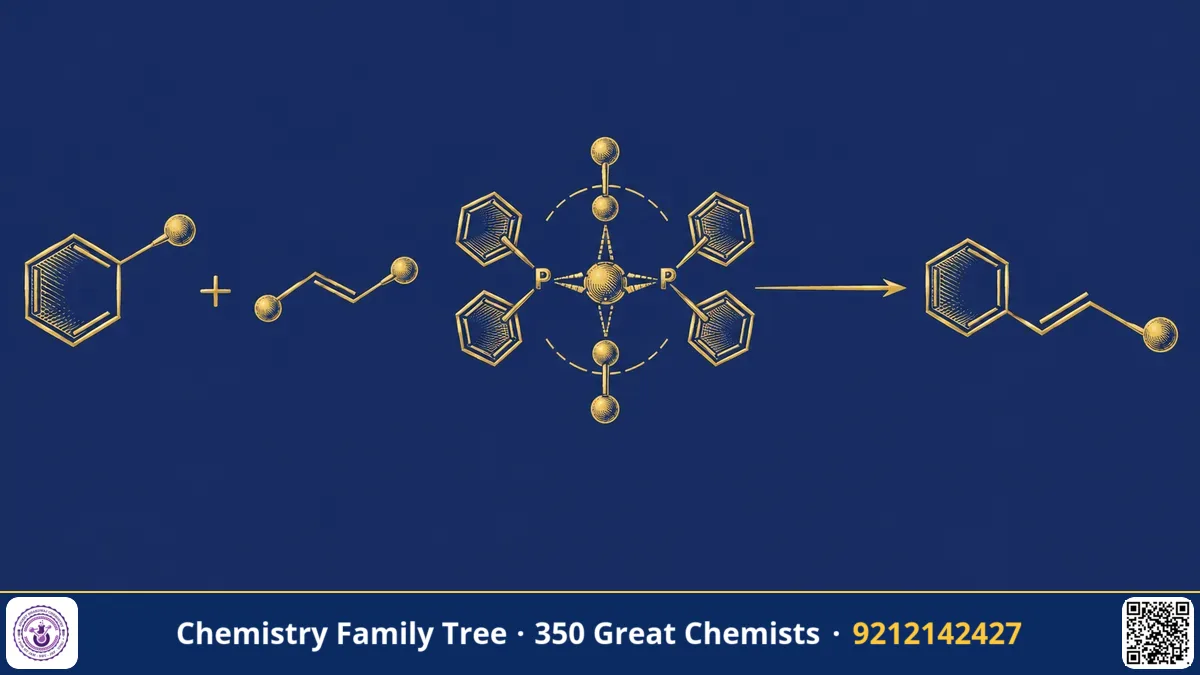
Look at the structure of a cinnamate sunscreen, a stilbene dye or a styrene-type drug intermediate. Each contains an aryl group attached to a carbon-carbon double bond. Richard F. Heck developed a palladium-catalysed reaction that makes this arrangement directly from an aryl halide and an alkene. In 1971-72, Heck, working at the Hercules company in the United States, and independently the Japanese chemist Tsutomu Mizoroki, reported that palladium would catalyse the arylation of alkenes. The reaction is now called the Mizoroki-Heck reaction, or simply the Heck reaction. It was the first of the modern palladium cross-couplings to be developed, and in 2010 Heck shared the Nobel Prize in Chemistry with Ei-ichi Negishi and Akira Suzuki.
The Scientific Problem Before the Discovery
Aryl halides such as bromobenzene are very unreactive towards simple nucleophilic substitution, because the C(sp²)–X bond is strong and the ring blocks backside attack. And simple alkenes do not easily react with aryl halides by themselves. Chemists could make substituted alkenes by the Wittig reaction or by aldol condensation followed by elimination, but these methods require a carbonyl compound. A direct way to replace a vinylic C–H bond by a C–aryl bond did not exist.
In the 1960s Heck was at Hercules Powder Company and studied organometallic reactions of palladium. He noticed that organopalladium compounds, made by exchange between arylmercury compounds and palladium(II) salts, could add to alkenes. This work was stoichiometric, which means that palladium was consumed, and palladium is expensive. The question was how to make it catalytic and use more convenient aryl halides instead of toxic mercury compounds.
The Discovery: Step by Step
- Stoichiometric studies (late 1960s). Heck showed that aryl-palladium(II) species add to alkenes and then lose a palladium hydride, giving an arylated alkene.
- Mizoroki's observation (1971). Mizoroki and his co-worker reported that iodobenzene reacts with styrene in the presence of palladium chloride and a base, giving stilbene.
- Heck's catalytic version (1972). Heck independently developed catalytic conditions with palladium acetate, an organic base such as triethylamine, and aryl halides. He then explored the scope, showing that many substituted alkenes could be arylated with excellent control.
- Later development. Others added phosphine ligands, which allowed the less reactive aryl bromides and, later, chlorides to be used. Intramolecular Heck reactions were found to make rings, and asymmetric versions were developed to create chiral centres.
General equation:
Ar–X + CH₂=CH–R --[Pd catalyst, base]--> Ar–CH=CH–R + Base·HX
Example: bromobenzene + methyl acrylate → methyl cinnamate (E-isomer), with Et₃N as base: C₆H₅Br + CH₂=CHCO₂CH₃ → C₆H₅CH=CHCO₂CH₃ + Et₃N·HBr.
The Chemistry Behind It
Heck reaction mechanism, four steps:
- Generation of Pd(0). If Pd(OAc)₂ is used, it is reduced in the flask (often by phosphine or amine) to the active Pd(0) species.
- Oxidative addition: Pd(0) + Ar–X → Ar–Pd(II)–X.
- Migratory insertion (syn carbopalladation): The alkene coordinates to Pd and then inserts into the Pd–Ar bond. The aryl group and palladium add to the same face of the alkene (syn addition). The aryl group usually attaches to the less substituted carbon of the alkene, giving a new alkyl-Pd species.
- Beta-hydride elimination: A hydrogen on the carbon next to palladium is removed in a syn manner, forming the new C=C bond and an H–Pd(II)–X species. Because syn insertion is followed by syn elimination, rotation about the new C–C single bond is needed, and the thermodynamically more stable E (trans) alkene results.
- Catalyst regeneration: The base removes HX from H–Pd–X and gives Pd(0) back.
The base is essential, not an optional additive; without it palladium would remain as H–Pd–X and the cycle would stop. Typical bases are Et₃N, K₂CO₃ or sodium acetate.
Features to remember
| Feature | Detail |
|---|---|
| Halide | Ar–I > Ar–Br >> Ar–Cl; also aryl triflates and vinyl halides |
| Alkene | Electron-poor alkenes (acrylates, styrenes) react best |
| Regiochemistry | Aryl group goes to the less hindered alkene carbon |
| Stereochemistry | Mostly E (trans) alkene |
| Organometallic reagent | None needed; it is a coupling with an alkene C–H |
| Oxidation states | Pd(0) ⇌ Pd(II) |
Applications Today
- Fine chemicals: The Heck reaction is used industrially to make cinnamate esters, including the sunscreen agent octyl methoxycinnamate (octinoxate), by coupling a 4-haloanisole with 2-ethylhexyl acrylate.
- Pharmaceuticals: It forms C–C bonds in the synthesis of several drug candidates and drugs, including the asthma medicine montelukast according to published routes.
- Natural products: Intramolecular Heck cyclisations create complex ring systems and quaternary carbon centres.
- Materials: Vinylene-linked conjugated molecules for light-emitting and electronic materials are prepared this way.
- Teaching labs: Palladium catalysis is introduced to B.Sc. and M.Sc. students using Heck examples.
Exam Corner
- Heck reaction: aryl or vinyl halide + alkene with Pd catalyst and base gives a substituted alkene, mostly E.
- Steps: oxidative addition, syn migratory insertion, syn beta-hydride elimination, base-mediated regeneration of Pd(0).
- Unlike Suzuki, Negishi and Stille, the Heck reaction does not need an organometallic nucleophile.
- Nobel Prize 2010: Heck, Negishi and Suzuki. Mizoroki (Japan) reported a similar reaction in 1971 and is credited in the name.
- The product is an alkene, so the final step is beta-hydride elimination and not reductive elimination.
Common Misconceptions
- "The last step is reductive elimination." Not in the classical Heck cycle. Beta-hydride elimination forms the alkene; the base then restores Pd(0).
- "Heck reaction gives the Z alkene." The major product is generally the more stable E isomer.
- "The base only neutralises acid." It is required to complete the catalytic cycle.
Quick Revision Box
- Heck (1972) and Mizoroki (1971): Pd-catalysed alkene arylation.
- Ar–X + alkene → Ar–CH=CH–R, trans selective.
- Cycle: oxidative addition → syn insertion → syn β-H elimination → base.
- No organometallic reagent needed.
- Pd(0)/Pd(II) catalysis; base regenerates Pd(0).
- Nobel Prize 2010 with Negishi and Suzuki.
FAQ
What is the Heck reaction?
It is a palladium-catalysed reaction between an aryl or vinyl halide and an alkene in the presence of a base, forming a new substituted alkene.
Why is it called Mizoroki-Heck?
Tsutomu Mizoroki reported a related reaction in 1971, and Heck developed the catalytic method in 1972, so both names are used.
Why is the product mostly trans?
After syn insertion, rotation puts bulky groups apart before syn beta-hydride elimination, so the more stable E alkene forms.
How does the Heck reaction differ from the Suzuki coupling?
The Heck reaction uses an alkene as the partner and forms an alkene product; the Suzuki reaction uses an organoboron compound and forms a bond between two carbon fragments.
Published by ABC Chemistry — IIT-JAM | CSIR-NET | GATE Chemistry Coaching. Visit abcchemistry.com

About the chemist
Richard F. Heck
1931-2015 · United States · Nobel Chemistry 2010
Heck palladium-catalysed coupling