Biography · Chemist no. 116 of 350
Richard Kuhn: Vitamin Hunter, Nobel Laureate and a Complicated Legacy
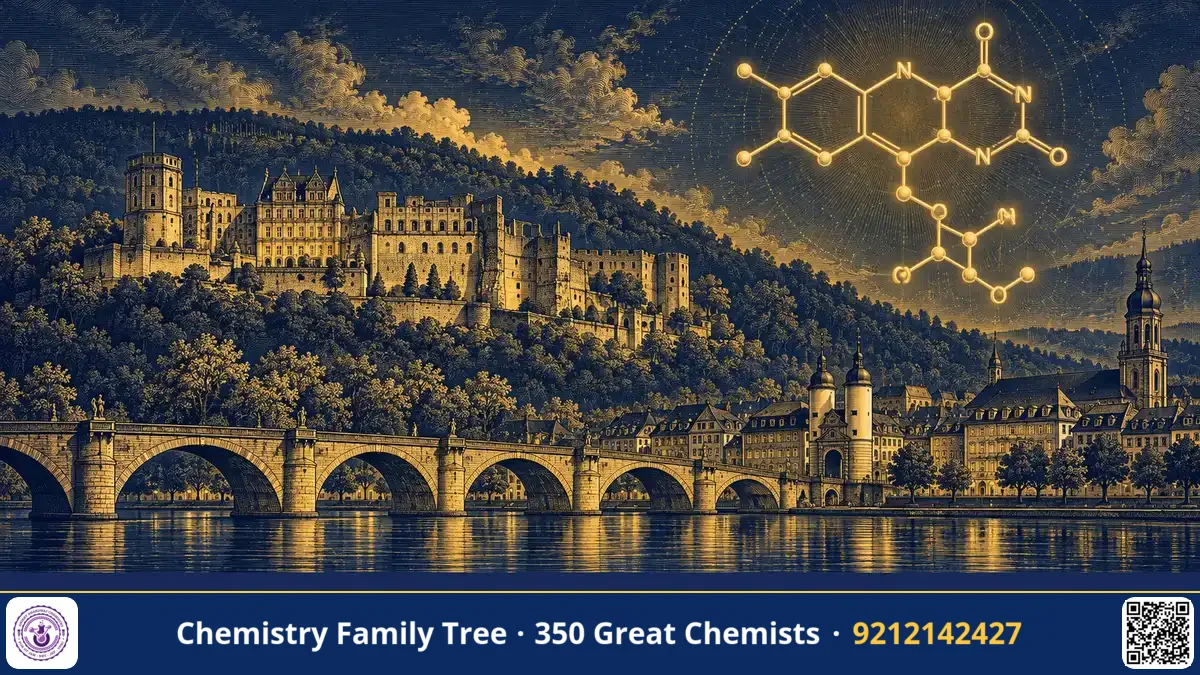
Richard Kuhn (1900-1967) was an Austrian-born German chemist who worked out the chemistry of riboflavin, carotenoids and vitamin B₆, and developed a number of methods that were important in organic chemistry. He received the Nobel Prize in Chemistry for 1938, but could not accept it at the time. His scientific legacy is large, while his wartime career is also part of the historical record, and we should read both honestly.
Early Life & Family
Richard Kuhn was born on 3 December 1900 in Vienna, then part of Austria-Hungary. His father, Richard Clemens Kuhn, was an engineer and teacher at the University of Agriculture, and his mother, Angelika, was a teacher. His mother is recorded as having taught him in his early years. He then attended the Döblinger Gymnasium in Vienna, a well-known school in the city, and showed unusual ability in science and mathematics.
His childhood fell in the years of the First World War and the collapse of the Austro-Hungarian empire, which made the early twentieth century a difficult time for young people in central Europe. He completed school in 1918 and began university studies soon after.
Education & Mentors
Kuhn studied chemistry at the University of Vienna, and then moved to the University of Munich. In Munich he joined the laboratory of Richard Willstätter, the leading authority on plant pigments and enzymes and Nobel laureate of 1915. Kuhn received his doctorate in 1922 for work on the specificity of enzymes that split carbohydrates, a topic that taught him both organic chemistry and biochemistry.
He stayed in Munich as an assistant and qualified as a university lecturer (habilitation) in 1925. Willstätter's work on chlorophyll and carotene in turn prepared Kuhn for his own studies of coloured natural products. The combination of enzyme chemistry and pigment chemistry became the core of Kuhn's later success.
Career Timeline
| Year | Event |
|---|---|
| 1900 | Born in Vienna |
| 1922 | Doctorate at Munich under Richard Willstätter |
| 1925 | Habilitation at Munich |
| 1926 | Professor of general and analytical chemistry at the ETH Zürich |
| 1929 | Moves to Heidelberg as professor and director of the chemistry department at the Kaiser Wilhelm Institute for Medical Research |
| 1931 | Separates alpha-, beta- and gamma-carotene with Edgar Lederer |
| 1933 | Isolates lactoflavin (riboflavin) from milk |
| 1935 | Synthesises riboflavin |
| 1938 | Isolates vitamin B₆; is awarded the Nobel Prize in Chemistry, which he is not allowed to accept |
| 1944 | Wartime research on organophosphorus compounds, including the discovery of the nerve agent soman |
| 1949 | Receives the Nobel medal and diploma |
| 1950s | Works on human milk oligosaccharides and later on gangliosides and other biologically active compounds |
| 1967 | Dies in Heidelberg |
Major Scientific Contributions
Kuhn is best known for his work on riboflavin. He isolated it from milk, showed that it forms the coloured group of Warburg's yellow enzyme, proved its structure, and synthesised it. These steps appear in our discovery post. His group also separated the carotenes with column chromatography, and isolated and characterised vitamin B₆ in 1938.
He also contributed in several other areas:
- Polyenes and colour. He prepared diphenylpolyenes of defined chain length and studied how the colour deepens as conjugation increases. Later, in 1948, he used a free-electron model to explain the absorption of polyenes and dyes in a simple way.
- Kuhn-Roth oxidation. A method for counting C-methyl groups by oxidation to acetic acid.
- Stereochemistry. He worked on the optical activity of hindered biphenyl derivatives and on rates of racemisation.
- Bifidus factor. With Paul György he studied factors in human milk that favour the growth of Lactobacillus bifidus in the gut of infants, work that led to the study of human milk oligosaccharides.
- Enzyme inhibitors and nerve agents. His wartime work on organophosphorus compounds is documented in historical sources.
Awards, Honours & Nobel Prize
The Nobel Prize in Chemistry for 1938 was awarded to Richard Kuhn "for his work on carotenoids and vitamins". In 1936, after the Nobel Peace Prize was given to the imprisoned German pacifist Carl von Ossietzky, the German government forbade its citizens from accepting Nobel Prizes. Kuhn was forced to decline in 1938. He later received the medal and diploma in 1949 after the war, though the prize money was no longer available to him. He also received other honours, including memberships in scientific academies and honorary degrees from several universities.
Personality, Struggles & Lesser-Known Facts
- A young professor. He became a full professor at ETH Zürich at only 26 years of age, among the youngest in the history of the institution.
- Huge raw materials. The isolation of riboflavin needed thousands of litres of milk for around one gram of product, which shows the patience and scale of the work.
- A prize he could not accept. His Nobel Prize was forced on hold by the political order of his own country, a rare case in the history of the prize.
- Wartime role. During the Second World War he led research for the German authorities, including research on organophosphorus nerve agents, and he held positions in institutions under the Nazi state. After the war, he returned to Heidelberg and continued as a scientist and teacher. Historians still discuss his conduct, and a fair reading must keep his scientific achievements and these facts side by side.
- Large research group. He trained a number of capable collaborators, including Edgar Lederer, who later became known for his own work on natural products and mass spectrometry.
Legacy & Influence on Modern Chemistry
Kuhn's work gave the chemical basis for understanding flavin coenzymes. Every biochemistry student who studies FAD, the electron transport chain or the oxidation of fatty acids is using a part of his legacy. His use of column chromatography on carotenes helped to make adsorption chromatography a basic tool. The Kuhn-Roth oxidation is still known in analytical organic chemistry. His physical-organic ideas on polyene colour were an early example of applying simple quantum models to organic molecules, a theme that continues in spectroscopy courses. At the same time, his career reminds students that science takes place within political and ethical contexts.
Lessons for Students
- Great discoveries can need patience and scale. Collecting one gram of a vitamin took thousands of litres of milk.
- Use the property of the molecule as a guide. Kuhn followed fluorescence during purification.
- Combine biology and chemistry. Kuhn linked a vitamin to an enzyme cofactor.
- Scientific skill does not replace ethical judgement. Think about how research is used.
Quick Facts Box
- Born: 3 December 1900, Vienna, Austria-Hungary
- Died: 31 July 1967, Heidelberg, West Germany
- Nationality: Austrian-born, worked in Germany and Switzerland
- Field: Organic chemistry, biochemistry
- Famous for: Riboflavin, carotenoids, vitamin B₆, Kuhn-Roth oxidation
- Nobel: Chemistry, 1938 (not accepted at the time; received 1949)
FAQ
Why did Kuhn not receive the Nobel Prize in 1938?
German citizens were barred by their government from accepting Nobel Prizes after 1936. He was awarded the prize but could receive only the medal and diploma in 1949.
Who was Kuhn's doctoral supervisor?
Richard Willstätter, at the University of Munich.
Where did Kuhn do his most famous work?
At the Kaiser Wilhelm Institute for Medical Research in Heidelberg, where he was director of the chemistry department from 1929.
What is the Kuhn-Roth oxidation used for?
To determine the number of C-methyl groups in an organic molecule by oxidising it with chromic acid and measuring the acetic acid formed.
Published by ABC Chemistry — IIT-JAM | CSIR-NET | GATE Chemistry Coaching. Visit abcchemistry.com
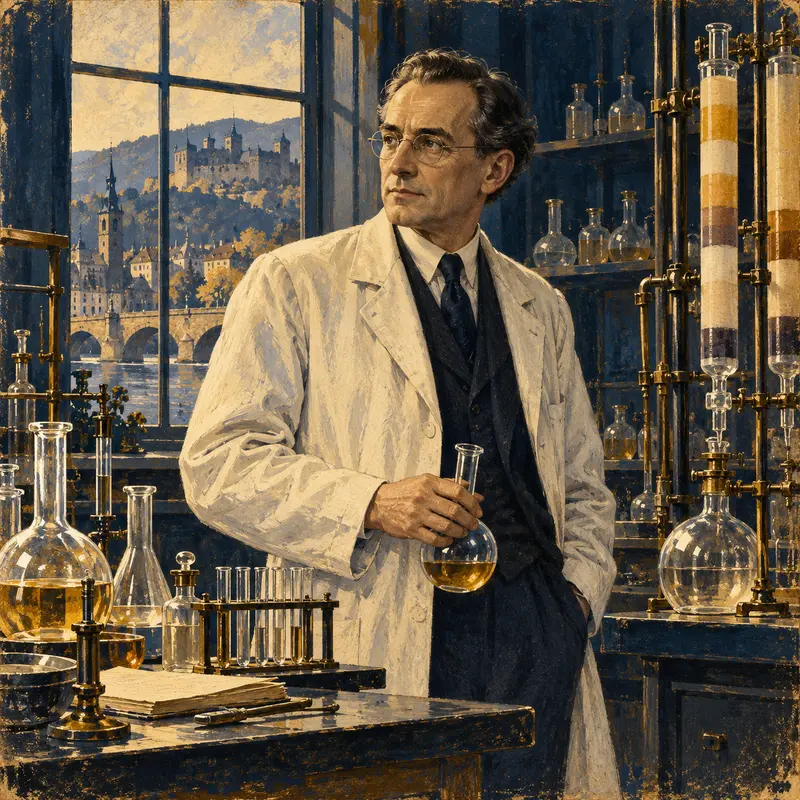
About the chemist
Richard Kuhn
1900-1967 · Austria · Nobel Chemistry 1938
Carotenoids and vitamins