The discovery, explained · Chemist no. 116 of 350
Richard Kuhn and the Yellow Vitamin: Riboflavin, Carotenoids and Vitamin B6
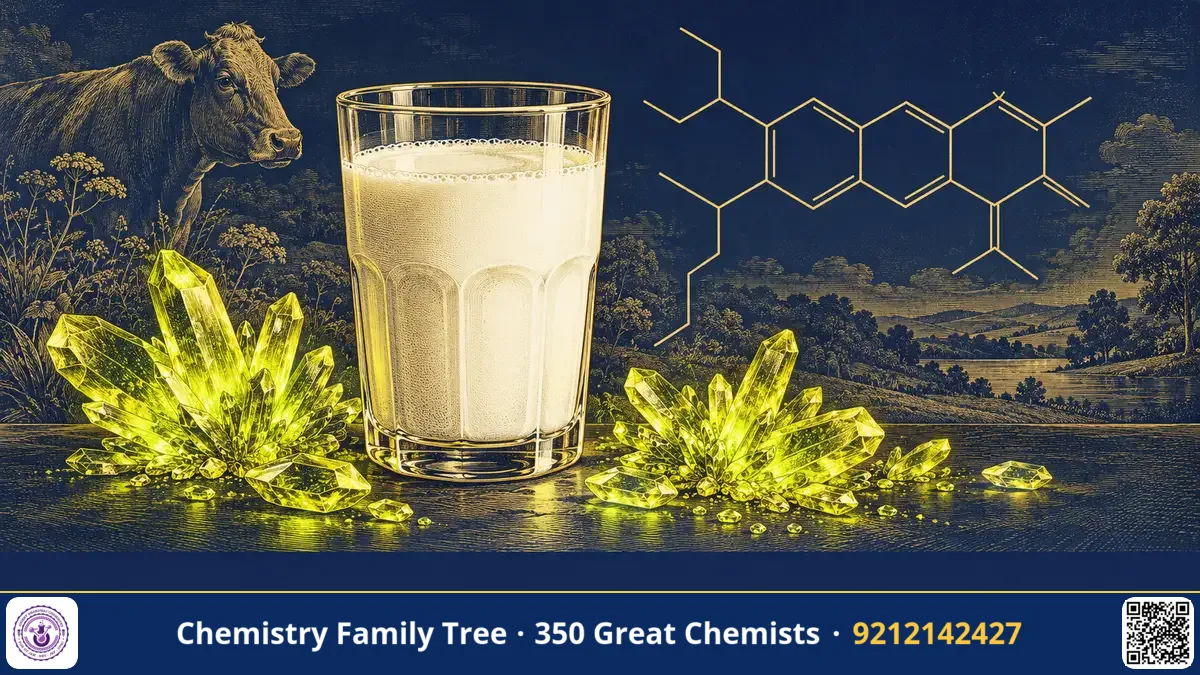
In the early 1930s a pale yellow-green, strongly fluorescent substance was known in milk, eggs and liver, but no one had a pure sample or a structure. Richard Kuhn, working at the Kaiser Wilhelm Institute for Medical Research in Heidelberg, took on the problem with a determination that was almost heroic. From about 5400 litres of skimmed milk his group isolated roughly 1 gram of crystalline lactoflavin, which we now call riboflavin or vitamin B₂. They then proved its structure and made it by synthesis. Kuhn also studied carotenoids and vitamin B₆, and developed methods such as the Kuhn-Roth oxidation that are still taught. He was awarded the Nobel Prize in Chemistry for 1938 for his work on carotenoids and vitamins.
The Scientific Problem Before the Discovery
By 1930 physicians knew that diets lacking "vitamin B" produced disease in animals, and that this factor was not a single compound. A heat-stable growth factor and a heat-labile antineuritic factor were being separated. In biochemistry, Otto Warburg had discovered a "yellow enzyme" in yeast that took part in cell respiration. Nobody knew what in the yellow enzyme was the coloured, active part, and nobody knew whether the milk pigment and the yeast pigment were related.
- The yellow pigments were present only in traces, so isolation needed large amounts of starting material.
- There was no modern chromatography or spectroscopy, so purity had to be judged by crystallisation, fluorescence and growth tests in rats.
- Structure determination had to use degradation and synthesis only.
The Discovery: Step by Step
Kuhn worked in a team with the physician Paul György and the chemist Theodor Wagner-Jauregg. Together they followed the bright fluorescence as a guide during purification, using an assay in young rats which stopped growing when the factor was missing.
- Isolation (1933). Whey from thousands of litres of milk was adsorbed on fuller's earth and then eluted. Repeated recrystallisation gave orange-yellow crystals of lactoflavin with an intense green fluorescence.
- Link to the yellow enzyme. The same flavin group was found in Warburg's yellow enzyme, as a phosphate ester bound to a protein. This showed that a vitamin is a part of a coenzyme.
- Degradation. Irradiation of the vitamin in alkaline solution gave lumiflavin, and in acid solution gave lumichrome. Lumiflavin, C₁₃H₁₂N₄O₂, is an isoalloxazine with methyl groups at positions 7, 8 and 10. This told Kuhn that the ring system is a tricyclic isoalloxazine and that the side chain on N-10 is the rest of the vitamin.
- The side chain. The chain was found to be a D-ribityl group, derived from the five-carbon sugar alcohol ribitol.
- Synthesis (1935). Kuhn built the molecule from 3,4-dimethylaniline, D-ribose-derived ribitylamine and alloxan. In outline: ribitylamino-xylidine is coupled with a diazonium salt, reduced to the diamine, and condensed with alloxan to close the pyrazine ring and give riboflavin. At almost the same time, Paul Karrer in Zürich completed a different synthesis.
riboflavin = 7,8-dimethyl-10-(D-ribityl)isoalloxazine   (C₁₇H₂₀N₄O₆)
riboflavin + ATP → FMN (riboflavin 5'-phosphate) → FAD (with AMP)
Carotenoids, vitamin B6 and other work
Kuhn used chromatographic adsorption on columns of alumina and calcium carbonate to separate carotenoids. In 1931, together with Edgar Lederer, he separated alpha-, beta- and gamma-carotene from carrots and showed that they are different compounds, an important early success for column chromatography in natural product chemistry. Kuhn also worked on the polyene pigments crocetin and bixin, and prepared diphenylpolyenes as model systems for conjugation.
In 1938 his group isolated vitamin B₆ (pyridoxine) from rice bran and determined its structure, a 3-hydroxypyridine with a methyl group, a hydroxymethyl group at 4 and 5. Another group, led by Stanton Harris and Karl Folkers in the United States, also worked on its synthesis. Kuhn also contributed to the study of pantothenic acid and p-aminobenzoic acid.
The Kuhn-Roth oxidation
This is an analytical method to find the number of C-methyl groups in an organic compound. The compound is boiled with chromic acid and sulfuric acid. Everything is oxidised, but the C-CH₃ group survives as acetic acid (CH₃COOH), which is distilled and titrated. The number of moles of acetic acid per mole of substrate gives the number of terminal methyl groups, such as those on a C-methyl or an ethyl group. It was very useful for terpenes and carotenoids.
The Chemistry Behind It
Flavin redox. The isoalloxazine ring takes two electrons and two protons. The oxidised form is yellow. One-electron reduction gives a semiquinone radical, and a two-electron reduction gives the colourless dihydroflavin (FADH₂ or FMNH₂).
FAD + 2H⁺ + 2e⁻ ⇌ FADH₂
This reversibility makes flavoproteins central to the electron transport chain, to the oxidation of fatty acids, to succinate dehydrogenase in the citric acid cycle and to many other oxidases. Because flavins can handle both one- and two-electron steps, they link two-electron donors like NADH with one-electron acceptors such as iron-sulfur centres and cytochromes.
Fluorescence. Riboflavin absorbs around 450 nm and emits green light near 530 nm. This property was the key to Kuhn's isolation, since the green glow showed which fractions to keep.
Light sensitivity. Riboflavin decomposes in light, which is why milk is stored in opaque containers. Vitamin B₆ in the body is converted to pyridoxal phosphate, the coenzyme for transamination and decarboxylation of amino acids, where its aldehyde group forms a Schiff base with the amino acid.
Applications Today
- Nutrition. Riboflavin is added to fortified cereals and given as a supplement. Good sources include milk, curd, eggs, green leafy vegetables and whole grains common in the Indian diet.
- Food colour. It is the yellow food colour E101.
- Clinical use. Vitamin B₆ is used to treat deficiency and some forms of neuropathy; riboflavin is used in some migraine prophylaxis regimens and, in ophthalmology, in corneal cross-linking treatment under UV light.
- Chromatography. Column adsorption chromatography, as used by Kuhn on carotenes, grew into the standard purification method of every organic laboratory.
- Analysis. The Kuhn-Roth oxidation still appears in textbooks for finding C-methyl groups.
Exam Corner
- Riboflavin = 7,8-dimethyl isoalloxazine plus D-ribityl chain at N-10; forms FMN and FAD.
- Riboflavin deficiency (ariboflavinosis) gives cheilosis, glossitis and angular stomatitis.
- Pyridoxine (B₆) is the precursor of pyridoxal phosphate, the coenzyme of transaminases.
- Kuhn-Roth oxidation: CrO₃/H₂SO₄ gives CH₃COOH from C-CH₃ groups; used to count C-methyl groups.
- Kuhn was awarded the 1938 Nobel Prize in Chemistry; he separated alpha-, beta- and gamma-carotene by column chromatography.
Common Misconceptions
- "Riboflavin is the same as vitamin B₁." It is B₂. Thiamine is B₁.
- "Flavins only carry two electrons." They can also form a stable semiquinone radical, which is what allows them to link one- and two-electron processes.
- "The Kuhn-Roth oxidation measures all methyl groups." It measures C-methyl groups (those attached to carbon). Groups like O-CH₃ are not detected in the same way.
Quick Revision Box
- Kuhn: Nobel Prize in Chemistry 1938 (carotenoids and vitamins).
- About 1 g of lactoflavin was isolated from roughly 5400 L of milk.
- Riboflavin: yellow, fluorescent, light-sensitive; absorbs near 450 nm.
- FAD/FMN: coenzymes for dehydrogenases and oxidases.
- Vitamin B₆ isolated 1938; coenzyme form is pyridoxal phosphate.
- Kuhn-Roth: counts C-methyl groups as acetic acid.
FAQ
Why is riboflavin yellow?
The isoalloxazine ring has an extended conjugated π system which absorbs blue light near 450 nm, so the compound looks yellow.
Why is milk stored in opaque containers?
Because riboflavin in milk is photosensitive. Light destroys it and can also cause off-flavours.
What is the difference between FMN and FAD?
FMN is riboflavin 5'-phosphate. FAD has an extra adenosine monophosphate unit joined to FMN through a pyrophosphate link.
Did Kuhn get the Nobel Prize in Medicine?
No. It was the Nobel Prize in Chemistry for 1938. He could not accept it at the time because of the German government's ban, and received the medal later, in 1949.
Published by ABC Chemistry — IIT-JAM | CSIR-NET | GATE Chemistry Coaching. Visit abcchemistry.com
About the chemist
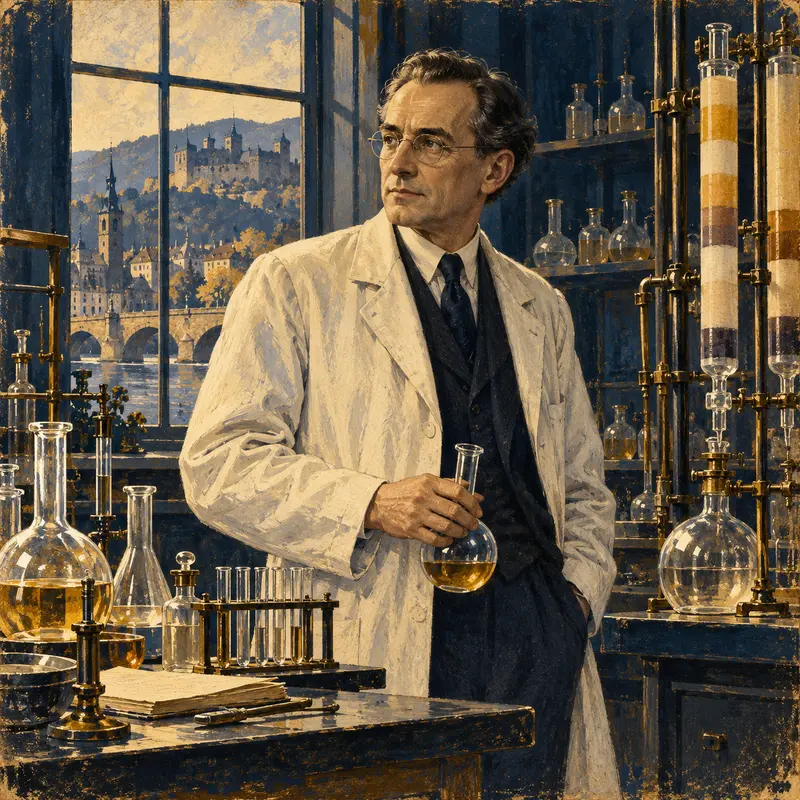
Richard Kuhn
1900-1967 · Austria · Nobel Chemistry 1938
Carotenoids and vitamins