Biography · Chemist no. 229 of 350
Richard Robson: The Melbourne Chemist Who Built Crystals From Wooden Models
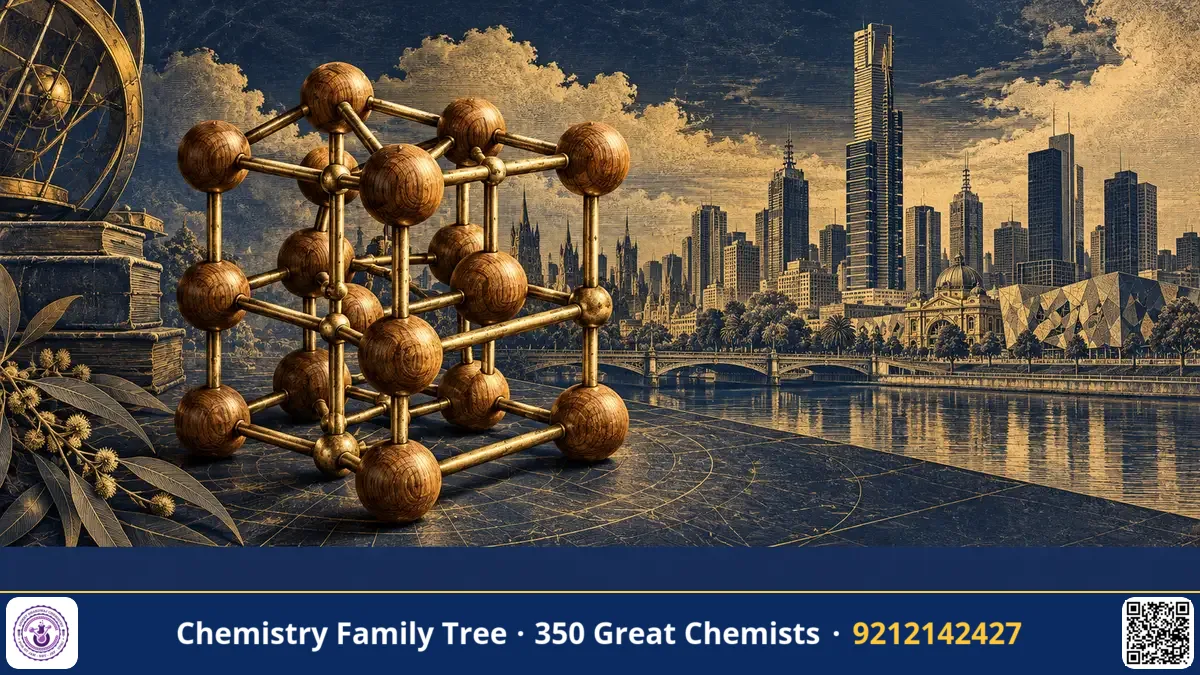
Richard Robson, born in 1937 in Yorkshire, England, is an emeritus professor at the University of Melbourne in Australia. In 1989, with Bernard Hoskins, he proposed and demonstrated a design principle for building extended crystal networks from tetrahedral nodes and organic linkers, which became the foundation of metal-organic frameworks. In 2025, at the age of 88, he shared the Nobel Prize in Chemistry with Susumu Kitagawa and Omar Yaghi. His legacy in one line: a teacher with wooden models imagined a new kind of material, and a field followed.
Early Life and Family
Robson was born on 4 June 1937 in Glusburn, a village in Yorkshire, in the north of England. He grew up in Britain during the Second World War and its aftermath. Information about his parents and childhood is limited in public sources, so this post focuses on what is reliably documented. Like many scientists of his generation, he came to chemistry through the strong British school and university tradition in the sciences.
Education and Mentors
Robson trained as a chemist in the United Kingdom, specialising in inorganic chemistry. He then moved to Australia in the mid-1960s. In 1966 he joined the University of Melbourne, where he spent the whole of his academic career, from lecturer to professor. His early research dealt with coordination chemistry and the structure of metal complexes, including studies of complexes with macrocyclic ligands and polynuclear compounds.
Career Timeline
| Year | Event |
|---|---|
| 1937 | Born in Glusburn, Yorkshire, England |
| Early 1960s | Trains as a chemist in the UK |
| 1966 | Joins the University of Melbourne, Australia |
| 1970s-1980s | Research on coordination chemistry, polynuclear metal complexes and structure |
| 1989 | With Bernard Hoskins, reports the diamond-like Cu(I) coordination network |
| 1990s | Extends the work to many networks and to ideas of crystal engineering |
| 2000s | Becomes emeritus professor, continues research on frameworks and structures |
| 2025 | Nobel Prize in Chemistry (shared) |
Major Scientific Contributions
The 1989 design concept. Robson proposed that the structures of extended solids could be designed by choosing building blocks with specific geometry. Using Cu(I) and a tetrahedral tetranitrile linker, he created a diamond-like network with large cavities. Please read our discovery post for the experiment.
A family of network structures. His group went on to make many networks of different topologies, such as honeycomb, square grid and cubic frameworks. They studied how the frameworks accommodate guest molecules, and how anions could be exchanged.
Interpenetration and catenation. He studied how multiple nets interweave, an important structural motif in MOF chemistry.
Molecular architecture and polynuclear complexes. Before the 1989 paper, he built binucleating macrocyclic ligands that can hold two metal ions close together, making models for biological metal sites and for magnetic coupling between metals.
Teaching models. His wooden models, drilled balls and sticks representing atoms and bonds, inspired the notion of nodes and rods, and are an example of how teaching can inspire research.
Awards, Honours and Nobel Prize
Richard Robson shared the 2025 Nobel Prize in Chemistry with Susumu Kitagawa and Omar M. Yaghi for the development of metal-organic frameworks. He is a Fellow of the Australian Academy of Science, as noted in Australian scientific circles. Other honours are not listed here because we cannot check them with complete confidence.
Personality, Struggles and Lesser-Known Facts
- Wooden models. The idea of the diamond-like network is said to have come while he was preparing wooden models for teaching. The reference to teaching in the Nobel story shows the value of educational work.
- A slow start. The 1989 work was not an immediate sensation. The materials were fragile, and the field took off after the stable frameworks of the late 1990s. Robson himself has been modest about it, and commentators have noted that the idea needed time to be recognised.
- Staying in one place. He spent almost his whole career at one university, the University of Melbourne, which shows that sustained work in a stable environment can produce discoveries.
- Late recognition. At 88, he received the prize 36 years after the 1989 paper, which reflects how long it can take for an idea to be recognised.
- Co-author credit. The 1989 work was done with Bernard Hoskins, whose crystallographic skill was essential.
Legacy and Influence on Modern Chemistry
Robson's idea belongs to a tradition called crystal engineering and reticular chemistry. Before his paper, extended solids were found by chance. Afterwards, chemists began to treat solid-state structure as a design problem, choosing geometric building blocks and predicting topologies. The notion was extended to covalent organic frameworks, supramolecular networks and hydrogen-bonded organic frameworks. Today MOFs are studied for carbon capture, hydrogen storage, catalysis, drug delivery and harvesting water from air. The field has produced tens of thousands of different structures. Research groups across India work on MOFs.
Lessons for Students
- Teaching can inspire research. Wooden models in a lecture became a Nobel Prize idea.
- Think geometrically. Coordination numbers and geometries are the language of design.
- Be patient. Recognition took thirty-six years.
- Take small, clear steps. A short paper with a clear idea and proof can open a field.
- Stay curious. Good ideas can come from ordinary teaching tasks.
Quick Facts Box
- Born: 4 June 1937, Glusburn, Yorkshire, England
- Died: Living
- Nationality: British-born, Australian
- Field: Inorganic and coordination chemistry, crystal engineering
- Famous for: 1989 design of a diamond-like coordination network; foundation of MOFs
- Nobel: Chemistry 2025, shared with Kitagawa and Yaghi
FAQ
Where did Richard Robson work?
At the University of Melbourne, Australia, from 1966.
What did he contribute to MOFs?
He provided the design concept: build extended crystals by linking nodes with predictable geometries, which he demonstrated in 1989.
Who was his co-author in 1989?
Bernard F. Hoskins, a colleague at Melbourne.
Why did the Nobel come so late?
The field of MOFs expanded after stable and porous examples were made in the late 1990s, and the impact of the original idea grew over time until the applications became clear.
Published by ABC Chemistry — IIT-JAM | CSIR-NET | GATE Chemistry Coaching. Visit abcchemistry.com
About the chemist
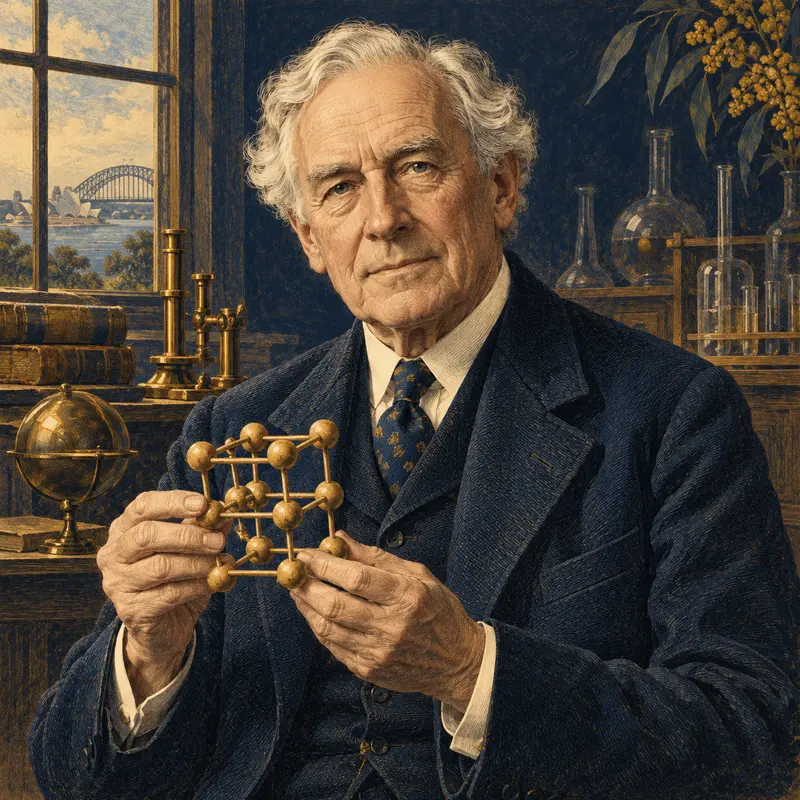
Richard Robson
1937- · Australia · Nobel Chemistry 2025
Metal-organic frameworks