The discovery, explained · Chemist no. 229 of 350
Designing Crystal Networks: How Richard Robson Used Wooden Models to Invent a New Kind of Material
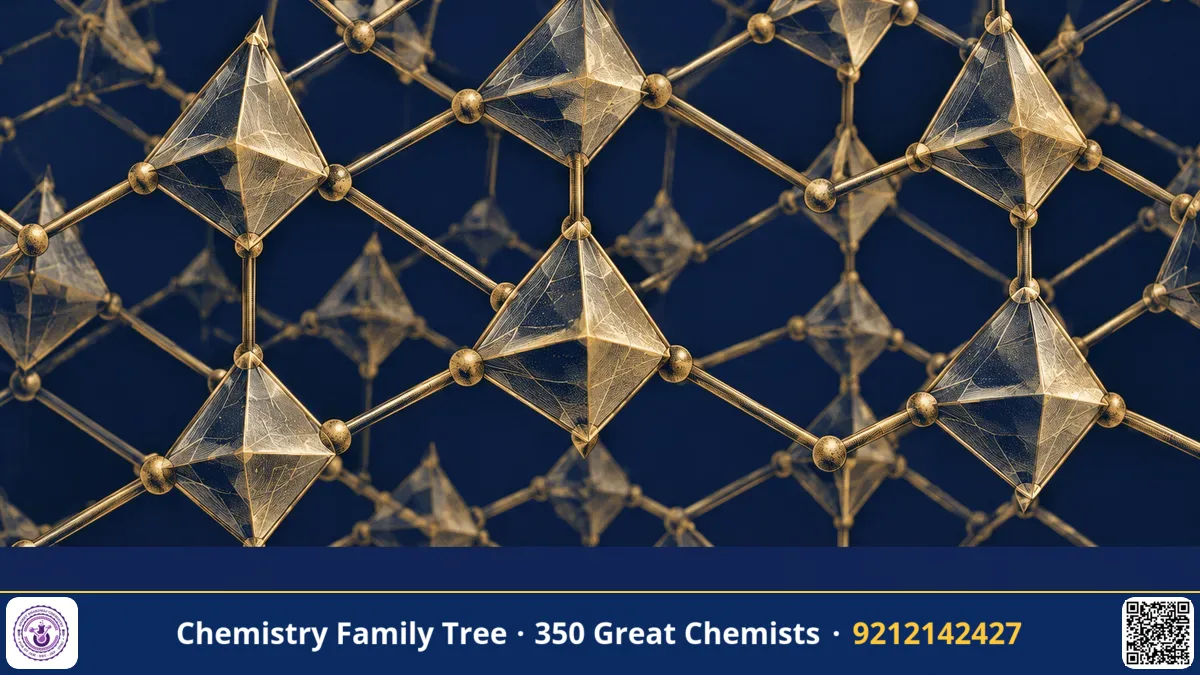
In 1989, Richard Robson and his colleague Bernard Hoskins at the University of Melbourne published a short paper that looks modest but changed chemistry. They proposed that if you choose building blocks with the right geometry, you can predict and design the structure of an extended crystal. To prove it, they mixed copper(I) ions, which like to bind four partners in a tetrahedral arrangement, with a rod-shaped organic molecule that has four binding arms pointing to the corners of a tetrahedron. The product was a crystal with a diamond-like network of enormous cavities. This was the ancestor of the metal-organic frameworks (MOFs). In 2025 Robson shared the Nobel Prize in Chemistry with Susumu Kitagawa and Omar Yaghi.
This post explains Robson's design logic, the experiment, and the chemistry of nodes, linkers and networks.
The Scientific Problem Before the Discovery
Chemists had been synthesising molecules for more than a century, but crystals of extended solids were mostly "found", not planned. A salt crystal such as NaCl or an oxide such as a zeolite was prepared under a given condition, and its structure was found out afterwards by X-ray diffraction. Predicting the structure in advance was considered close to impossible. In molecular chemistry the tools of organic synthesis could build molecules deliberately, atom by atom, but in solid-state chemistry, designing a crystal remained a matter of luck.
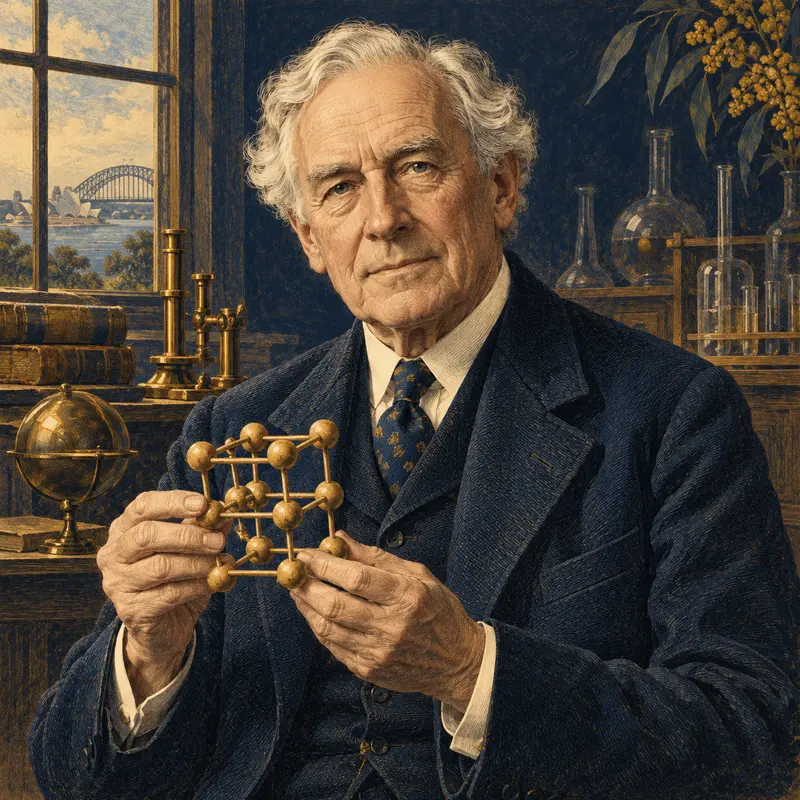
Robson's curiosity began in teaching. For lectures on structure he and his colleagues built large wooden ball-and-stick models of crystals, using drilled wooden balls for atoms and sticks for bonds. While preparing models for a demonstration of the diamond structure, he realised that the carbon atoms in diamond, each bonded tetrahedrally to four others, could be replaced by "nodes" with tetrahedral valence, and the bonds could be replaced by longer "rods". The resulting structure would resemble diamond, but with much greater distances between nodes, leaving large void spaces. A thought experiment became a research plan: use the natural bonding preferences of atoms or ions to design extended networks.
The Discovery / Experiment
The design for the 1989 experiment, published in the Journal of the American Chemical Society (Hoskins and Robson, 1989), had two components:
- Node: copper(I) ion, d10, which strongly prefers a tetrahedral geometry with four ligands (a coordination number of four) and a nitrile (C≡N) group as a donor.
- Linker: tetrakis(4-cyanophenyl)methane, C(C6H4CN)4, a central carbon atom with four arms of benzene rings, each ending in a nitrile group. The four arms point to the corners of a tetrahedron, so the molecule is itself a tetrahedral node.
- Dissolve a Cu(I) salt and the tetranitrile in a suitable organic solvent.
- Allow crystals to form slowly.
- Analyse by single-crystal X-ray diffraction.
Cu+  +  C(C6H4CN)4   →   [Cu{C(C6H4CN)4}]+ (diamond-like 3D network)
 (tetrahedral)  (tetrahedral)       Cu-N≡C bonds link both nodes
The crystal structure showed the expected diamond-like framework: each Cu(I) is surrounded by four nitrile nitrogen atoms, and each organic molecule is connected to four copper ions. The framework has large channels, about 0.7 nm across, filled with solvent molecules and the counter-ion (BF4- or similar). Roughly two-thirds of the volume of the crystal is empty space. The network is so open that a second identical network could in principle interpenetrate it, but here the large cavities remained.
The key claim of Hoskins and Robson was that a well-chosen "tinkertoy" strategy would give predictable topologies. They then extended the idea to other nets, such as the cubic, square-grid and honeycomb patterns, and showed with more examples that cavities could contain anions or neutral guest molecules, and that anions could be exchanged without loss of the framework in some cases, giving the idea of ion exchange in a coordination polymer.
The Chemistry Behind It
Node geometry. The coordination geometry of the metal ion fixes the angle between linkers. Cu(I) (d10) is tetrahedral because there are no crystal field stabilisation preferences, and the ligand repulsion is minimised. Other d10 ions such as Zn(II) are also tetrahedral. Octahedral nodes (coordination number six) give cubic nets. Square-planar Pd(II) or Pt(II) give square grids.
| Node geometry | Typical ion | Network produced with linear linkers |
|---|---|---|
| Tetrahedral | Cu(I), Zn(II) | Diamond-type (dia) net |
| Octahedral | Co(II), Ni(II) | Primitive cubic (pcu) net |
| Square planar | Pd(II), Pt(II) | Square grid (2D layers) |
| Linear | Ag(I) | Chains |
Diamond structure. In diamond each carbon is bonded to four others with C-C bond length 1.54 angstrom and tetrahedral angles of 109.5 degrees; the face-centred cubic lattice has an 8-atom unit cell. Replacing each atom with a node and each bond with a long rod scales up the structure. The concept is called reticular design, from Latin "reticulum", a net.
Interpenetration. When the voids are large, a second (or third) network may grow through the first, reducing porosity. This is a common feature in MOF chemistry and is controlled by choice of linker, solvent and conditions.
The limitation that followed. Robson's first frameworks, based on weak metal-nitrogen bonds, were not robust. They tended to collapse when the guest molecules were removed. Later work by Kitagawa and Yaghi, with stronger or better-chosen bonds, showed permanent porosity, completing the story.
Applications Today
- Design principle for materials. Chemists now design porous materials like architects by choosing nodes and linkers.
- Gas storage and separation. MOFs store hydrogen or methane and separate CO2 from other gases.
- Catalysis. Metal nodes and functional linkers act as well-defined catalytic sites.
- Water treatment and sensing. Frameworks can bind pollutants such as heavy metals or detect toxins.
- Education. The wooden models that inspired Robson remain a good teaching tool for crystallography in Indian classrooms.
Exam Corner
- Cu(I) is d10 and prefers tetrahedral geometry with four ligands.
- Diamond has a tetrahedral network, sp3 carbon, 8 atoms per cubic unit cell, coordination number 4.
- Nitriles (R-C≡N) bind metals through the N lone pair.
- Interpenetration is the growth of two or more independent networks through each other.
- 2025 Nobel Prize in Chemistry: Kitagawa, Robson, Yaghi.
Common Misconceptions
- "Robson made the first useful MOF." He proposed the design concept and made the first example of the idea; robust, porous MOFs came later.
- "A big cavity means a porous material." Only if the framework survives the removal of guests.
- "Copper(I) in this compound is coloured due to d-d transitions." d10 ions have no d-d transitions.
Quick Revision Box
- 1989: Hoskins and Robson, University of Melbourne.
- Nodes: Cu(I) (tetrahedral) and tetrakis(4-cyanophenyl)methane (tetrahedral).
- Product: diamond-like network with large cavities.
- Key idea: choose geometry of building blocks to predict the net (reticular design).
- Limitation: early frameworks were fragile without guests.
- Nobel Prize in Chemistry 2025 (with Kitagawa and Yaghi).
FAQ
Why did Robson use wooden models?
They were teaching aids for crystal structure. Working with them helped him see how nodes and rods could generate extended networks.
What is a node and a linker?
A node is the junction point, such as a metal ion or cluster, and a linker is the organic molecule that connects nodes.
What is a nitrile ligand?
It is a molecule containing the C≡N group, whose nitrogen lone pair can coordinate to metal ions.
How does his work relate to Yaghi's MOF-5?
Robson showed the design principle in 1989; Yaghi later used carboxylate linkers and metal clusters to make stable frameworks such as MOF-5.
Published by ABC Chemistry — IIT-JAM | CSIR-NET | GATE Chemistry Coaching. Visit abcchemistry.com
About the chemist
Richard Robson
1937- · Australia · Nobel Chemistry 2025
Metal-organic frameworks