Biography · Chemist no. 93 of 350
Richard R. Schrock: The Chemist Who Tamed the High-Valent Metal Carbene
Richard Royce Schrock (born 1945) is an American inorganic and organometallic chemist who spent most of his career at the Massachusetts Institute of Technology (MIT). He is known for preparing the first stable high-oxidation-state metal alkylidene complexes and for designing molybdenum and tungsten catalysts for olefin metathesis. In 2005 he shared the Nobel Prize in Chemistry with Yves Chauvin and Robert Grubbs. His legacy is the idea that you can design a catalyst, molecule by molecule, by choosing the metal and its ligands. This is a lesson that every student of coordination chemistry can appreciate.
Early Life and Family
Schrock was born on 4 January 1945 in Berne, a small town in Indiana, in the American Midwest. He grew up in a modest, small-town setting, far away from the world of big research laboratories. As a boy he did not know that he would one day work on catalysts that change how medicines are made. Like many people of his generation, he moved west for university, which opened a path to research. He later lived in the Boston area while working at MIT, and he has been described by colleagues as a quiet, focused person who prefers to let experiments speak.
Education and Mentors
Schrock studied at the University of California, Riverside, where he earned his bachelor's degree in chemistry in 1967. He then moved to Harvard University for his PhD, which he completed in 1971 under John A. Osborn, a well-known organometallic chemist who worked on rhodium catalysts and hydrogenation. After the PhD he spent a postdoctoral period in Cambridge, England, an experience that exposed him to European inorganic chemistry. In 1972 he joined the Central Research Department of the DuPont company in the United States, an industrial laboratory famous for polymers such as nylon and Teflon. Working in industry gave him a practical outlook, and it was here that the key discovery was made.
Career Timeline
| Year | Event |
|---|---|
| 1945 | Born in Berne, Indiana, USA |
| 1967 | BA in Chemistry, University of California, Riverside |
| 1971 | PhD, Harvard University (John A. Osborn) |
| 1971-1972 | Postdoctoral work in Cambridge, England |
| 1972-1975 | Researcher at DuPont Central Research |
| 1974 | Prepared the first stable tantalum alkylidene (Schrock carbene) |
| 1975 | Joined the MIT faculty |
| 1980s | Developed tungsten alkylidene and alkylidyne complexes |
| 1990 | Reported well-defined molybdenum imido alkylidene metathesis catalysts |
| Early 2000s | Molybdenum complex that reduces dinitrogen to ammonia catalytically |
| 2005 | Nobel Prize in Chemistry (with Chauvin and Grubbs) |
Major Scientific Contributions
1. High-oxidation-state alkylidenes. At DuPont, Schrock set out to make a pentaalkyl tantalum compound. He chose the neopentyl group, CH₂CMe₃, because it cannot undergo beta-hydride elimination. Instead, loss of an alpha hydrogen gave a metal-carbon double bond:
Ta(CH₂CMe₃)₃Cl₂ + 2 LiCH₂CMe₃ → Ta(=CHCMe₃)(CH₂CMe₃)₃ + CMe₄ + 2 LiCl
This type of compound, with a nucleophilic carbene carbon and a d⁰ metal, is now called a Schrock carbene (see our discovery post on Schrock carbenes for comparison with Fischer carbenes).
2. Metathesis catalysts. At MIT, his group made molybdenum and tungsten alkylidene complexes that serve as well-defined catalysts for olefin metathesis. The 1990 molybdenum imido alkylidene catalysts are very active and can be tuned by changing the alkoxide ligands.
3. Alkylidyne complexes and alkyne metathesis. Schrock prepared metal-carbon triple bonds, such as tungsten neopentylidyne complexes, which are involved in alkyne metathesis.
4. Nitrogen fixation model. His group created a molybdenum complex supported by a very large triamidoamine ligand that catalytically turns N₂ into NH₃ in the laboratory at room temperature and pressure:
N₂ + 6 H⁺ + 6 e⁻ → 2 NH₃
This is not a replacement for the Haber-Bosch process, but it was important mechanistic evidence for how a single metal atom can bind and reduce dinitrogen step by step.
Awards, Honours and Nobel Prize
Schrock shared the 2005 Nobel Prize in Chemistry "for the development of the metathesis method in organic synthesis". Alongside the Nobel Prize, he is a member of the US National Academy of Sciences and the American Academy of Arts and Sciences, and he held a named professorship at MIT, the Frederick G. Keyes Professorship of Chemistry. His work has been recognised by several major chemistry society awards; for an exact list, always consult an official source. For exam purposes the most important fact is the three-way division of the Nobel: mechanism (Chauvin), Mo/W catalysts (Schrock) and Ru catalysts (Grubbs).
Personality, Struggles and Lesser-Known Facts
- A discovery by design failure: The tantalum alkylidene appeared because the target compound did not form as expected. Schrock recognised that the unexpected product was more interesting than the planned one.
- Industry first: His breakthrough came at an industrial research lab, not a university. It shows the value of basic research even in a company.
- Patience with sensitive compounds: The catalysts he made are sensitive to air and moisture, so his group worked in gloveboxes and used Schlenk techniques. This is a good example of why air-free techniques are taught in inorganic labs.
- Different from Grubbs: Though they shared a prize, the two chemists approached the same reaction from opposite sides, early metals (Schrock) and late metals (Grubbs).
- Team science: Schrock often worked with outstanding collaborators, such as Amir Hoveyda on chiral catalysts, and credited his students for key advances.
Legacy and Influence on Modern Chemistry
The concept of a Schrock carbene appears in every advanced inorganic and organometallic textbook. His molybdenum catalysts allow chemists to control the Z or E geometry of new double bonds and to build rings with high enantioselectivity. Metathesis is used in the synthesis of pharmaceuticals, polymers and speciality chemicals, and Schrock's catalysts remain important wherever very high activity is needed. His nitrogen-fixation work also inspires research on ammonia production under milder conditions, which matters for a country like India that uses large amounts of fertiliser.
Lessons for Students
- Study the unexpected. A "failed" experiment may be the start of a new field.
- Design with logic. Choosing neopentyl groups to block beta-hydride elimination is an example of reasoning from mechanism.
- Learn the basics well. Oxidation states, d-electron counts and ligand effects explain a Nobel Prize result.
- Be persistent. The step from the 1974 carbene to a practical catalyst took many years.
Quick Facts Box
- Born: 4 January 1945, Berne, Indiana, USA
- Died: Still living (as of the date of this post)
- Nationality: American
- Field: Inorganic and organometallic chemistry
- Famous for: Schrock carbenes and Mo/W metathesis catalysts
- Nobel: Chemistry 2005 (shared with Chauvin and Grubbs)
FAQ
Where did Richard Schrock do his PhD?
He earned his PhD at Harvard University in 1971 with John A. Osborn.
What did Schrock discover at DuPont?
In 1974 he prepared a stable tantalum neopentylidene complex, the first well-characterised high-oxidation-state metal alkylidene.
Why did Schrock share the Nobel Prize with Chauvin and Grubbs?
The three scientists together built the modern metathesis method: Chauvin explained the mechanism, Schrock made the first efficient defined Mo and W catalysts, and Grubbs developed robust Ru catalysts.
Which institute did Schrock serve for most of his career?
The Massachusetts Institute of Technology (MIT), where he joined the faculty in 1975.
Published by ABC Chemistry — IIT-JAM | CSIR-NET | GATE Chemistry Coaching. Visit abcchemistry.com
About the chemist
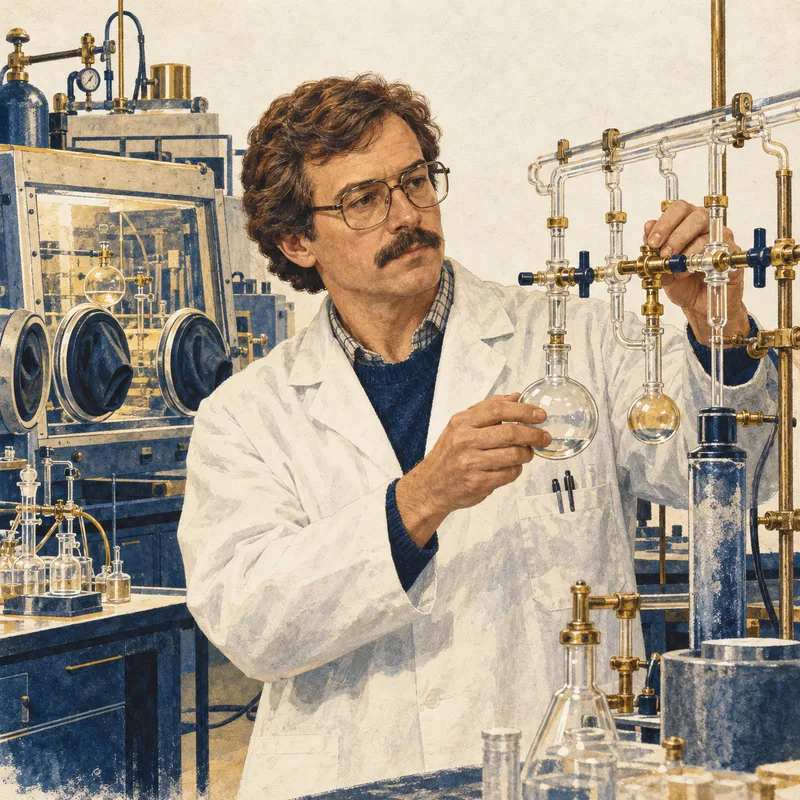
Richard R. Schrock
1945- · United States · Nobel Chemistry 2005
Metal-alkylidene metathesis catalysts