The discovery, explained · Chemist no. 93 of 350
Richard Schrock and the Metal Carbenes That Made Metathesis Predictable
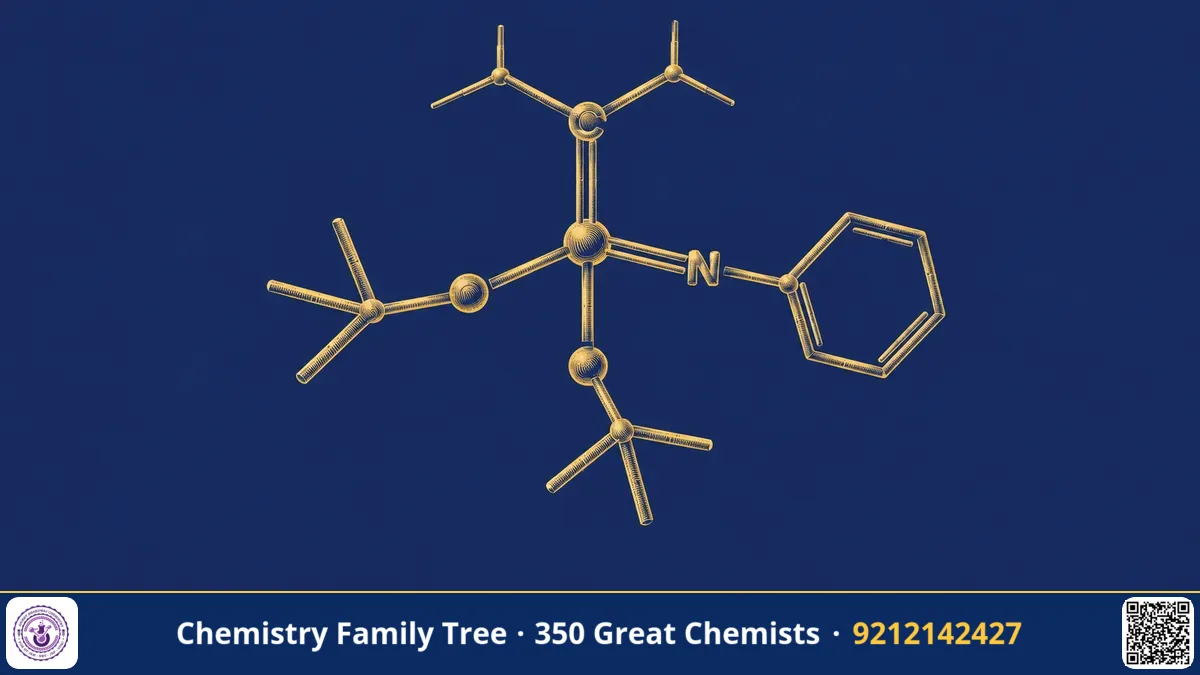
When you first meet organometallic chemistry, carbenes seem like fleeting species that exist for a split second. Richard R. Schrock showed that a carbene could be a stable, isolable ligand on an early transition metal, and that such a compound could drive one of the most useful reactions in organic chemistry, olefin metathesis. In 1974, while working at DuPont, he prepared a tantalum alkylidene complex. Later, at MIT, he designed molybdenum and tungsten catalysts that were fast, well defined and tunable. For this work he shared the 2005 Nobel Prize in Chemistry with Yves Chauvin and Robert Grubbs. The "Schrock carbene" is now a standard textbook category that you must be able to compare with the Fischer carbene.
The Scientific Problem Before the Discovery
By the early 1970s metathesis was industrially known, and Yves Chauvin had suggested that metal carbenes and metallacyclobutanes were the key species. But there was a gap in the evidence. The catalysts used were ill-defined mixtures such as WCl₆ with alkylaluminium co-catalysts. Nobody could point at one molecule and say "this is the active species". Also, the carbene complexes known at the time were Fischer carbenes, made by E. O. Fischer in 1964. These contain a low-oxidation-state metal such as Cr(0) or W(0), carry CO ligands, and have an electrophilic carbene carbon. They were poor metathesis catalysts. So chemists needed to know: could a different type of carbene, on a high-oxidation-state early metal, be made and would it react with alkenes?
The Discovery: Step by Step
- The accident at DuPont (1974). Schrock was trying to make a tantalum compound with five neopentyl groups, Ta(CH₂CMe₃)₅, a species with only alkyl groups. Neopentyl (CH₂CMe₃) has no hydrogen on the beta carbon, so beta-hydride elimination cannot occur. Instead, an alpha hydrogen was removed, and a stable alkylidene compound formed: Ta(=CHCMe₃)(CH₂CMe₃)₃. This was the first well-defined high-oxidation-state alkylidene and is called a Schrock carbene.
- Testing reactivity. The tantalum carbene reacted like a Wittig reagent with carbonyl compounds, showing a nucleophilic carbene carbon, but it did not give an efficient metathesis catalyst.
- Switching metals. At MIT, Schrock moved to molybdenum and tungsten, the metals used in industrial metathesis. In 1990 his group published molybdenum imido alkylidene complexes with the general formula Mo(=NAr)(=CHCMe₂R)(OR')₂, where Ar is a bulky 2,6-diisopropylphenyl group. These were highly active catalysts for metathesis of many alkenes, and they were single, characterisable compounds.
- Tuning by ligands. By changing the alkoxide groups (OR'), for instance using fluorinated alkoxides or bulky biaryl diolates, the activity and selectivity could be controlled. Chiral versions, developed with Amir Hoveyda, allowed enantioselective ring-closing metathesis.
The Chemistry Behind It
The reaction is the same Chauvin cycle:
M=CHR + R'CH=CHR' → metallacyclobutane → M=CHR' + RCH=CHR'
Why do these metals work? In a Schrock carbene the metal is in a high oxidation state (for example Mo(VI) or Ta(V)) and is d⁰, meaning there are no d electrons on the metal. The metal-carbon double bond is polarised so that the carbon carries partial negative charge, M(δ+)=C(δ−). Think of it as the metal-carbon bond being like a phosphorus ylide, which is why it reacts with C=O in a Wittig-like way.
Fischer vs Schrock carbene: an exam favourite
| Property | Fischer carbene | Schrock carbene |
|---|---|---|
| Metal | Middle-to-late, low oxidation state (Cr(0), W(0), Fe(0)) | Early, high oxidation state (Ta(V), Mo(VI), W(VI)) |
| Other ligands | π-acceptors such as CO | σ- and π-donors such as alkyl, alkoxide, imido |
| Carbene carbon | Electrophilic | Nucleophilic |
| Carbene substituents | π-donors such as OMe | H or alkyl |
| Bonding model | Singlet carbene to metal (donor-acceptor) | Triplet carbene with triplet metal fragment (covalent) |
| Example | (CO)₅W=C(OMe)Ph | Ta(=CHCMe₃)(CH₂CMe₃)₃ |
Another Schrock discovery is the metal alkylidyne (M≡CR), such as W(≡CCMe₃)(CH₂CMe₃)₃. These react with alkynes in a similar [2+2] way and are the basis of alkyne metathesis.
Applications Today
- Fine chemicals and drugs: Molybdenum catalysts shine when the alkene is hindered or when a specific Z or E geometry is required, which is hard for ruthenium catalysts.
- Natural product synthesis: Chiral Mo catalysts help build complex rings with high enantiomeric excess.
- Polymers: Ring-opening metathesis polymerisation (ROMP) with Schrock catalysts gives living polymers with controlled length and tacticity.
- Nitrogen fixation research: Schrock also developed a molybdenum complex that catalytically converts N₂ to NH₃ under mild conditions, N₂ + 6H⁺ + 6e⁻ → 2NH₃. This work in the early 2000s is a model for the Haber-Bosch alternative, although it is not yet industrial.
- Green chemistry: Metathesis forms fewer by-products and needs fewer steps. For students in India, this links to the green chemistry theme in the syllabus.
Exam Corner
- Schrock carbene: early transition metal, high oxidation state, no π-acceptor ligands, nucleophilic carbene carbon. Fischer carbene: low-valent late metal, CO ligands, electrophilic carbene carbon.
- The first Schrock carbene was a tantalum neopentylidene complex made in 1974. Remember that neopentyl groups lack beta hydrogens, which favours alpha-hydrogen abstraction.
- Schrock metathesis catalyst: Mo(=NAr)(=CHCMe₂R)(OR')₂. Mo is in the +6 oxidation state and is d⁰, so there are no metal d electrons to count.
- The Nobel Prize in Chemistry in 2005: Chauvin (mechanism), Schrock (Mo/W catalysts), Grubbs (Ru catalysts).
- Alkylidyne W(≡CR) complexes do alkyne metathesis; alkylidene complexes do alkene metathesis.
Common Misconceptions
- "A carbene carbon is always electrophilic." Not true. In Fischer carbenes it is electrophilic, but in Schrock carbenes it is nucleophilic.
- "Schrock catalysts are better than Grubbs catalysts." They are more active in some cases but far more sensitive to air, water and polar functional groups. Each has its own best uses.
- "Alpha-hydrogen abstraction is a minor side reaction." It is the key reaction that gave the first Schrock carbene.
Quick Revision Box
- Schrock carbene = M(δ+)=C(δ−), nucleophilic, early metal, d⁰.
- First example: Ta(=CHCMe₃)(CH₂CMe₃)₃ at DuPont in 1974.
- Molybdenum imido alkylidene catalysts published in 1990.
- Works through the Chauvin metallacyclobutane mechanism.
- Fischer carbene is the opposite: electrophilic carbon, CO ligands.
- Nobel Prize in Chemistry 2005 with Chauvin and Grubbs.
FAQ
What is a Schrock carbene?
It is a metal-carbon double bond in which the metal is an early transition metal in a high oxidation state and the carbene carbon is nucleophilic. It is also called an alkylidene.
How is a Schrock carbene different from a Fischer carbene?
Fischer carbenes have low-valent metals, CO ligands and an electrophilic carbon. Schrock carbenes have high-valent metals, donor ligands and a nucleophilic carbon.
Why are molybdenum catalysts sensitive to air?
The metal centre is electron-poor and has an open coordination site, so oxygen, water and polar groups attack it. This is the price paid for high activity.
Is Schrock's work only about metathesis?
No. He also worked on alkylidyne complexes, polymerisation catalysts, and a molybdenum system that reduces dinitrogen to ammonia.
Published by ABC Chemistry — IIT-JAM | CSIR-NET | GATE Chemistry Coaching. Visit abcchemistry.com
About the chemist
Richard R. Schrock
1945- · United States · Nobel Chemistry 2005
Metal-alkylidene metathesis catalysts