Biography · Chemist no. 84 of 350
Richard Smalley (1943-2005): The Chemist Behind the Buckyball
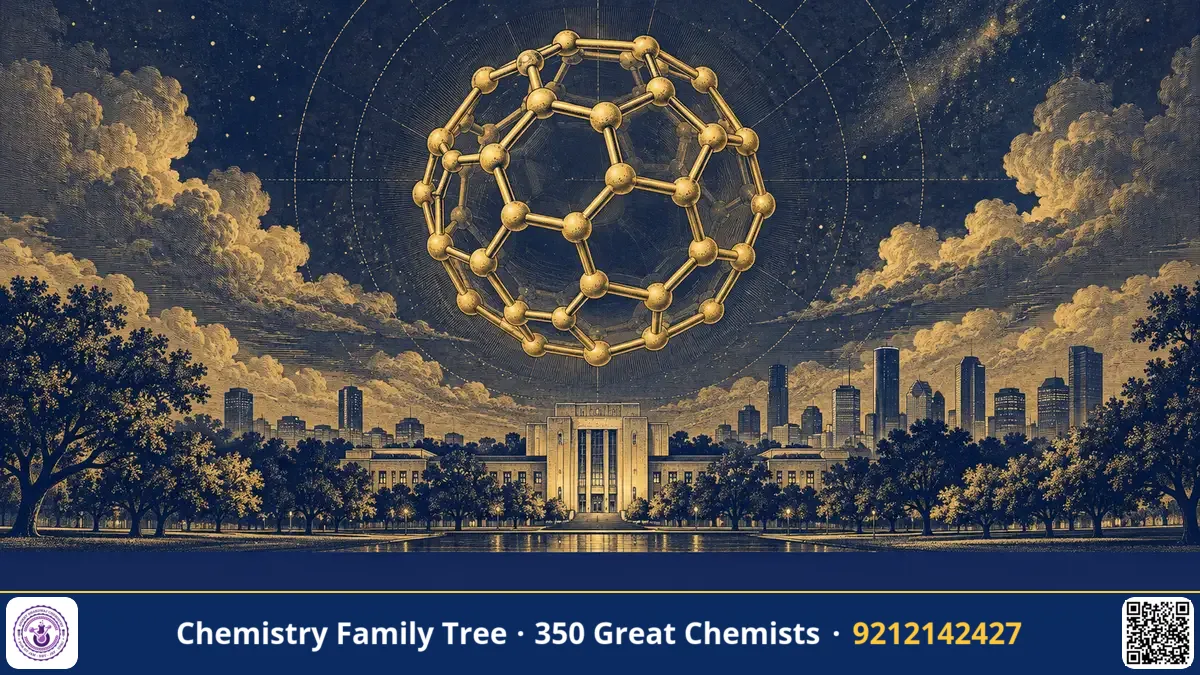
Richard Errett Smalley was an American chemist and physicist who, with Robert Curl and Harold Kroto, discovered the C60 molecule called buckminsterfullerene. His legacy in one line: he helped open the world of fullerenes and carbon nanotubes, and he became one of the strongest voices for nanotechnology and for new energy solutions. He shared the Nobel Prize in Chemistry in 1996. Later in life he worked hard to inspire students to take up science and engineering.
Early Life & Family
Smalley was born on 6 June 1943 in Akron, Ohio, and grew up in Kansas City, Missouri. From childhood Richard liked building things and experimenting at home. He was encouraged by a family member who was a chemist, and he enjoyed science projects, especially kitchen-table chemistry. Like many students, he did not move in a straight line toward his future career. He did, however, always enjoy the practical side of science: instruments, glassware and construction.
Education & Mentors
Smalley began his university studies at Hope College in Michigan and then moved to the University of Michigan, where he received his bachelor's degree in chemistry in 1965. He did not go directly to a PhD. Instead, he worked for several years in industry at Shell Chemical Company, where he learned about practical chemistry and industrial problems. He then went to Princeton University for graduate study, working with Elliot R. Bernstein in the field of laser spectroscopy, and received his PhD in 1973. He did postdoctoral work at the University of Chicago with Donald Levy and Lennard Wharton, who pioneered the use of supersonic molecular beams cooled by expansion. These beam techniques became the technical foundation of his later cluster experiments.
Career Timeline
| Year | Event |
|---|---|
| 1943 | Born in Akron, Ohio (6 June) |
| 1965 | Bachelor's degree, University of Michigan; joins Shell Chemical |
| 1973 | PhD, Princeton University |
| 1973-1976 | Postdoctoral research at the University of Chicago on supersonic beams |
| 1976 | Joins the faculty of Rice University, Houston |
| 1981-1985 | Builds the laser-vaporisation cluster source and studies clusters |
| 1985 | Co-discovers C60 with Kroto, Curl, Heath and O'Brien (September) |
| 1990s | Leads Rice work on carbon nanotubes; founds the Center for Nanoscale Science and Technology |
| 1996 | Nobel Prize in Chemistry, shared with Curl and Kroto |
| 2005 | Dies in Houston (28 October) |
Major Scientific Contributions
- Laser-vaporisation cluster source: a new instrument to make and study small clusters of almost any element.
- Discovery of C60: the proposal that a 60-atom carbon cage with 12 pentagons and 20 hexagons explains the strong mass-spectrum peak.
- Fullerene chemistry: his group explored endohedral fullerenes (atoms trapped inside cages) and the formation mechanism of fullerenes.
- Carbon nanotubes: methods for producing single-walled nanotubes, including a laser-oven method and the HiPco process using carbon monoxide.
- Nanotechnology advocacy: he helped build support for national research programmes in nanoscience.
The experiment, the structure and the equations appear in the companion discovery blog on buckminsterfullerene.
Awards, Honours & Nobel Prize
The Nobel Prize in Chemistry 1996 was awarded jointly to Robert F. Curl Jr., Harold W. Kroto and Richard E. Smalley "for their discovery of fullerenes". Smalley also received many scientific medals and honours from chemical and physical societies, and he was a member of national academies. At Rice University he held a named professorship and led the centre where nanotubes and nanomaterials were made and studied.
Personality, Struggles & Lesser-Known Facts
- He worked in industry before his PhD, which is unusual for a Nobel laureate. Real-world experience gave him practical insight.
- The Rice team tuned the helium conditions in September 1985 until the 60-carbon peak dominated the mass spectrum.
- The word "buckyball" is a popular nickname, and the molecule's shape is the same as that of a modern association football.
- He was a well-known critic of the idea of "molecular assemblers", describing the problems of "fat fingers" and "sticky fingers" in a public debate with K. Eric Drexler in the early 2000s.
- In his last years he spoke widely about the need for cheap, clean energy as humanity's top problem, and gave talks to encourage young people to become scientists and engineers.
- He died of leukemia in 2005, at the age of 62.
Legacy & Influence on Modern Chemistry
Smalley's discovery expanded the list of carbon allotropes, which now includes diamond, graphite, fullerenes, nanotubes and graphene. The last two earned further Nobel recognition: graphene was honoured in Physics in 2010. Fullerene derivatives are used in organic solar cells, and nanotubes are studied for strong light composites, electronics and sensors. His career also shows how an instrument built for one purpose (studying semiconductor clusters) can lead to an unexpected discovery in another field. His name is also attached to the nanoscale science institute at Rice University.
Lessons for Students
- Build good tools. A new instrument gave a new view of nature.
- Collaborate across fields. Smalley's laboratory skills and Kroto's astrophysical questions came together.
- Stay alert to surprises. A single large peak in a mass spectrum was not an error; it was a discovery.
- Think about society. Energy and education mattered to him as much as molecules.
Quick Facts Box
- Born: 6 June 1943, Akron, Ohio, USA
- Died: 28 October 2005, Houston, Texas, USA
- Nationality: American
- Field: Physical chemistry, cluster science, nanotechnology
- Famous for: Co-discovery of buckminsterfullerene C60; carbon nanotubes
- Nobel Prize: Chemistry, 1996 (with R. F. Curl Jr. and H. W. Kroto)
FAQ
Where did Smalley do the C60 experiment?
At Rice University in Houston, Texas, using his laser-vaporisation cluster apparatus.
Who were Smalley's co-discoverers?
Robert Curl and Harold Kroto, together with graduate students James Heath and Sean O'Brien.
Is Smalley the inventor of carbon nanotubes?
No. Nanotubes were observed earlier by other researchers, notably Sumio Iijima in 1991, but Smalley's group developed important methods to make single-walled nanotubes.
What did Smalley do after the Nobel Prize?
He continued nanotube research and campaigned for new energy technologies, including better electrical grids and renewable energy, and for science education.
Published by ABC Chemistry — IIT-JAM | CSIR-NET | GATE Chemistry Coaching. Visit abcchemistry.com
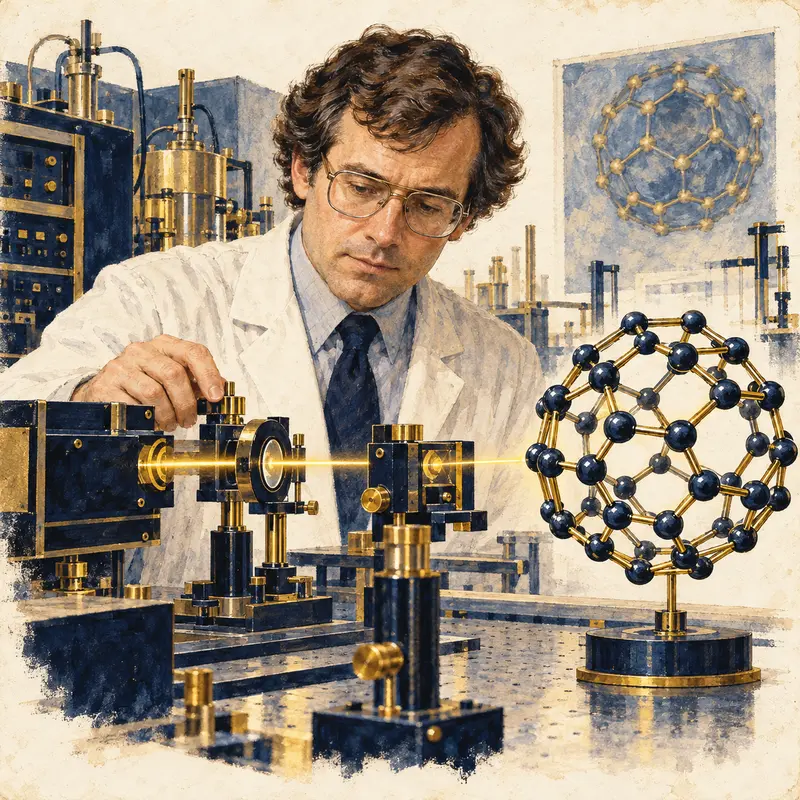
About the chemist
Richard Smalley
1943-2005 · United States · Nobel Chemistry 1996
Discovery of fullerenes