The discovery, explained · Chemist no. 84 of 350
Buckminsterfullerene C 60 : How Richard Smalley Helped Discover a Third Form of Pure Carbon
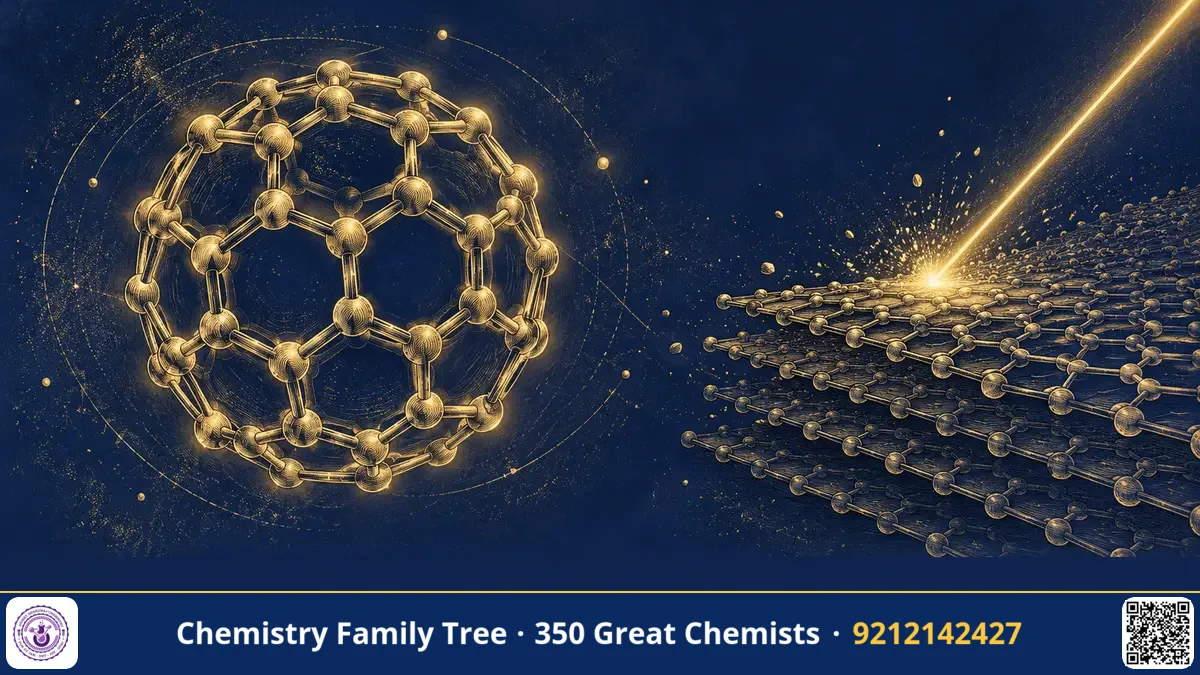
For centuries students learned that carbon has two crystalline allotropes: soft, black graphite and hard, transparent diamond. In September 1985, in a laboratory at Rice University in Houston, Texas, a third form appeared as a surprise in a mass spectrometer. It was a hollow cage of exactly 60 carbon atoms shaped like a football. Richard Smalley, with Robert Curl, Harold Kroto and two graduate students, James Heath and Sean O'Brien, named it buckminsterfullerene, after the architect Buckminster Fuller, who designed geodesic domes. The discovery started the field of fullerenes and nanotubes, and Smalley, Curl and Kroto shared the 1996 Nobel Prize in Chemistry. This blog explains the experiment, the structure and the chemistry you need for IIT-JAM, CSIR-NET and GATE.
The Scientific Problem Before the Discovery
Smalley was an expert in making and studying clusters, small groups of atoms between a single atom and a bulk solid. In the early 1980s he built a laser-vaporisation cluster source: a pulsed laser vaporises a target material, and a burst of helium gas carries the hot vapour into a vacuum, where it cools and forms clusters that can be separated by mass. Smalley used the machine to study semiconductor clusters of silicon and germanium.
Meanwhile, Harold Kroto, a British spectroscopist, had been studying long carbon-chain molecules such as HC5N, HC7N and HC9N in interstellar space and in the atmospheres of red giant stars. He wanted to know how such chains form, and he suspected that carbon-rich stars make them. He needed a laboratory that could vaporise graphite and study the carbon vapour, and he arranged to use Smalley's apparatus at Rice. The scientific question was therefore: what do carbon atoms assemble into when graphite is vaporised?
The Discovery / Experiment — Step by Step
- Vaporisation. A pulsed laser hits a rotating graphite disc. Carbon atoms and small fragments are released as a hot plasma.
- Cooling and clustering. A pulse of helium gas sweeps the vapour into an expansion chamber. Collisions with helium cool the carbon, which condenses into clusters Cn.
- Mass analysis. The clusters are ionised by another laser and detected by a time-of-flight mass spectrometer, which sorts ions by mass-to-charge ratio.
- The surprise. The mass spectrum showed many carbon clusters, but one peak at mass 720 (60 × 12) was far stronger than the others, with a smaller peak at mass 840 (C70). Under certain conditions of helium pressure, the C60 signal could be made to dominate the spectrum.
- Structure. The group reasoned that a peak so strong must come from an especially stable species. A flat sheet of carbon would have unsatisfied edge bonds. A closed cage would have none. They built paper and then model structures and proposed a truncated icosahedron, a polyhedron with 12 pentagons and 20 hexagons, like a modern soccer ball.
The proposal was published in Nature in November 1985 with the title "C60: Buckminsterfullerene". Direct proof of the structure needed larger samples, and in 1990 Wolfgang Krätschmer and Donald Huffman produced C60 in gram amounts by an arc discharge between graphite electrodes in helium. Extracting the soot with benzene gave a wine-red solution, from which crystals of C60 and C70 could be separated. Spectroscopy and X-ray studies confirmed the cage structure.
The Chemistry Behind It
Geometry and Euler's theorem
Any closed polyhedron obeys Euler's formula: V − E + F = 2, where V is the number of vertices, E the number of edges and F the number of faces. For C60:
V = 60 (carbon atoms)
F = 12 pentagons + 20 hexagons = 32
E = (12×5 + 20×6) / 2 = 90
V − E + F = 60 − 90 + 32 = 2
Every fullerene Cn has exactly 12 pentagons and (n/2 − 10) hexagons. So C70 has 12 pentagons and 25 hexagons and looks like a rugby ball. The pentagons are required to curve the sheet into a closed surface. In C60, no two pentagons touch (the isolated pentagon rule), which lowers the strain.
Bonding and properties
- Each carbon is bonded to three others, so the hybridisation is close to sp2, but the curvature adds some sp3 character.
- There are two types of C-C bonds: the 6:6 bonds (between two hexagons, shorter, about 1.38 Å, double-bond-like) and the 5:6 bonds (between a pentagon and a hexagon, about 1.45 Å, single-bond-like).
- C60 behaves like an electron-poor alkene, not like benzene. It readily undergoes addition reactions at the 6:6 bonds, such as hydrogenation and cycloaddition.
- It dissolves in non-polar solvents such as benzene and toluene (purple solution in toluene), but not in water.
- With alkali metals it forms salts; K3C60 is a superconductor below about 18 K.
Applications Today
- Organic solar cells: fullerene derivatives such as PCBM are widely used as electron acceptors.
- Medicine research: functionalised fullerenes are studied as antioxidants (radical scavengers) and for drug delivery and imaging.
- Carbon nanotubes: Smalley's group developed the laser-oven method for single-walled carbon nanotubes and later a high-pressure CO process (HiPco). Nanotubes are used in composites, conductive films and sensors.
- Materials and lubricants: fullerene additives and fullerene-based coatings are used in specialised materials.
- Education and research in India: fullerene and nanotube chemistry is now part of M.Sc. and research courses, with active groups in the IITs, IISc and national laboratories.
Exam Corner — 5 Likely Points
- C60: 60 vertices, 90 edges, 32 faces (12 pentagons, 20 hexagons); molar mass 720 g/mol.
- Every fullerene has 12 pentagons; number of hexagons = (n/2) − 10.
- C60 has 30 double-bond-like 6:6 bonds and 60 single-bond-like 5:6 bonds.
- Point group of C60 is Ih; it has 12 pentagonal faces with five-fold axes (total C5 axes: 6).
- K3C60 superconducts below about 18 K.
Common Misconceptions
- "C60 is aromatic like benzene." It is not strongly aromatic; the pentagons break the delocalisation, and C60 reacts as an electron-deficient polyene.
- "Fullerenes were first found in soot made in a lab only." Fullerenes were later found in natural sources, including some meteorites and soot from flames.
- "All 60 bonds are equal." There are two bond lengths, 6:6 and 5:6.
Quick Revision Box
- C60 discovered in September 1985 at Rice University by Kroto, Heath, O'Brien, Curl and Smalley.
- Method: laser vaporisation of graphite in helium plus time-of-flight mass spectrometry.
- Structure: truncated icosahedron, Ih symmetry.
- Bulk synthesis: Krätschmer and Huffman, 1990, by arc discharge.
- Euler: V − E + F = 2, giving 12 pentagons in every fullerene.
- Nobel Prize in Chemistry 1996: Curl, Kroto and Smalley.
FAQ
Why is it called buckminsterfullerene?
Because its shape resembles the geodesic domes designed by the architect R. Buckminster Fuller. The short name is "buckyball".
Is C60 harder than diamond?
No. Single molecules of C60 are compressible and the solid is soft. Diamond is harder because of its three-dimensional covalent network.
Why is C60 so stable?
C60 is the smallest fullerene that satisfies the isolated pentagon rule, and it has only one such arrangement, which keeps strain low.
Which Nobel Prize did Smalley receive?
The Nobel Prize in Chemistry in 1996, shared with Robert F. Curl Jr. and Harold W. Kroto, for the discovery of fullerenes.
Published by ABC Chemistry — IIT-JAM | CSIR-NET | GATE Chemistry Coaching. Visit abcchemistry.com
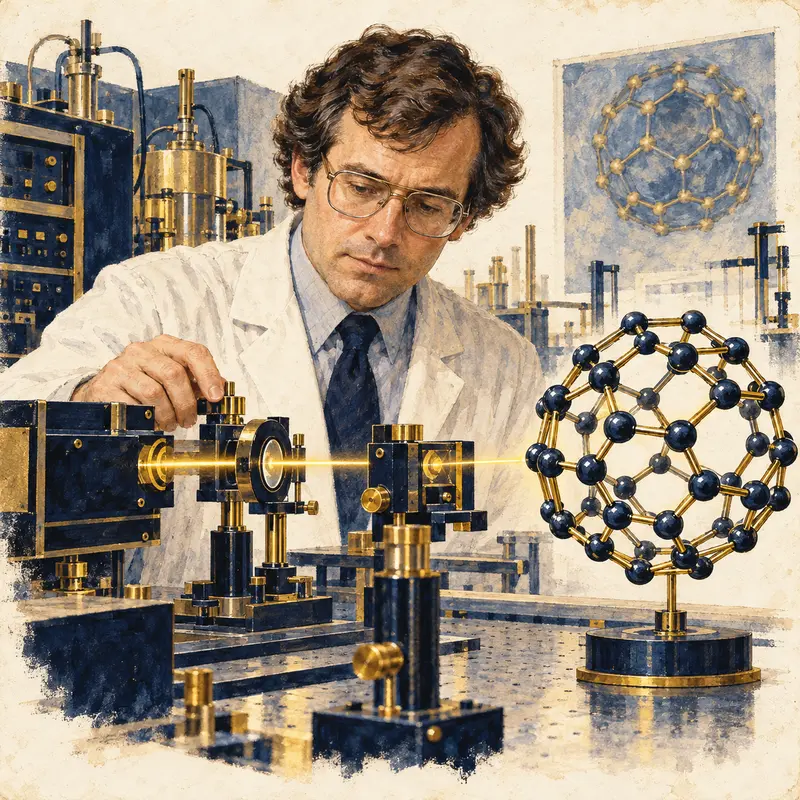
About the chemist
Richard Smalley
1943-2005 · United States · Nobel Chemistry 1996
Discovery of fullerenes