Biography · Chemist no. 129 of 350
Richard Laurence Millington Synge (1914-1994): The Quiet Biochemist Behind Partition Chromatography
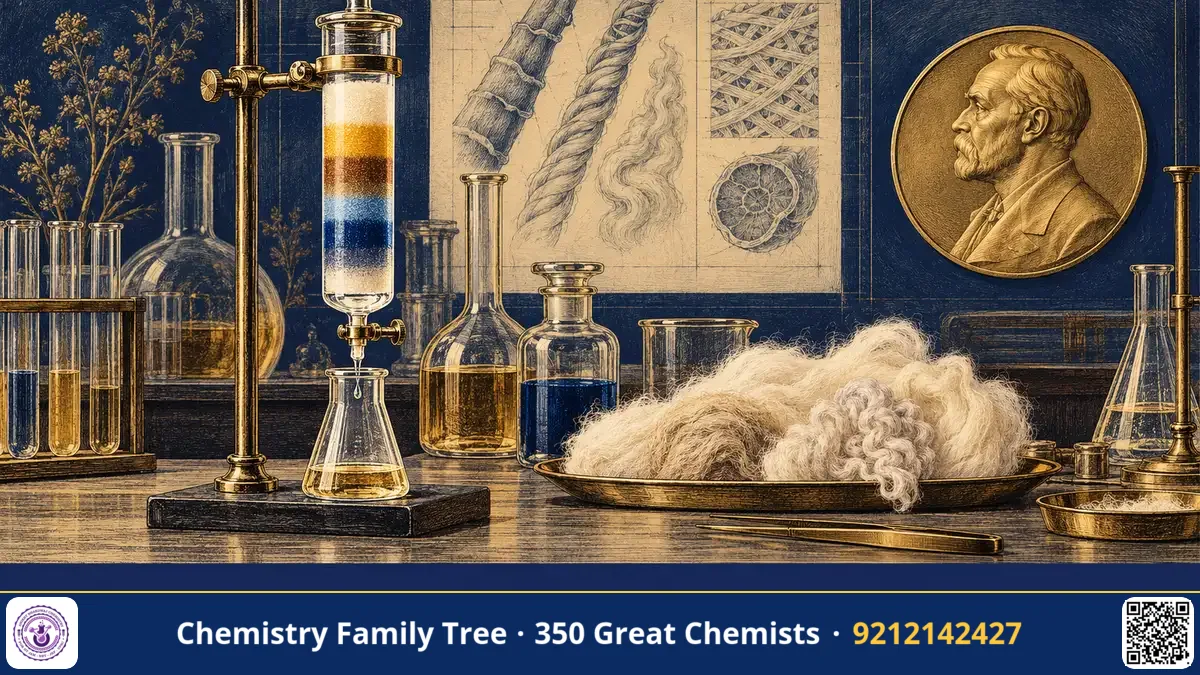
Richard Synge was an English biochemist whose invention, with Archer Martin, of partition chromatography reshaped analytical chemistry and made modern protein science possible. He shared the 1952 Nobel Prize in Chemistry with Martin. Over a long career he studied amino acids, peptides, plant proteins and the chemistry of food and feed. His legacy in one line: he showed how to separate molecules that look almost identical, and thereby opened the door to protein sequencing.
Early Life and Family
Synge was born on 28 October 1914 in Liverpool, England. His father was a stockbroker, and his mother's family was also well established; he was brought up in a comfortable middle-class household. He attended Winchester College, where he was good at science and developed an early interest in chemistry, which he continued at university.
Education and Mentors
Synge studied at Trinity College, Cambridge, and graduated in chemistry (and later biochemistry) in the 1930s. At Cambridge he worked in the Dunn Nutritional Laboratory in the tradition of Sir Frederick Gowland Hopkins's school of biochemistry, working on protein and amino acid analysis. He was interested in how to separate amino acids from protein hydrolysates, and he published work on how amino acids distribute between solvents. In 1938 he moved to the Wool Industries Research Association in Leeds, where he met Archer Martin, also a young Cambridge biochemist who built excellent apparatus. The two men complemented each other: Synge supplied knowledge of protein chemistry, Martin supplied physical-chemistry insight and technical skill.
Career Timeline
| Year | Event |
|---|---|
| 1914 | Born in Liverpool |
| 1930s | Studies at Trinity College, Cambridge; research in the Dunn Nutritional Laboratory |
| 1939 | Works at the Wool Industries Research Association, Leeds |
| 1941 | Publishes partition chromatography with Martin |
| 1943 | Moves to the Lister Institute, London, and works on gramicidin and peptides |
| 1948 | Joins the Rowett Research Institute, Aberdeen |
| 1950 | Elected Fellow of the Royal Society |
| 1952 | Shares the Nobel Prize in Chemistry with Archer Martin |
| 1967 | Joins the Food Research Institute, Norwich |
| 1994 | Dies in Norwich |
Major Scientific Contributions
Partition chromatography. The 1941 method of using water held on silica gel against a flowing organic solvent separated acetylated amino acids by their partition coefficients (K = Cs / Cm). It gave chemists the first practical way to resolve very similar compounds on a small scale.
Paper chromatography and peptides. After the 1944 introduction of paper chromatography, Synge applied it to peptides. He studied gramicidin S, a cyclic peptide antibiotic from Bacillus brevis, and contributed to showing that it contains the unusual D-form of phenylalanine. This was important evidence that natural peptides are not limited to L-amino acids.
Early thinking about sequence analysis. His work on separating fragments from partial hydrolysis of peptides demonstrated the method later used by Sanger to sequence insulin. Sanger openly used the chromatographic tools of Martin and Synge.
Plant and food biochemistry. In later years at Aberdeen and Norwich, Synge studied plant proteins, leaf protein extraction, and the chemistry of natural products found in food crops, especially compounds relevant to human and animal nutrition.
Awards, Honours and Nobel Prize
Synge shared the 1952 Nobel Prize in Chemistry with Archer J. P. Martin "for their invention of partition chromatography". He was elected a Fellow of the Royal Society in 1950. He also received honorary degrees and was recognised by learned societies for his lifelong research on proteins and peptides.
Personality, Struggles and Lesser-Known Facts
- Synge continued his scientific work through the Second World War years, moving from Leeds to the Lister Institute in London.
- He is remembered as a modest, thoughtful and shy scientist, who gave much credit to his co-workers and to Martin in particular.
- Both men were from Cambridge biochemistry, but their ways of working were different: Synge was the careful protein chemist, Martin the instrument builder.
- His later research on plant proteins, including protein from leaves as a possible food source, shows his lasting interest in nutrition.
- Before partition chromatography, the group in Leeds was struggling with the slow, difficult separation of amino acids in wool, which is why their early work felt so urgently practical.
Legacy and Influence on Modern Chemistry
Every time a student runs a thin-layer chromatography plate, every time a laboratory runs an HPLC peptide map, the work of Synge and Martin is being used. Their approach made it possible to prove that proteins have definite amino acid sequences, which was the foundation for molecular biology. Gramicidin S studies were an early model for peptide antibiotic research, and the "separate, analyse, reassemble" philosophy lives on in modern proteomics. In India, partition chromatography principles appear in the syllabus of every university chemistry programme, from B.Sc. practicals to GATE and CSIR-NET instrumental analysis.
Lessons for Students
- Pick a problem that really matters to you. Synge wanted to know what wool is made of, and that practical question led to a Nobel Prize.
- Work with people whose skills are different from yours. A protein chemist and an instrument builder together created something neither could alone.
- Give credit generously.
- Stay curious beyond one discovery; Synge kept working for decades on peptides and plants.
Quick Facts Box
- Born: 28 October 1914, Liverpool, England
- Died: 18 August 1994, Norwich, England
- Nationality: British
- Field: Biochemistry, peptide and protein chemistry
- Famous for: Partition chromatography; gramicidin S peptide studies
- Nobel Prize: Chemistry, 1952 (shared with Archer J. P. Martin)
FAQ
What is Richard Synge best known for?
For inventing partition chromatography with Archer Martin, which won them the 1952 Nobel Prize in Chemistry.
Where did Synge and Martin do their work?
At the Wool Industries Research Association in Leeds, England, around 1941.
Is Synge's Nobel Prize in Medicine?
No. It was in Chemistry.
How did Synge's work help Frederick Sanger?
Sanger used paper chromatography and related partition methods to separate peptides from insulin and determine its amino acid sequence.
Published by ABC Chemistry — IIT-JAM | CSIR-NET | GATE Chemistry Coaching. Visit abcchemistry.com
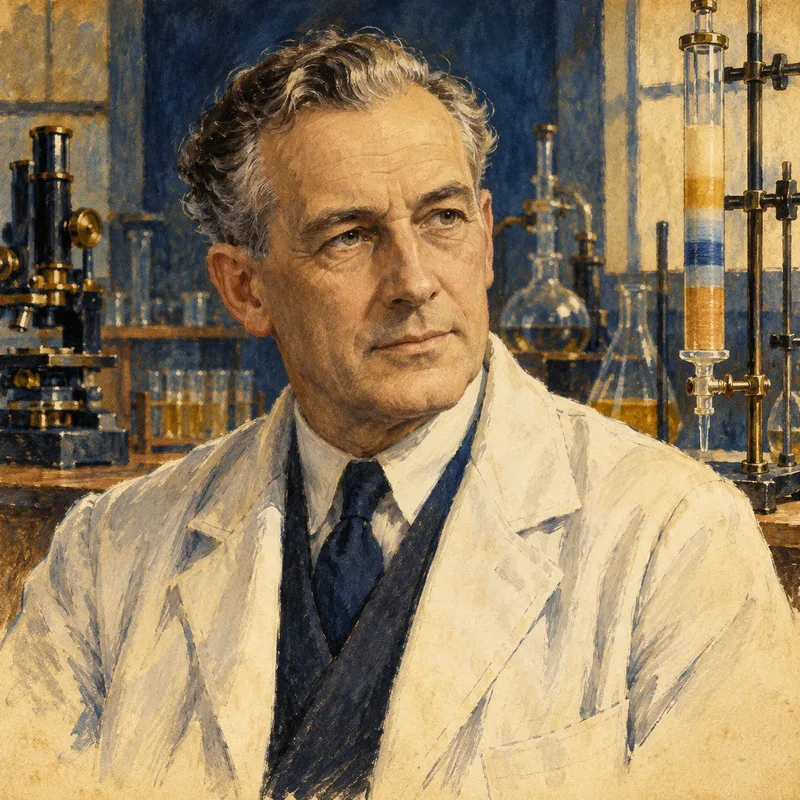
About the chemist
Richard Synge
1914-1994 · United Kingdom · Nobel Chemistry 1952
Partition chromatography of amino acids