The discovery, explained · Chemist no. 129 of 350
Richard Synge and the Chemistry of Separating Peptides: From Partition Chromatography to Protein Structure
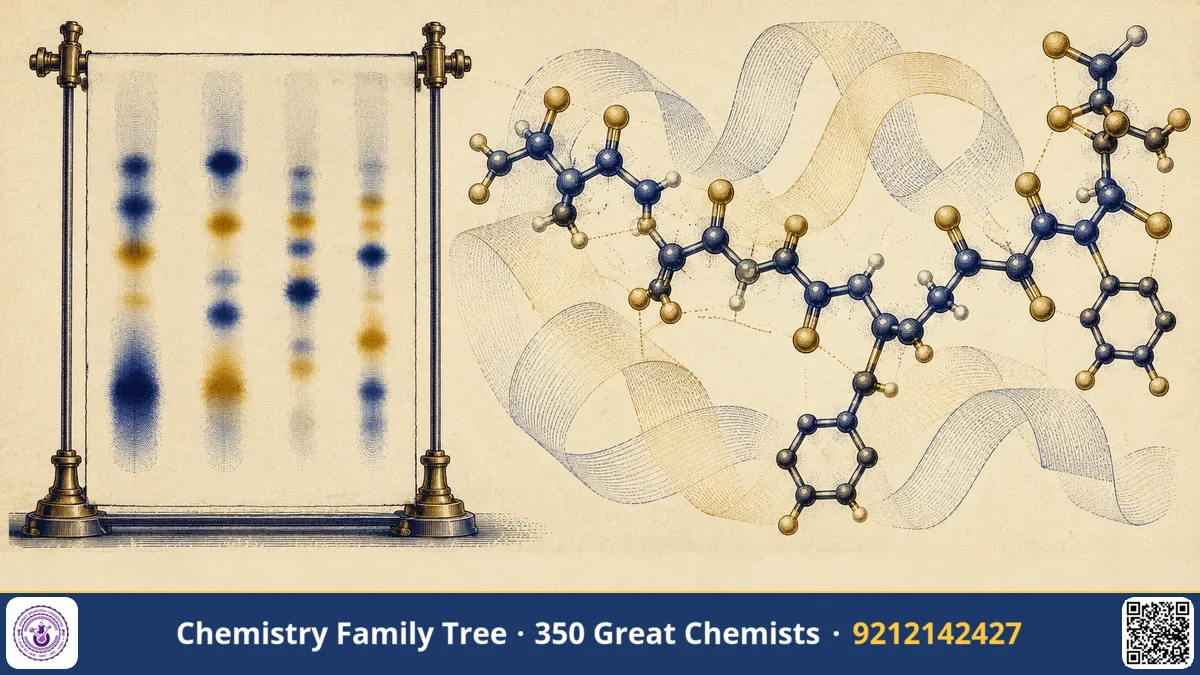
Richard Laurence Millington Synge was a British biochemist who, together with Archer Martin, invented partition chromatography in 1941. Their method let scientists separate tiny amounts of closely related amino acids and peptides for the first time. Synge himself used it to study the structure of the antibiotic peptide gramicidin S and to analyse the amino acid content of proteins, while Frederick Sanger used the same tools to sequence insulin. In 1952 Synge and Martin shared the Nobel Prize in Chemistry. In this post we look at the problem Synge wanted to solve, the experiment, and the chemistry of peptides and chromatography that you need for competitive exams.
The Scientific Problem Before the Discovery
Proteins are long polymers of amino acids joined by peptide bonds. In the 1930s nobody knew whether a protein had a fixed sequence or was a random aggregate. To find out, chemists first had to know which amino acids were present and in what proportion. The standard method was to boil the protein with acid, hydrolyse it, and then separate the free amino acids:
Protein + (n-1) H₂O →(6 M HCl, heat)→ n amino acids
But amino acids are colourless, polar, similar in size and often present in milligram amounts. Isolating them by crystallisation, as Emil Fischer had done, was laborious and lost material. Synge, who worked at the Wool Industries Research Association in Leeds, wanted to analyse wool keratin and needed a fast, quantitative method.
The Discovery: Step by Step
Synge's earlier work was on protein analysis by dissolving amino acid derivatives in organic solvents, and with Martin he thought about counter-current extraction. Then they realised that one liquid could be kept fixed on a solid support.
- Prepare the column. Silica gel was mixed with water so that the grains held a film of water, which was the stationary phase.
- Convert amino acids to acetyl derivatives. Free amino acids dissolve poorly in organic solvents, so the N-acetyl derivatives were used, which can partition into chloroform.
- Elute. A water-immiscible solvent flowed down the column, and the different derivatives travelled at different speeds depending on how they partition between water and chloroform.
- Collect and titrate. Fractions were collected, and the amount of acid in each fraction was determined, giving bands for different amino acids.
The 1941 paper described this "new type of chromatogram" and also noted that gas could serve as mobile phase. In 1944, Consden, Gordon and Martin used filter paper instead of silica columns, and by 1944-45 Synge and colleagues were using paper chromatography to separate the amino acids of a whole protein hydrolysate. Two-dimensional paper chromatography, using two different solvents at right angles, resolved dozens of amino acids on a single sheet.
The Chemistry Behind It
Chromatographic separation depends on the partition coefficient K = Cs / Cm. A solute that is more soluble in the stationary phase moves slowly. On paper, the positions of the spots are described by Rf = distance of solute / distance of solvent front.
Several features of amino acid chemistry matter here:
- Amino acids are zwitterions,
H₃N⁺–CHR–COO⁻, at neutral pH. This makes them strongly polar and explains why they dissolve in water but not in non-polar solvents. - Side chains change the polarity. Leucine and phenylalanine have non-polar side chains and travel further in butanol-rich solvents. Serine and glycine are more polar and move less.
- Ninhydrin reacts with the free α-amino group to give a purple product called Ruhemann's purple, which makes the spots visible. Proline, a secondary amine, gives a yellow colour instead.
Synge applied the method to peptides as well. He worked on gramicidin S, a cyclic decapeptide antibiotic from Bacillus brevis. Together with Gordon and others, he showed that hydrolysis gives the amino acids valine, ornithine, leucine, phenylalanine and proline, and that the molecule is a cyclic peptide containing D-phenylalanine, an unusual amino acid. This was one of the first proofs of a cyclic peptide structure. By partial hydrolysis, which breaks the chain into small peptides, and by separating these on paper, Synge worked out how the amino acids were arranged. This approach, hydrolyse partly, separate, identify, and then overlap fragments, is exactly the strategy used by Sanger for insulin.
Applications Today
- Protein chemistry. Amino acid analysis and peptide mapping are routine for characterising proteins and biopharmaceuticals, such as the insulin and monoclonal antibodies produced in India.
- Antibiotics. Peptide antibiotics, including gramicidin, polymyxin and vancomycin-type molecules, are analysed by HPLC, a descendant of partition chromatography.
- Quality control. Pharmaceutical laboratories use chromatography to check purity and assay content.
- Food and agriculture. Amino acid profiles are used to judge the nutritional value of cereals, pulses and animal feed.
- Research. Thin-layer chromatography, an offspring of paper chromatography, is still the quickest way to follow the progress of an organic reaction in an undergraduate or research laboratory.
Exam Corner
- The 1952 Nobel Prize in Chemistry went to A. J. P. Martin and R. L. M. Synge for partition chromatography.
- In partition chromatography the stationary phase is a liquid held on an inert support; in adsorption chromatography it is the solid surface.
- Rf lies between 0 and 1 and depends on solvent, temperature and paper.
- Ninhydrin test: amino acids give purple colour, proline and hydroxyproline give yellow.
- Gramicidin S is a cyclic decapeptide antibiotic containing D-phenylalanine and ornithine.
Common Misconceptions
- "Synge and Sanger discovered chromatography together." No. Sanger used chromatography, but the invention is from Martin and Synge.
- "Paper chromatography is separation by the paper's pores, like a sieve." It is mainly partition between water in the cellulose and the moving solvent.
- "Synge won a Medicine Nobel Prize." His Nobel Prize was in Chemistry.
Quick Revision Box
- Synge and Martin invented partition chromatography in 1941 in Leeds.
- Stationary phase: water on silica gel; mobile phase: chloroform or butanol mixtures.
- Rf = distance moved by solute / distance moved by solvent front.
- Amino acid detection with ninhydrin; two-dimensional runs separate complex mixtures.
- Synge's peptide work included gramicidin S, a cyclic decapeptide.
- Nobel Prize in Chemistry 1952.
FAQ
What was Synge's main contribution?
He co-invented partition chromatography and applied it to amino acid and peptide analysis, including work on gramicidin S.
Why were N-acetyl amino acids used in the first column?
Free amino acids dissolve poorly in organic solvents. Acetylation made them soluble enough to partition into chloroform.
How does partial hydrolysis help in sequencing?
It breaks a protein or peptide into small fragments whose compositions can be found; overlapping fragments reveal the order of amino acids.
Is partition chromatography still used?
Yes. Reversed-phase HPLC, thin-layer chromatography and GC are all based on distribution of solutes between two phases.
Published by ABC Chemistry — IIT-JAM | CSIR-NET | GATE Chemistry Coaching. Visit abcchemistry.com
About the chemist
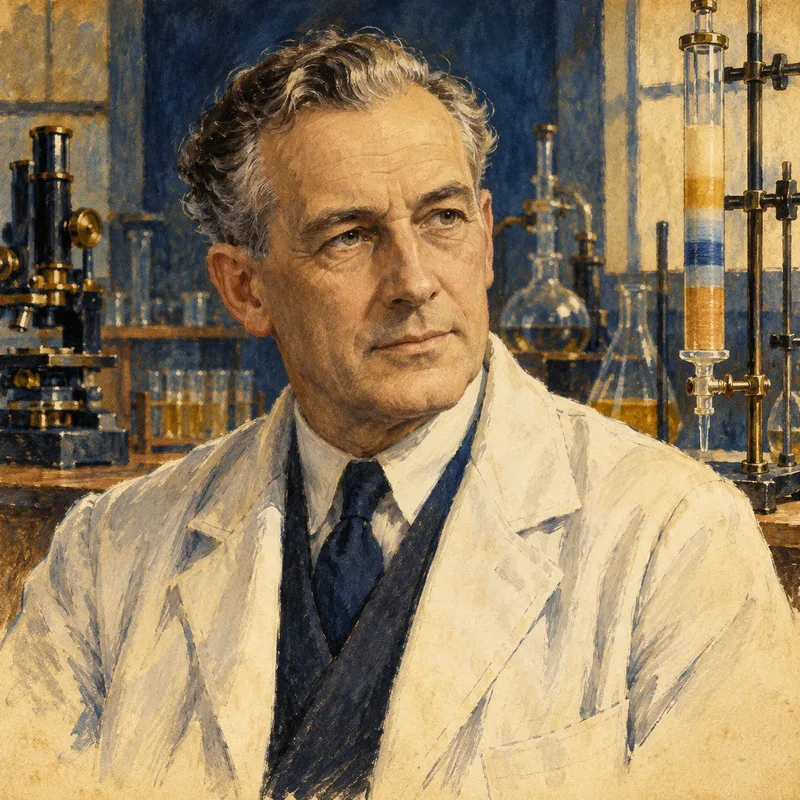
Richard Synge
1914-1994 · United Kingdom · Nobel Chemistry 1952
Partition chromatography of amino acids