Biography · Chemist no. 104 of 350
Richard Willstätter: Complete Life and Legacy
Introduction
Richard Willstätter (1872–1942) was a German organic chemist and one of the most gifted experimentalists of his age. He explained the structure of cocaine and atropine, discovered that chlorophyll contains magnesium, studied the pigments of flowers and fruits, and made a major effort to understand enzymes. He received the Nobel Prize in Chemistry in 1915. His life also carries a hard lesson of history: a celebrated professor who resigned in protest against antisemitism in 1925 and had to flee his country in 1939. His legacy is both scientific and moral.
Early Life and Family
Richard Martin Willstätter was born on 13 August 1872 in Karlsruhe, in the Grand Duchy of Baden, to a Jewish family. His father, Max Willstätter, was a textile merchant, and his mother was Sophie, née Ulmann. When Richard was a child, the family moved to Nuremberg, where he attended school. He later wrote about his boyhood in his autobiography, Aus meinem Leben (From My Life), published after his death.
He was a gifted student, interested in chemistry from a young age. He decided early to study chemistry. The family did not have much interest in science, but they encouraged his studies. Growing up as a Jewish boy in Germany of the late nineteenth century, he experienced the mixture of opportunity and prejudice that would shape his later life.
Education and Mentors
Willstätter entered the University of Munich in 1890 to study chemistry. His early studies were under Alfred Einhorn, who was working on local anaesthetics such as novocaine, and this led Willstätter to research on cocaine and related alkaloids. He completed his doctorate in 1894 with a thesis on the structure of cocaine. He remained in Munich as a lecturer and worked in the laboratory of Adolf von Baeyer, the Nobel laureate of 1905 and the greatest German organic chemist of his time. He became an extraordinary professor at Munich in 1902.
Baeyer's influence on him was strong, and Willstätter's skill at reaching difficult structures by degradation and synthesis reflected that training. Later, Willstätter's own students included Arthur Stoll and Richard Kuhn, who would himself win the Nobel Prize in Chemistry in 1938.
Career Timeline
| Year | Event |
|---|---|
| 1872 | Born in Karlsruhe on 13 August. |
| 1894 | Doctorate at Munich on the structure of cocaine. |
| 1896–1901 | Determines the structure of cocaine and atropine; synthesises tropinone-related compounds. |
| 1902 | Becomes extraordinary professor at Munich. |
| 1905 | Appointed professor at the ETH in Zurich. |
| 1906–1913 | Studies chlorophyll and discovers magnesium; also works on carotenoids and anthocyanins. |
| 1912 | Moves to Berlin as director of a chemistry department at the Kaiser Wilhelm Institute and professor at the University. |
| 1915 | Awarded the Nobel Prize in Chemistry; becomes professor at Munich, succeeding Baeyer. |
| 1915–1918 | During the First World War develops a charcoal-based gas mask filter. |
| 1920s | Studies enzymes such as lipase, peroxidase and invertase. |
| 1925 | Resigns his chair in protest against antisemitism at Munich. |
| 1939 | Leaves Germany for Switzerland. |
| 1942 | Dies in Muralto near Locarno, Switzerland, on 3 August. |
Major Scientific Contributions
- Structure and synthesis of cocaine and atropine: his early work on tropane alkaloids led to the first synthesis of cocaine, and the synthesis of cycloheptatriene and cyclooctatetraene from tropane-related compounds. His 1913 cyclooctatetraene synthesis from pseudopelletierine was a landmark in the study of aromaticity, as the compound turned out not to be aromatic.
- Chlorophyll: showed that chlorophyll contains magnesium, separated chlorophylls a and b and defined their relation to haem. See our discovery post on chlorophyll.
- Carotenoids and anthocyanins: established the formula of carotene and explained the structure of flower pigments.
- Quinones: synthesised ortho-quinones and studied quinone chemistry.
- Enzymes: in the 1920s, he tried to purify enzymes by adsorption on gels and concluded that they were small molecules attached to colloidal carriers. This conclusion was wrong, because James Sumner and John Northrop later showed enzymes to be proteins, but his purification methods were highly influential.
- Gas mask: he developed an effective filter for protection against poison gases during the First World War, for which he was widely thanked in Germany.
Awards, Honours and Nobel Prize
The Nobel Prize in Chemistry for 1915 went to Richard Willstätter "for his researches on plant pigments, especially chlorophyll". He was a member of numerous academies, including the Bavarian Academy of Sciences, and held honorary doctorates.
The importance of the Nobel Prize for the history of science is that it recognised the chemistry of natural pigments as a major field. Willstätter's work on cocaine and his later work on chlorophyll were seen as examples of how classical organic chemistry could reveal the chemistry of living things.
Personality, Struggles and Lesser-Known Facts
- Resignation in protest. In 1925, when the Munich faculty rejected a well-qualified Jewish candidate for a chair for reasons of antisemitism, Willstätter resigned his own professorship, though colleagues begged him to stay. He continued to do some research privately, with a few assistants, in Munich.
- Escape. After Kristallnacht in November 1938, and with great difficulty, he obtained permission to leave. He escaped to Switzerland in 1939, leaving behind his property and his research materials. His friends in Switzerland, including the Swiss chemist Arthur Stoll, helped him.
- Autobiography. He wrote Aus meinem Leben in exile in Switzerland. It was published posthumously in 1949.
- Gas-mask hero. His wartime contribution to gas protection was valued highly in Germany, yet this did not protect him later from the discrimination of the Nazi regime.
- Family tragedy. His wife Sophie died in 1908 and his daughter Margarete died in 1925, events which affected him deeply.
Legacy and Influence on Modern Chemistry
Willstätter's pigment work led directly to Hans Fischer's total synthesis of haemin and the full structure of chlorophyll, and to the later synthesis of chlorophyll a by R. B. Woodward in 1960. The cyclooctatetraene he made in 1911–1913 became a central case in the Hückel (4n+2) rule: it has eight π electrons, is tub-shaped, and behaves like a polyene, not an aromatic ring. He taught a generation of chemists and showed how to combine degradation, synthesis and careful measurement.
His wrongly interpreted enzyme work is also instructive. The adsorption and purification techniques he introduced were adopted by others, and his group trained Richard Kuhn. In science education, his name appears in discussions of tropane alkaloids, chlorophyll and aromaticity. For students, the moral story also matters: he is a reminder that science must be defended against prejudice.
Lessons for Students
- Choose problems that connect fields, such as plant chemistry and animal chemistry through porphyrins.
- Accept that even a great scientist can be wrong, as in his enzyme theory, and that science corrects itself.
- Stand by principle. His resignation in 1925 cost him his post but preserved his integrity.
- Value careful, gentle methods when working with delicate molecules.
- Write down your story; his autobiography preserves the voice of a lost generation of German scientists.
Quick Facts Box
- Born: 13 August 1872, Karlsruhe, Baden, Germany.
- Died: 3 August 1942, Muralto (Locarno), Switzerland.
- Nationality: German.
- Field: Organic chemistry, natural products.
- Famous for: Structure of chlorophyll, cocaine synthesis, cyclooctatetraene.
- Nobel: Chemistry, 1915.
FAQ
Why did Willstätter win the Nobel Prize?
He received the 1915 Nobel Prize in Chemistry for his researches on plant pigments, particularly chlorophyll.
Why did he resign from Munich?
He resigned in 1925 in protest against antisemitic attitudes in the faculty's appointment decisions.
What is cyclooctatetraene and why is it important?
It is C8H8, a non-planar ring with alternating double bonds. Willstätter synthesised it in 1911, and its non-aromatic behaviour supported the Hückel rule for aromaticity.
How did he escape Nazi Germany?
After years of pressure and the events of 1938, he managed to emigrate to Switzerland in 1939, where he spent his last years.
Published by ABC Chemistry — IIT-JAM | CSIR-NET | GATE Chemistry Coaching. Visit abcchemistry.com
About the chemist
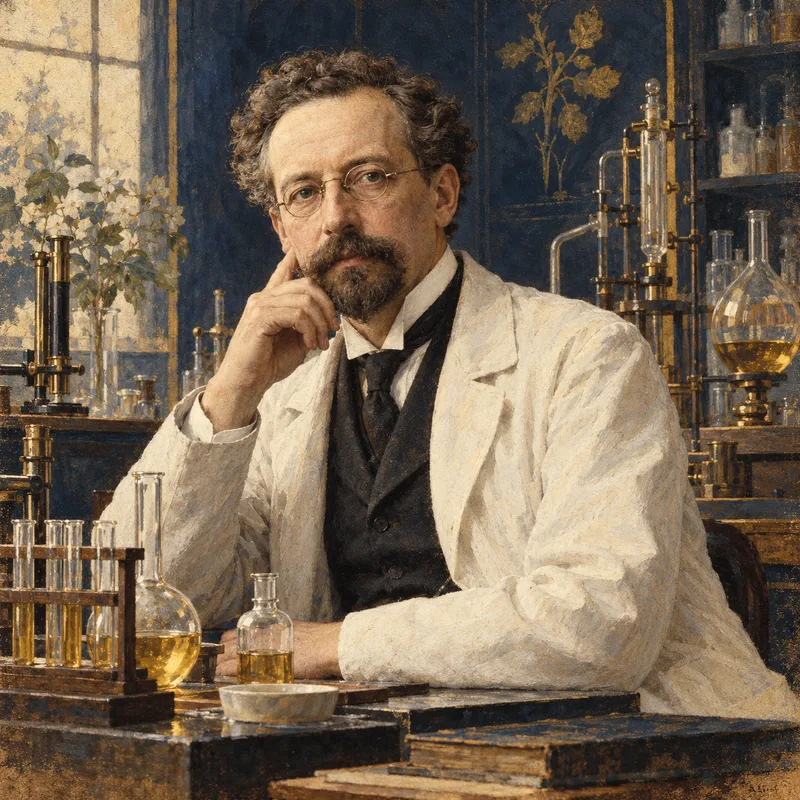
Richard Willstätter
1872-1942 · Germany · Nobel Chemistry 1915
Structure of chlorophyll and plant pigments