The discovery, explained · Chemist no. 104 of 350
Richard Willstätter and the Chemistry of Chlorophyll
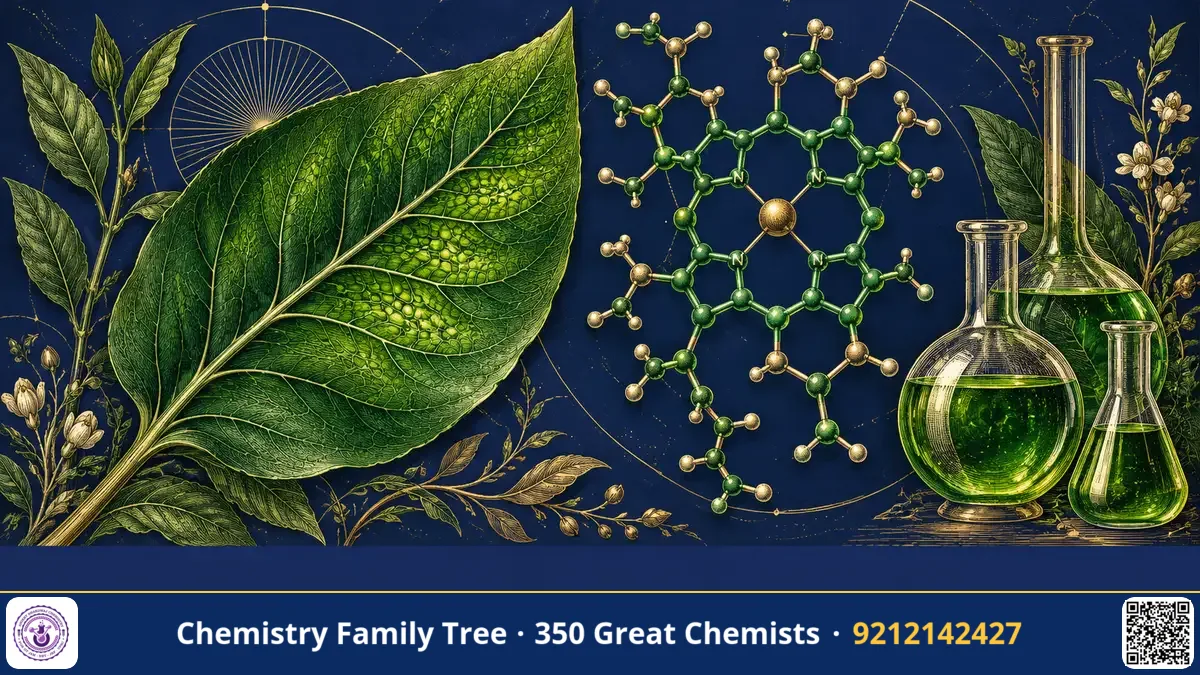
Every green leaf is a chemical factory powered by sunlight, and the key to that factory is the pigment chlorophyll. Before 1906, nobody knew what chlorophyll really was. It seemed a muddled green substance, mixed with fats, waxes and other pigments, impossible to purify. The German chemist Richard Willstätter changed this. By clever extraction methods and chemical analysis he showed that chlorophyll contains magnesium as an integral part of the molecule, that it is not one substance but two closely related ones (chlorophyll a and chlorophyll b), and that it is related in structure to the blood pigment haem. For his work on plant pigments, especially chlorophyll, he received the Nobel Prize in Chemistry in 1915.
The Scientific Problem Before the Discovery
The word chlorophyll (Greek for "green leaf") was coined in 1817 by Pelletier and Caventou. For nearly ninety years afterwards, chemists disagreed on its nature. Some believed that it was a single compound; others thought it was a mixture. Some reports claimed that the ash of green leaves contained iron, and chemists wondered whether chlorophyll, like haemoglobin, was an iron compound. The pigment was extremely sensitive: heat, acid, light and air changed it, and the extraction methods in use produced altered products rather than the natural pigment.
There was another puzzle. It was known from the work of Marceli Nencki and Leon Marchlewski that the breakdown products of chlorophyll and of haemoglobin, when treated with reducing agents, gave similar pyrrole derivatives. This suggested a chemical relationship between plants and animals, but the actual structure was unknown. The elemental composition was not even settled: nobody had reported the presence of magnesium within the molecule because it was believed to be present only as a mineral impurity.
The Discovery: Step by Step
Willstätter, then working at the Eidgenössische Technische Hochschule (ETH) in Zurich, began his chlorophyll studies in about 1905–1906. His approach was thorough and gentle, designed not to destroy the molecule.
- Gentle extraction. He extracted chlorophyll from fresh or dried leaves (such as nettle and grass) with organic solvents like acetone and ethanol. Treating the solution with ether and water allowed the pigment to move into the ether layer, leaving many impurities behind. This avoided the harsh methods which had destroyed the pigment earlier.
- Purification. Chlorophyll was separated from carotenoids and from xanthophylls by partition between solvents, such as petroleum ether and aqueous methanol, and crystallised or precipitated in pure form.
- Elemental analysis. Careful analysis of purified material showed the presence of nitrogen and, importantly, about 2.7% magnesium. By using extraction conditions that would remove loosely held mineral ions, he showed the magnesium was bound strongly in the molecule. No iron was found.
- Demonstrating the bond. When chlorophyll was treated with dilute acid, magnesium was lost and the green colour changed to an olive-brown pigment, pheophytin. This showed that the magnesium was part of the molecule rather than a contaminant.
- Two forms. Further separations showed there are two chlorophylls, chlorophyll a (blue-green) and chlorophyll b (yellow-green), which differ in a single group on the ring. In chlorophyll a it is a methyl group, in chlorophyll b it is a formyl group (CHO).
- Hydrolysis. Alkaline hydrolysis of chlorophyll produced a long-chain alcohol, phytol, and methanol, together with water-soluble chlorophyllins. This revealed that chlorophyll is an ester.
The Chemistry Behind It
The structure that emerged from Willstätter's work (completed in fine detail by Hans Fischer, who was a later Nobel laureate) is a porphyrin-type tetrapyrrole ring with a magnesium ion coordinated to four nitrogen atoms. In chlorophyll, one pyrrole ring is partly reduced (a chlorin), and there is an additional five-membered isocyclic ring. A long hydrophobic phytol chain, C20H39OH, is attached as an ester, anchoring the molecule in the thylakoid membrane.
Chlorophyll a:  C55H72O5N4Mg
Chlorophyll b:  C55H70O6N4Mg
Key reactions and ideas:
- Loss of magnesium by acid: chlorophyll + 2H+ → pheophytin + Mg2+. The same step occurs when green vegetables are cooked in acid and turn olive green.
- Saponification: chlorophyll + OH- → chlorophyllin (a salt, the phytol and methanol are removed).
- Metal substitution: replacing Mg with Cu gives copper chlorophyllin, which is stable green, used as a food colour.
- Light absorption: the extended conjugated π-system absorbs strongly in the blue (about 430 nm) and red (about 660 nm) regions, and reflects green.
Note the comparison with haem. Haem has an iron(II) ion in a protoporphyrin ring; chlorophyll has magnesium in a chlorin ring. Both are metal–tetrapyrrole complexes, an example of nature using the same chemical scaffold for very different tasks, oxygen transport in animals and light harvesting in plants.
Willstätter also worked on other plant pigments. With Arthur Stoll he studied the carotenoids (such as carotene and lycopene), and by analysis he established the formula C40H56 for carotene. He also investigated the red, blue and violet pigments of flowers and fruits, the anthocyanins, showing that they are glycosides which, on hydrolysis, give a sugar and a coloured aglycone (anthocyanidin). He explained how the colour depends on pH and on the presence of metal ions.
Applications Today
- Photosynthesis research: understanding the role of chlorophyll in the light reactions:
6CO2 + 6H2O → C6H12O6 + 6O2(light, chlorophyll). - Chromatography and pigment analysis: methods like paper and thin-layer chromatography, used in school laboratories in India to separate leaf pigments, descend from Willstätter's separation ideas.
- Food industry: natural green colours from chlorophyll and chlorophyllins; carotenoids as colours and as vitamin A precursors.
- Medicine and cosmetics: chlorophyllin derivatives are used in some deodorant and wound-care products.
- Solar energy research: artificial photosynthesis and dye-sensitised solar cells take inspiration from chlorophyll.
- Agriculture: magnesium fertilisers are used in many Indian soils to prevent chlorosis in crops.
Exam Corner
- Richard Willstätter won the 1915 Nobel Prize in Chemistry for his research on plant pigments, especially chlorophyll.
- Chlorophyll contains Mg2+ at the centre of a chlorin (porphyrin-like) ring, coordinated by four nitrogen atoms; haem contains Fe2+.
- Chlorophyll a differs from chlorophyll b by having CH3 instead of CHO at the C-7 position of the ring.
- Acid removes Mg from chlorophyll to give pheophytin; alkali hydrolyses the ester to give phytol.
- Anthocyanins are glycosides whose colour depends on pH: red in acid, violet or blue in neutral or alkaline medium.
Common Misconceptions
- "Chlorophyll contains iron because plants need iron." Iron is needed for chlorophyll synthesis but is not in the molecule; magnesium is.
- "There is only one chlorophyll." There are several, including a, b, and others in algae and bacteria.
- "Plants are green because chlorophyll absorbs green." It absorbs red and blue and reflects green.
Quick Revision Box
- Chlorophyll: Mg2+ complex of a chlorin ring with a phytol ester chain.
- Formulas: chlorophyll a C55H72O5N4Mg; chlorophyll b C55H70O6N4Mg.
- Mg content about 2.7% by weight.
- Willstätter: Nobel Prize in Chemistry, 1915.
- Structure completed later by Hans Fischer (Nobel 1930).
- Anthocyanins: glycoside pigments of flowers; colour depends on pH.
FAQ
Why is the discovery of magnesium in chlorophyll important?
It showed that metals are essential building blocks of biological molecules, and it linked plant chemistry with the chemistry of haemoglobin. It also explained why magnesium deficiency causes yellowing of leaves.
What is pheophytin?
It is chlorophyll that has lost its central magnesium ion, replaced by two hydrogen atoms. It is olive-brown and plays a role as an electron carrier in photosystem II.
How are chlorophyll a and b different?
Chlorophyll a has a methyl group on ring II; chlorophyll b has a formyl group there. This changes the absorption spectrum slightly and allows plants to capture more light.
Is Willstätter's work part of the competitive exam syllabus?
Yes, indirectly. Questions on coordination compounds in biology (chlorophyll, haemoglobin, vitamin B12), porphyrins and pigments are common in JAM, NET and GATE.
Published by ABC Chemistry — IIT-JAM | CSIR-NET | GATE Chemistry Coaching. Visit abcchemistry.com
About the chemist
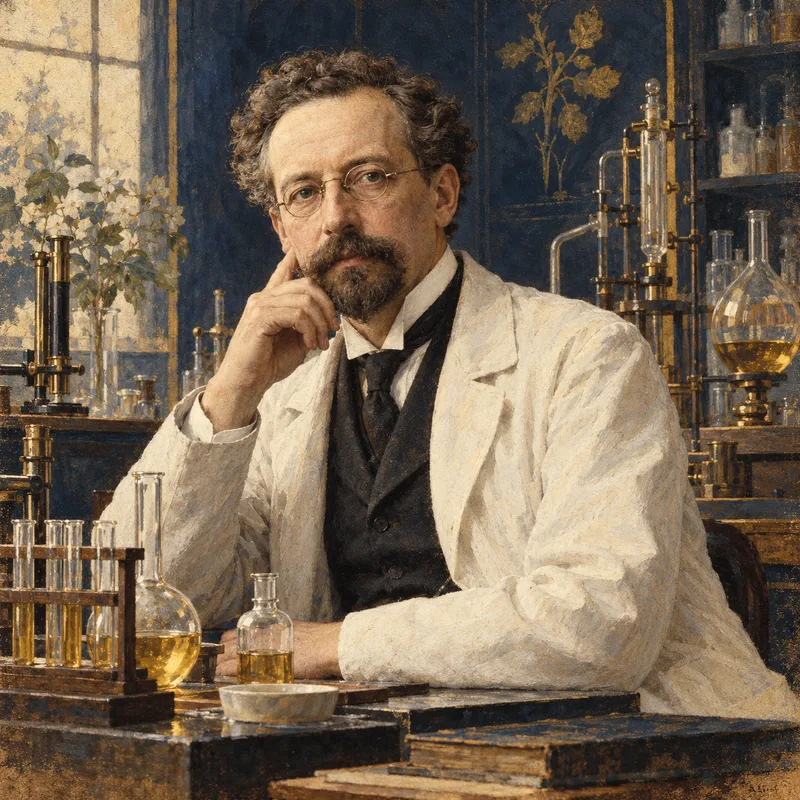
Richard Willstätter
1872-1942 · Germany · Nobel Chemistry 1915
Structure of chlorophyll and plant pigments