Biography · Chemist no. 106 of 350
Richard Zsigmondy: Complete Life and Legacy
Introduction
Richard Adolf Zsigmondy (1865–1929) was an Austrian-born chemist who spent most of his working life in Germany. He made colloid chemistry an exact science. With Henry Siedentopf he invented the ultramicroscope in 1903, and with it he showed that colloidal solutions consist of tiny discrete particles rather than being true solutions. He received the Nobel Prize in Chemistry in 1925. His name is linked to the gold number and to the first ultrafilters. His life shows how an interest in glass, colour and light can grow into a new branch of science.
Early Life and Family
Richard Zsigmondy was born in Vienna on 1 April 1865. His family had Hungarian roots. His father, Adolf Zsigmondy, was a dentist and a person of wide interests, and he was also a pioneer in dental science. The family was cultured and there was an interest in science and mountaineering in the household. His brothers included Emil Zsigmondy, a physician and well-known mountaineer who died in an accident in the Alps in 1885, and Otto and Karl, who also became important people in their fields; Karl Zsigmondy became a mathematician.
Richard shared the family's love of mountains. As a young man he became a skilled alpinist, and he made many climbs in the Alps, sometimes without guides, which was unusual in that period. He grew up in the vibrant intellectual life of late nineteenth-century Vienna.
Education and Mentors
Zsigmondy studied at the Technical University of Vienna and the University of Vienna, and later in Munich. He received his doctorate in 1889 at Erlangen, with research in organic chemistry. He then worked as an assistant to the physicist August Kundt in Berlin, and later became a lecturer at the Technical University in Graz.
These years taught him two things: the value of physics for chemistry, and the use of precise measurement. Both would later be needed when he turned to colloids. He kept a strong interest in physical methods throughout his life.
Career Timeline
| Year | Event |
|---|---|
| 1865 | Born in Vienna on 1 April. |
| 1889 | Doctorate in chemistry. |
| 1893 | Becomes lecturer at the Technical University in Graz. |
| 1897–1900 | Works at the Schott glassworks in Jena, studying coloured glasses. |
| 1900 | Leaves Schott and works as a private researcher in Jena, with his own small laboratory; studies gold ruby glass and gold sols. |
| 1903 | With Henry Siedentopf, invents the ultramicroscope. |
| 1907 | Appointed professor of inorganic chemistry at the University of Göttingen. |
| 1925 | Awarded the Nobel Prize in Chemistry. |
| 1929 | Dies in Göttingen on 23 September. |
Major Scientific Contributions
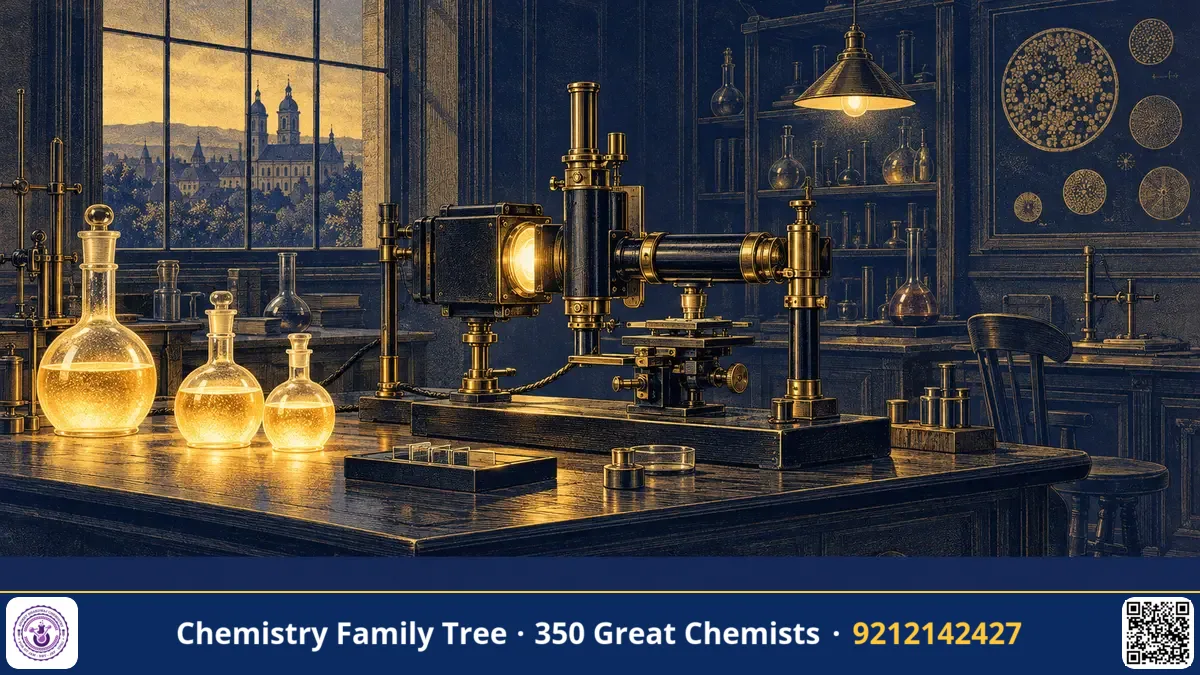
- Ultramicroscope (1903): a dark-field instrument based on the Tyndall effect that makes particles below the resolving limit visible as points of light. Details are in our discovery post.
- Gold sols: reproducible preparation of gold sols by reduction with formaldehyde, and the nucleus method for controlled growth.
- Gold number: a measure of the protective action of lyophilic colloids on gold sol against coagulation by electrolytes.
- Ultrafilters: developed membrane filters with graded pore size, which are used to separate colloidal particles and viruses, and were the ancestors of modern membrane technology.
- Coloured glass: explained the origin of colours in ruby glass and milk glass as due to dispersed particles.
- Silicic acid and gels: studied the structure of silica gels and the colloidal behaviour of silicic acid.
Awards, Honours and Nobel Prize
The Nobel Prize in Chemistry for 1925 was awarded to Richard Zsigmondy "for his demonstration of the heterogeneous nature of colloid solutions and for the methods he used, which have since become fundamental in modern colloid chemistry". The prize was awarded in 1926 (the 1925 prize was reserved for a year), as sometimes happened.
He also received other honours and was a member of scientific academies in Germany.
Personality, Struggles and Lesser-Known Facts
- Mountaineer. He was an enthusiastic climber, like his brothers. The death of Emil Zsigmondy in an Alpine accident in 1885 deeply affected the family.
- Industrial researcher, then independent. He left the secure position at Schott after some years to follow his own interests and set up a small private laboratory in Jena. This was a risk, but it freed him to study colloids.
- Cooperation with a physicist. The ultramicroscope depended on Henry Siedentopf's optical expertise at Zeiss. Zsigmondy often acknowledged that the invention was a joint achievement of chemistry and physics.
- Inspired by Faraday. He repeated and improved Faraday's gold sol experiments and credited Faraday's observation of the light beam in sols.
- Books. His book on colloids and the ultramicroscope was translated into English by Jerome Alexander in 1909.
- Focused researcher. In his Göttingen laboratory he worked for many hours with individual gold sols, counting particles by eye, which required exceptional patience.
Legacy and Influence on Modern Chemistry
Zsigmondy's work provided the experimental backbone for the theory of colloids. The dancing motion he observed was consistent with the theories of Brownian motion by Einstein and Smoluchowski, which Jean Perrin used to determine Avogadro's number. Theodor Svedberg, who invented the ultracentrifuge, also worked on colloidal systems. In the broader picture, the ultramicroscope was a forerunner of modern techniques such as dynamic light scattering, nanoparticle tracking analysis and single-particle fluorescence microscopy.
Today, nanoscience is built on the type of systems that he studied. Gold nanoparticles are used in diagnostics, drug delivery and catalysis. His ultrafilters led to the membrane technologies used in water purification and dialysis. The vocabulary of colloid chemistry, sol, gel, coagulation, protective colloid and gold number, remains standard in school and college courses.
Lessons for Students
- Combine disciplines. The ultramicroscope came from a partnership of chemist and physicist.
- Build on the work of predecessors. Faraday's sol and Tyndall's beam gave Zsigmondy his starting point.
- Be willing to take risks for research that interests you.
- Make observations quantitative. Counting particles turned a qualitative idea into proof.
- Good tools create new science; invest in instruments and methods.
Quick Facts Box
- Born: 1 April 1865, Vienna, Austria.
- Died: 23 September 1929, Göttingen, Germany.
- Nationality: Austrian (worked in Germany).
- Field: Colloid chemistry.
- Famous for: Ultramicroscope; gold number; ultrafilters.
- Nobel: Chemistry, 1925.
FAQ
What did Zsigmondy win the Nobel Prize for?
He won the Nobel Prize in Chemistry for 1925 for demonstrating the heterogeneous nature of colloid solutions and for the methods he developed.
Where did he work?
He worked in Vienna, Graz, Jena (at the Schott glassworks and privately), and for the last two decades of his life at the University of Göttingen.
What was his connection with Faraday?
Faraday made the first ruby gold sols in the 1850s. Zsigmondy improved the preparation and used the ultramicroscope to prove they contain tiny gold particles.
Why is colloid chemistry important for exams?
Topics such as the Tyndall effect, Brownian motion, electrophoresis, coagulation, the Hardy–Schulze rule and gold number are part of physical chemistry and surface chemistry in Class 12, JAM and NET.
Published by ABC Chemistry — IIT-JAM | CSIR-NET | GATE Chemistry Coaching. Visit abcchemistry.com
About the chemist
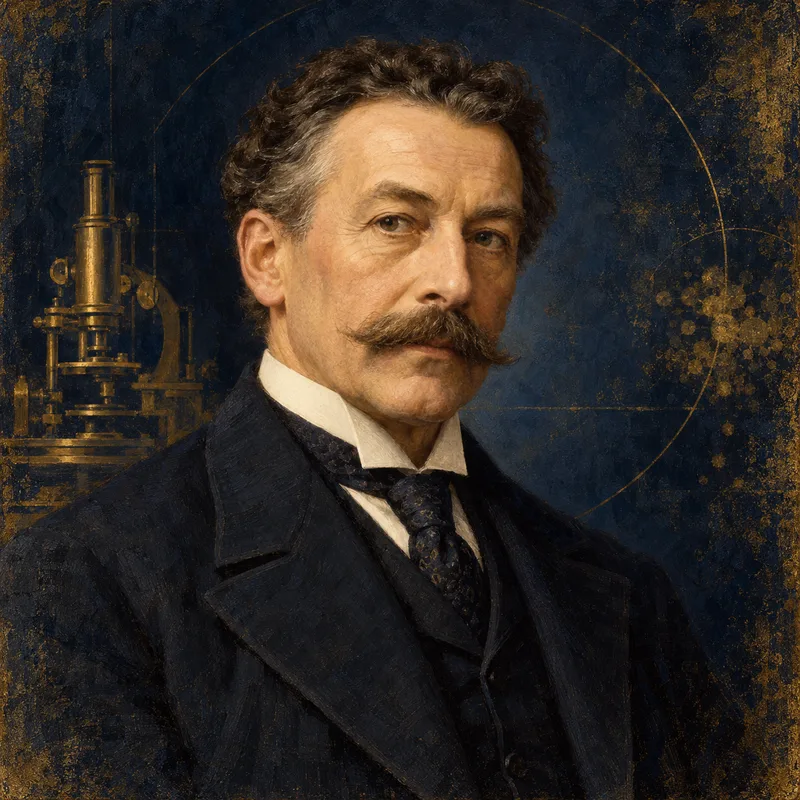
Richard Zsigmondy
1865-1929 · Austria · Nobel Chemistry 1925
Colloid chemistry, ultramicroscope