The discovery, explained · Chemist no. 106 of 350
Richard Zsigmondy and the Ultramicroscope: Seeing Colloids
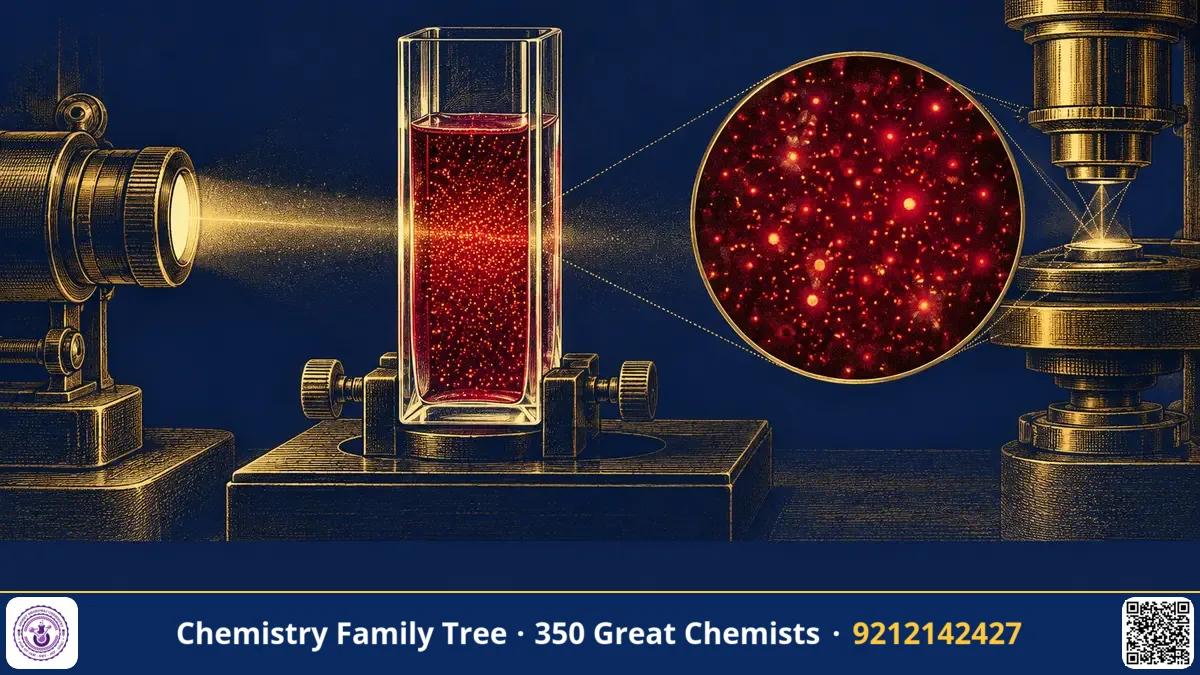
Milk, blood, fog, ink, paint, gelatin and the ruby-red glass of old church windows all have something in common: they are colloids, systems in which tiny particles are spread through another medium. For most of the nineteenth century, colloids were a mystery. Were they true solutions, or something else? The Austrian-born chemist Richard Zsigmondy answered the question in 1903 when he and Henry Siedentopf of the Zeiss company built the ultramicroscope, an instrument that made visible particles far smaller than any ordinary microscope could resolve. With it, Zsigmondy proved that a colloid such as ruby gold sol is a heterogeneous system of discrete particles. He received the Nobel Prize in Chemistry in 1925 for demonstrating the heterogeneous nature of colloid solutions and for the methods he used.
The Scientific Problem Before the Discovery
Thomas Graham, a Scottish chemist, coined the word "colloid" (from the Greek for glue) in the 1860s. He noticed that substances like gelatin, starch and gum diffused very slowly and could not pass through a parchment membrane, while salt and sugar did, and he named these crystalloids. Michael Faraday had prepared ruby-coloured gold sols in the 1850s by reducing gold chloride with phosphorus, and noticed that a beam of light became visible when passed through them. John Tyndall studied the same scattering of light.
Despite this, the real nature of a sol remained debated. Some chemists thought that a gold sol was a kind of solution; others suspected it consisted of particles. The particles were too small to see in a microscope, since the resolving power of an optical microscope is limited by the wavelength of light to about 200 nm. Without a way to see or count them, the question could not be settled. Zsigmondy, who had worked with glass chemistry and gold ruby glass, was convinced that the red colour came from tiny gold particles.
The Discovery: Step by Step
- Glass chemistry. While working at the Schott glassworks in Jena in the 1890s, Zsigmondy studied the colours of glass, including gold ruby glass and milk glass. He found that the colour came from finely dispersed metal or other particles.
- Preparing gold sols. He improved Faraday's recipe by reducing a dilute, weakly alkaline solution of gold chloride (HAuCl4) with formaldehyde. This gave reproducible red sols with very uniform particle size. Later he used very small "nuclei" to grow bigger particles in a controlled way, the nucleus method.
- The key idea. A particle too small to be resolved can still be detected if it scatters enough light, just as dust in a sunbeam appears as shining points. He decided to use strong side illumination against a dark background.
- The instrument (1902–1903). Together with Henry Siedentopf, he used an intense beam of sunlight or arc light, focused to a thin slit, passing through the sol at right angles to the axis of the microscope. The observer looked into a dark field and saw bright points of light, each one a particle.
- Counting and sizing. By counting the particles in a known volume and knowing the amount of gold in solution, one can compute the size of each particle. Zsigmondy found sizes as small as a few nanometres.
- Observation of Brownian motion. The bright points danced and zigzagged, confirming the kinetic picture and supporting the work of Einstein and Perrin on molecular reality.
The Chemistry Behind It
Gold sol preparation, in its simplest form, is a reduction:
2 HAuCl4 + 3 HCHO + 11 KOH → 2 Au + 3 HCOOK + 8 KCl + 8 H2O
(a simplified, balanced equation for illustration). The gold atoms nucleate to form nanoparticles of 5–100 nm. The sol is stabilised by negative charge from adsorbed ions, giving an electrical double layer. When electrolyte is added, the charge is neutralised and the particles aggregate (coagulate), turning the sol from red to blue or purple and finally to a precipitate.
Important ideas from colloid chemistry connected with Zsigmondy:
- Size range: colloids have particle dimensions between about 1 nm and 1000 nm, between true solutions and coarse suspensions.
- Tyndall effect: scattering of light by colloidal particles, which makes the beam visible. The ultramicroscope uses the same effect.
- Hardy–Schulze rule: the coagulating power of an ion increases with its charge; for a negative sol such as gold, Al3+ > Ba2+ > Na+.
- Gold number: introduced by Zsigmondy to measure the protective power of a lyophilic colloid. It is the number of milligrams of a protective colloid that just prevents the colour change of 10 mL of a standard gold sol when 1 mL of 10% NaCl solution is added. A smaller gold number means greater protective power; gelatin has a very low value.
- Lyophilic and lyophobic sols: gold sol is lyophobic (solvent-hating) and needs a stabiliser.
- Membrane filters: Zsigmondy developed ultrafilters of graded pore size to separate particles by size, a precursor of modern membrane filtration.
Applications Today
- Nanotechnology: gold and silver nanoparticles prepared by Faraday–Zsigmondy type reduction are used in sensors, catalysts and medicine. Dynamic light scattering instruments measure sizes using the principle he used.
- Medical diagnostics: colloidal gold is the red line in rapid pregnancy and COVID-19 antigen tests, which are sold across India.
- Water treatment: alum is used to coagulate colloidal clay in turbid river water, an application of the Hardy–Schulze rule.
- Ultrafiltration and dialysis: membranes are used in water purification and in kidney dialysis.
- Paints, inks, food and cosmetics: emulsions, gels, foams and sols are everywhere.
- Delta formation: river water meets sea water, the salt coagulates the clay sol and silt is deposited, as in the Sundarbans delta of the Ganga and Brahmaputra.
Exam Corner
- Richard Zsigmondy won the 1925 Nobel Prize in Chemistry for demonstrating the heterogeneous nature of colloidal solutions and for the methods he used.
- The ultramicroscope works on the Tyndall effect: particles are seen as bright spots of scattered light in a dark field; the actual shape and size are not resolved.
- Gold number: milligrams of protective colloid that just prevent coagulation of 10 mL gold sol by 1 mL of 10% NaCl. Lower gold number means better protection.
- Hardy–Schulze rule: the greater the valence of the oppositely charged ion, the greater its coagulating power.
- Colloidal particle size: 1–1000 nm (10 Å to 10,000 Å).
Common Misconceptions
- "The ultramicroscope produces a magnified picture of the particle." It shows only scattered light spots; it does not reveal shape.
- "A higher gold number means a better protective colloid." It is the reverse.
- "A colloid is a true solution." It is heterogeneous: particles are dispersed and can be detected by light scattering.
Quick Revision Box
- Ultramicroscope (1903): Zsigmondy and Siedentopf; dark-field, side illumination.
- Nobel Prize in Chemistry, 1925.
- Colloid size range: 1–1000 nm.
- Gold number measures protective power; lower is better.
- Gold sol made by reduction of HAuCl4 with formaldehyde.
- Coagulation of sols by electrolytes follows the Hardy–Schulze rule.
FAQ
Why can we not see colloidal particles in an ordinary microscope?
They are smaller than the resolving limit of visible light, about half a wavelength (around 200 nm). They scatter light but do not form a resolved image.
Who built the ultramicroscope?
Zsigmondy and Henry Siedentopf, a physicist at the Zeiss works in Jena, built it in 1902–1903.
What is the Tyndall effect?
It is the scattering of light by particles of colloidal size, which makes a light beam visible when it passes through a sol or a smoky or misty room.
How does the gold number help in industry?
It lets one compare protective colloids such as gelatin, gum arabic and starch, which is useful in making stable inks, paints and photographic emulsions.
Published by ABC Chemistry — IIT-JAM | CSIR-NET | GATE Chemistry Coaching. Visit abcchemistry.com
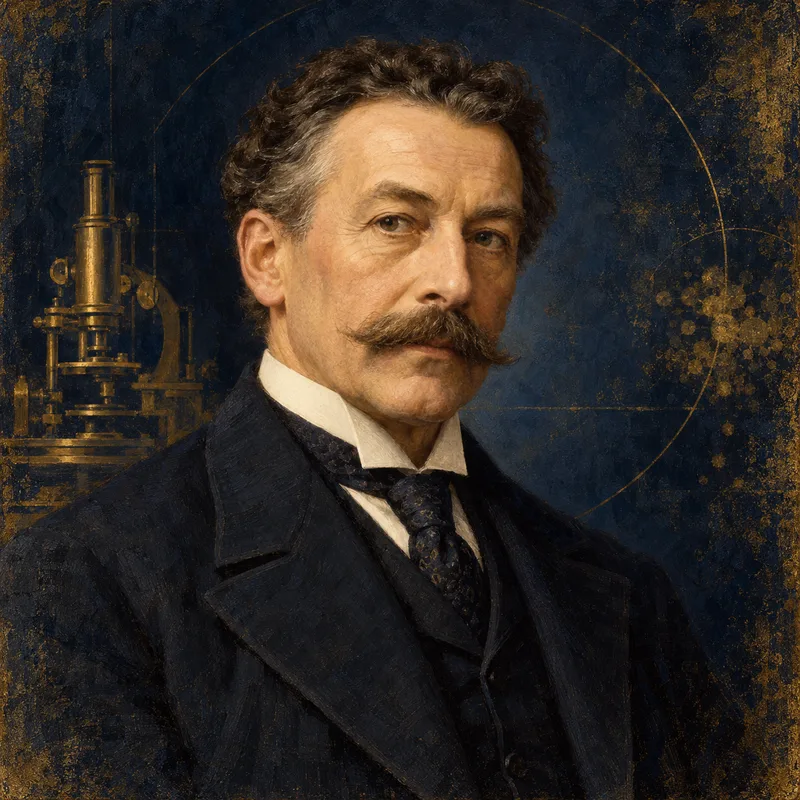
About the chemist
Richard Zsigmondy
1865-1929 · Austria · Nobel Chemistry 1925
Colloid chemistry, ultramicroscope